
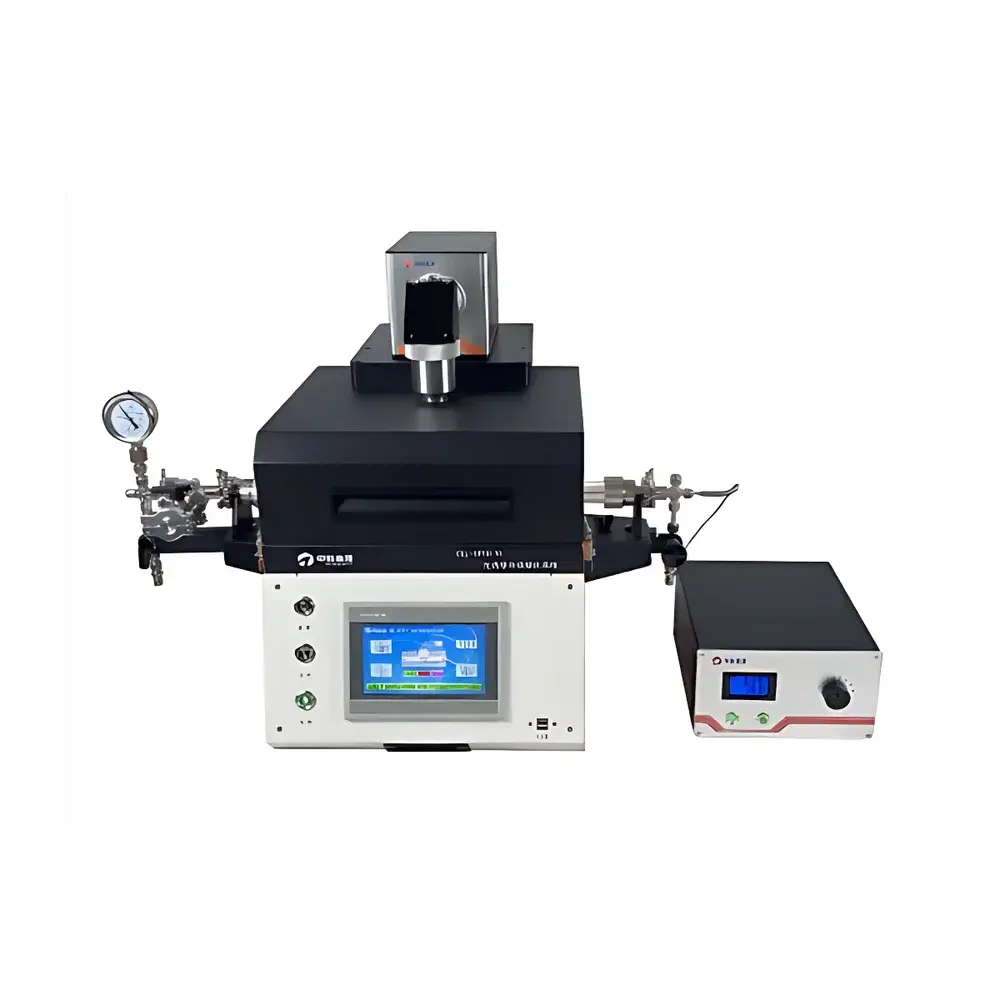
CEL-OPTH-VI Photothermal Synergistic Catalytic Synthesis System (Optional Light Source)
| Brand | CEAULIGHT |
|---|---|
| Origin | Beijing, China |
| Manufacturer Type | Original Equipment Manufacturer (OEM) |
| Region of Origin | Domestic (China) |
| Model | CEL-OPTH-VI |
| Pricing | Upon Request |
Overview
The CEL-OPTH-VI Photothermal Synergistic Catalytic Synthesis System is an integrated laboratory platform engineered for precision-controlled, simultaneous thermal and photochemical activation in heterogeneous catalysis research. It operates on the fundamental principle of photothermal synergy—where controlled high-temperature thermal energy (up to 800 °C) is spatially and temporally coupled with broadband optical irradiation (UV–vis–NIR) delivered via a collimated light guide into the reaction zone. This dual-stimulus architecture enables rigorous investigation of kinetic and mechanistic pathways inaccessible under purely thermal or purely photochemical conditions. Designed for reproducible materials synthesis and activity benchmarking under industrially relevant operating envelopes, the system supports both batch-mode catalyst preparation and continuous-flow catalytic evaluation under programmable temperature ramps, gas composition control, and dynamic illumination protocols.
Key Features
- Integrated high-temperature furnace with 1000 W single-zone heating, achieving precise temperature control from ambient to 800 °C (±0.1 °C resolution) across 64 programmable segments
- Uniform thermal zone (>30 mm length) with axial temperature gradient < ±1 °C—critical for isothermal kinetic studies and phase-pure material synthesis
- Optically transparent high-purity fused quartz reactor tube (Ø30 mm), UV-grade transmission >90% at 200–2500 nm, enabling full-spectrum photon delivery to the catalyst bed
- Front-access 30 mm-diameter optical port aligned coaxially with the reactor axis, compatible with external xenon arc lamps (e.g., CEL-PF300-T3/T8/T9/T10 series) and fiber-coupled LED or laser sources
- Modular gas handling architecture: KF16 quadruple flange manifold, 3 mm stainless-steel tubing with Swagelok compression fittings, vacuum-tight design supporting pressures from 10−3 Pa (high-vacuum molecular pump option) to 5 bar overpressure
- Real-time process monitoring via three independent thermocouple inputs, two external heating jacket interfaces, and dedicated optical coupling port for in situ spectroscopic integration
- 7-inch industrial HMI touchscreen (MCGS software suite) with built-in overtemperature cutoff, automatic power shutdown, and audit-trail-capable event logging per GLP-compliant workflows
Sample Compatibility & Compliance
The CEL-OPTH-VI accommodates solid-state catalysts—including metal oxides, perovskites, MOFs, doped semiconductors, and supported noble-metal nanoparticles—in powder, pellet, or monolithic forms. Its quartz reactor geometry ensures complete gas-phase contact with the catalyst surface (reaction zone: 28 mm × 22 mm cross-section), eliminating boundary-layer mass-transfer limitations common in superficial-flow configurations. The system conforms to ISO 17025 calibration traceability requirements for temperature and flow instrumentation. Optional configurations support compliance with ASTM E2628 (photocatalytic hydrogen evolution), ISO 22197-1 (NO removal), and USP analytical instrument qualification frameworks when paired with validated GC or IC modules.
Software & Data Management
Control firmware runs on embedded Linux with MCGS-based HMI interface, offering real-time visualization of temperature profiles, gas flow rates (via optional mass flow controllers), and alarm status. All operational parameters—including ramp rates, dwell times, light-on/off timestamps, and pressure setpoints—are timestamped and exportable as CSV files for LIMS integration. The system provides RS485/Modbus RTU and Ethernet TCP/IP interfaces for remote orchestration within automated lab environments. When configured with GC7920 or ion chromatography modules, data synchronization enables time-resolved quantification of gaseous products (H2, O2, CO, CH4, CO2) and aqueous intermediates (NH4+, NO2−, SO42−), satisfying FDA 21 CFR Part 11 electronic record requirements with user-level access controls and electronic signature capability.
Applications
- Synthesis and crystallization of photocatalytically active semiconductors (e.g., TiO2, g-C3N4, BiVO4) under controlled photothermal annealing
- Structure–activity correlation studies for CO2 hydrogenation, N2 fixation, and selective VOC oxidation (formaldehyde, toluene, NOx, SOx)
- Quantitative assessment of quantum yield and apparent quantum efficiency (AQE) under combined thermal–photonic excitation
- In situ thermal stability screening of plasmonic catalysts under reactive atmospheres (H2/Ar, O2/N2, synthetic air)
- Development of tandem catalytic systems for solar-driven water splitting (H2 and O2 co-evolution)
- Accelerated aging protocols for evaluating long-term operational robustness of photocatalytic coatings and filters
FAQ
What light sources are compatible with the CEL-OPTH-VI system?
The system accepts all CEL-PF300-series xenon lamp systems (T3, T8, T9, T10) and can be adapted for fiber-coupled LEDs or CW lasers via its standardized 30 mm optical port and internal light-guide interface.
Can the reactor operate under inert or reducing atmospheres?
Yes—the sealed quartz reactor supports continuous purging, vacuum evacuation (down to 10−3 Pa with optional molecular pump), and precise multi-gas blending using mass flow controllers (e.g., CEL-GPPCN series).
Is the temperature uniformity verified across the catalyst bed?
Temperature homogeneity is validated using three calibrated thermocouples positioned axially within the heated zone; measured deviation remains ≤ ±1 °C over a 30 mm working length under steady-state conditions.
How is gas residence time controlled during catalytic testing?
Residence time is tuned via adjustable mass flow rates (0–1000 sccm range with optional MFCs) and fixed reactor volume (22 mm ID × 28 mm height), enabling first-order kinetic modeling under plug-flow assumptions.
Does the system support automated data acquisition synchronized with illumination cycles?
Yes—trigger signals from the light source controller can initiate timed sampling sequences in connected GC or IC systems, ensuring temporal alignment between photon flux and product formation kinetics.



