
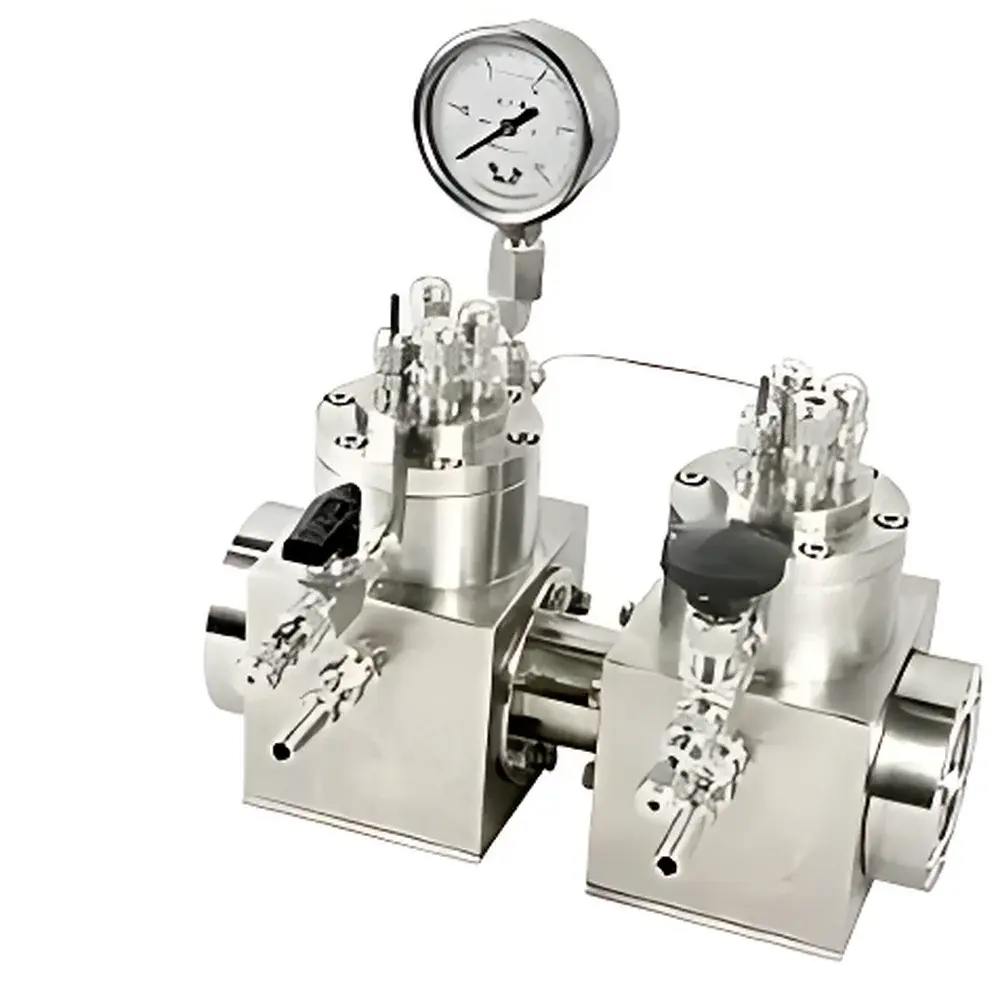
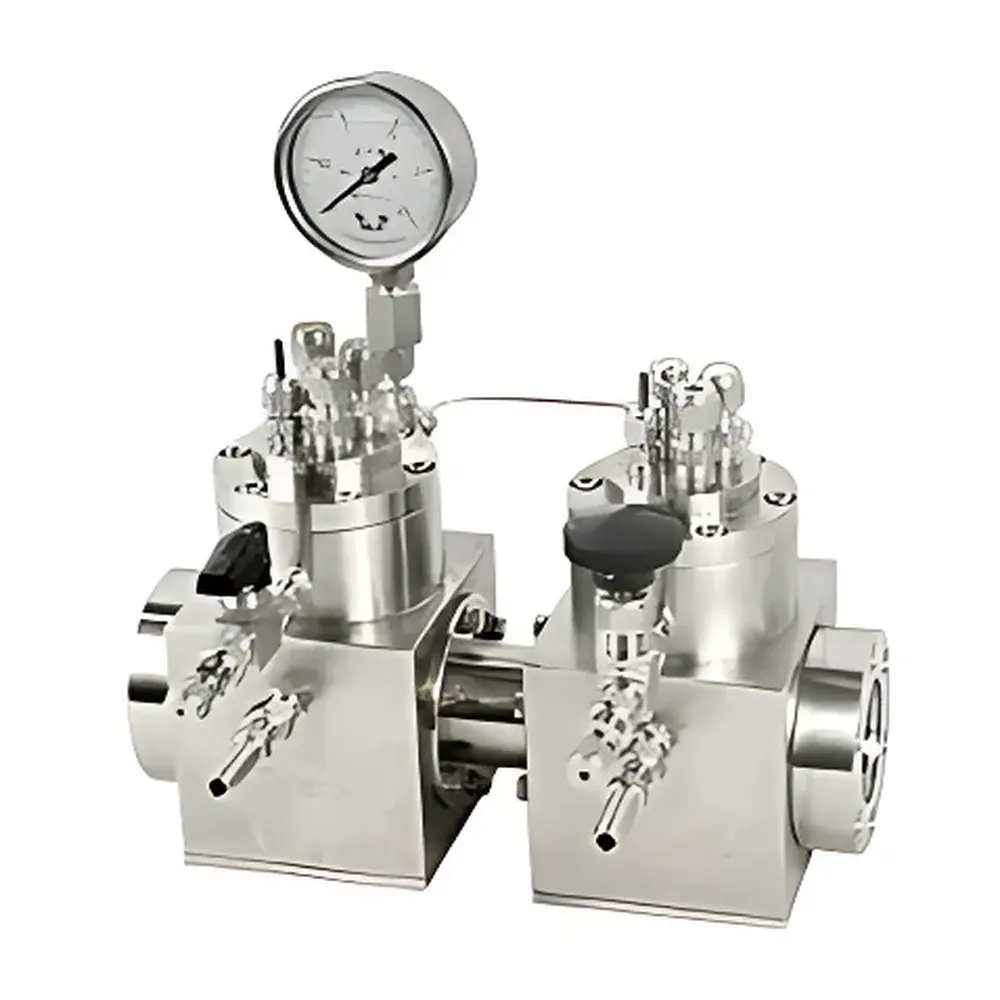
CEL-HT7 Temperature-Controlled, Pressure-Resistant H-Type Photoelectrochemical Reactor
| Brand | CEA (China Education Goldsource) |
|---|---|
| Model | CEL-HT7 |
| Construction Material | 316L Stainless Steel with Internal PTFE Coating |
| Working Pressure | ≤2 MPa |
| Vacuum Level | 0.1 Pa |
| Single-Chamber Volume | 100 mL |
| Operating Temperature Range | ≤100 °C (water bath), ≤200 °C (oil bath) |
| Temperature Control Accuracy | ±0.1 °C |
| Internal Temperature Sensor | Pt100 |
| Optical Window | Dual Φ35 mm Quartz Windows (UV–Vis–NIR Transparent) |
| Electrode Configuration | Triple-Electrode Setup (PEEK Body, Standard) |
| Ion-Exchange Membrane Compatibility | Φ50 mm |
| Gas Inlet/Outlet Valves | Anlok™ Precision Needle & Ball Valves |
| Thermal Jacket | Integrated Circulating Jacket for External Bath Coupling |
| Electrical Feedthroughs | Hermetic PEEK-Sealed |
| Light Source Compatibility | Xenon, Mercury, and High-Power LED Lamps (Optional) |
| Cooling/Heating System Compatibility | HX105 Circulating Thermostat (Optional) |
Overview
The CEL-HT7 is a precision-engineered, temperature-controlled, pressure-resistant H-type photoelectrochemical reactor designed for fundamental and applied research in photocatalysis, photoelectrochemistry, and solar fuel synthesis. It operates on the principle of spatially segregated dual-chamber electrochemical cell architecture, enabling controlled interfacial charge transfer across an ion-conductive membrane under simultaneous illumination and potentiostatic/galvanostatic bias. The reactor’s core design integrates robust mechanical integrity—rated for continuous operation up to 2 MPa—with optical transparency (via dual high-purity quartz windows) and electrochemical compatibility (PEEK-insulated three-electrode configuration). Its fully jacketed 316L stainless steel body, internally coated with chemically inert polytetrafluoroethylene (PTFE), ensures long-term resistance against corrosive electrolytes—including acidic, alkaline, and halide-containing media—at elevated temperatures (≤200 °C with oil bath coupling) and high vacuum (≤0.1 Pa). This enables rigorous kinetic studies under well-defined mass transport, thermal, and photonic boundary conditions—critical for quantifying quantum efficiency, Faradaic yield, and reaction selectivity.
Key Features
- Modular H-cell geometry supporting both single-chamber (100 mL) and dual-chamber configurations via interchangeable Φ50 mm ion-exchange membranes (e.g., Nafion®, Fumasep®)
- Hermetically sealed, pressure-rated construction with Anlok™ stainless steel needle and ball valves for precise gas handling and leak-tight operation up to 2 MPa
- Dual Φ35 mm fused-silica quartz optical ports (transmission range: 190–2500 nm) enabling collimated or focused irradiation from either side; optional anti-reflective coating available
- Integrated thermal jacket compatible with external HX105 circulating thermostats or standard water/oil baths; internal Pt100 sensor provides real-time, high-fidelity temperature feedback with ±0.1 °C stability
- Triple-electrode system with PEEK-bodied working, counter, and reference electrodes—chemically inert, mechanically stable, and rated for >150 °C and >1.5 MPa; optional certified high-pressure Ag/AgCl or Hg/HgO reference electrodes available
- Full PTFE internal lining eliminates metal ion leaching and ensures compatibility with aggressive redox mediators and halogen-based electrolytes
Sample Compatibility & Compliance
The CEL-HT7 accommodates a broad spectrum of heterogeneous and homogeneous photoactive systems, including colloidal quantum dots, metal–organic frameworks (MOFs), perovskite nanocrystals, carbon nitride suspensions, and immobilized photoanodes/cathodes on conductive substrates (FTO, ITO, Ni foam). Its design conforms to ISO 8502-3 (surface cleanliness verification), ASTM D1193 (reagent water specifications for electrochemical testing), and supports GLP-compliant experimental protocols through traceable temperature logging and pressure monitoring interfaces. While not intrinsically certified for hazardous area use, its pressure containment meets ASME B31.3 process piping design margins for laboratory-scale chemical reactors. All wetted materials comply with USP Class VI biocompatibility standards and FDA 21 CFR 177.1550 (fluoropolymer food-contact regulations), ensuring suitability for pharmaceutical intermediate synthesis and catalytic degradation studies.
Software & Data Management
The CEL-HT7 is hardware-agnostic and fully interoperable with industry-standard electrochemical workstations (e.g., BioLogic SP-300, Gamry Interface 5000E, PalmSens EmStat GO) and optical power meters (Thorlabs PM100D). Temperature and pressure data streams can be logged via analog outputs (0–5 V / 4–20 mA) into LabVIEW, MATLAB, or Python-based acquisition platforms using NI DAQ or Raspberry Pi HAT modules. Optional integration with EL-Soft™ (CEA’s proprietary reactor control suite) enables synchronized ramping of temperature, light intensity (via TTL-modulated lamp drivers), and electrochemical potential—all timestamped with millisecond resolution and audit-trail-enabled for 21 CFR Part 11 compliance when deployed with electronic signature modules.
Applications
- Photoelectrochemical water splitting (H₂/O₂ evolution) under controlled pH, ionic strength, and backpressure
- CO₂ photoreduction to CO, CH₄, or C₂H₄ with quantified product distribution via online GC–MS coupling
- Photocatalytic degradation kinetics of emerging contaminants (pharmaceuticals, PFAS) under simulated solar irradiation
- Charge-transfer resistance mapping at semiconductor/electrolyte interfaces using intensity-modulated photocurrent spectroscopy (IMPS)
- In situ Raman and UV-Vis absorption measurements during operando photoelectrolysis
- Electrocatalyst stability screening under combined thermal, photonic, and electrochemical stress
FAQ
Can the CEL-HT7 operate under inert atmosphere without external gas supply?
Yes—the reactor achieves ultra-high vacuum (0.1 Pa) and maintains inert conditions via repeated purge-and-pump cycles using integrated Schrader-style gas ports.
Is quartz window replacement user-serviceable?
Yes—quartz disks are secured with PTFE-coated stainless steel retaining rings and require only standard torque wrench calibration (5.5 N·m) for reinstallation.
What is the maximum permissible thermal gradient across the ion-exchange membrane?
For optimal proton conductivity and mechanical stability, a differential of ≤15 °C between chambers is recommended; larger gradients require custom membrane selection (e.g., reinforced Nafion® NR212).
Does the PEEK electrode housing interfere with electrochemical impedance spectroscopy (EIS)?
No—PEEK exhibits negligible dielectric loss (<0.002 at 1 MHz) and does not contribute parasitic capacitance; validated EIS measurements down to 10 mHz show no phase distortion.
Can the reactor be retrofitted with fiber-optic temperature probes?
Yes—two 10 mm diameter coolant access ports are configurable as optical feedthroughs for fluoroptic or sapphire-fiber Pt100 probes.



