
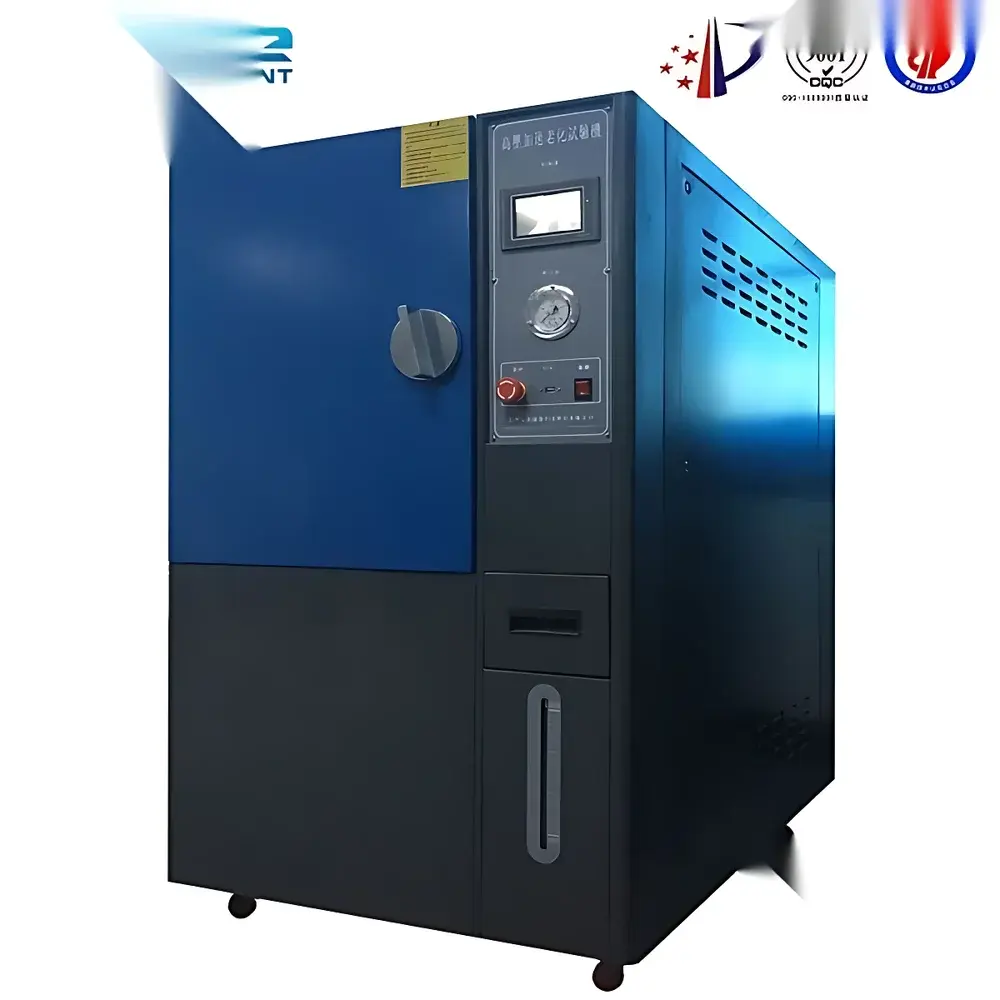
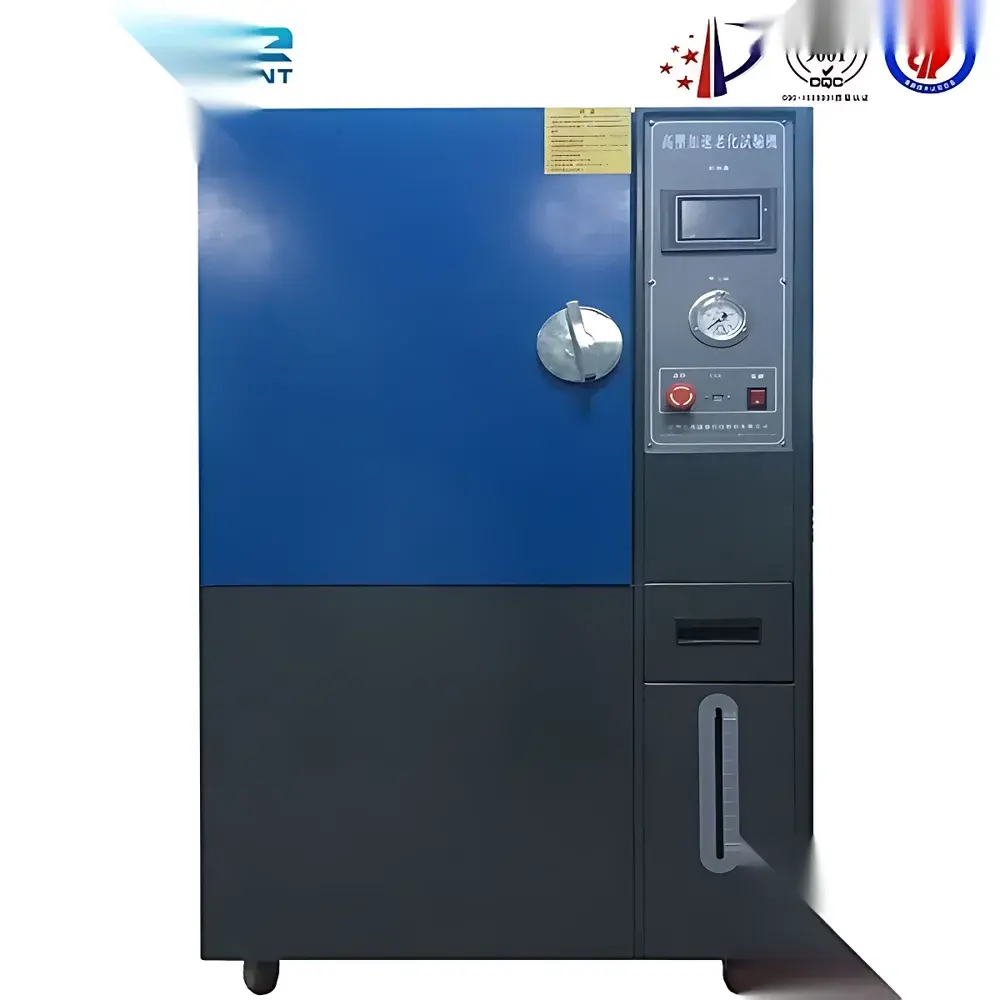
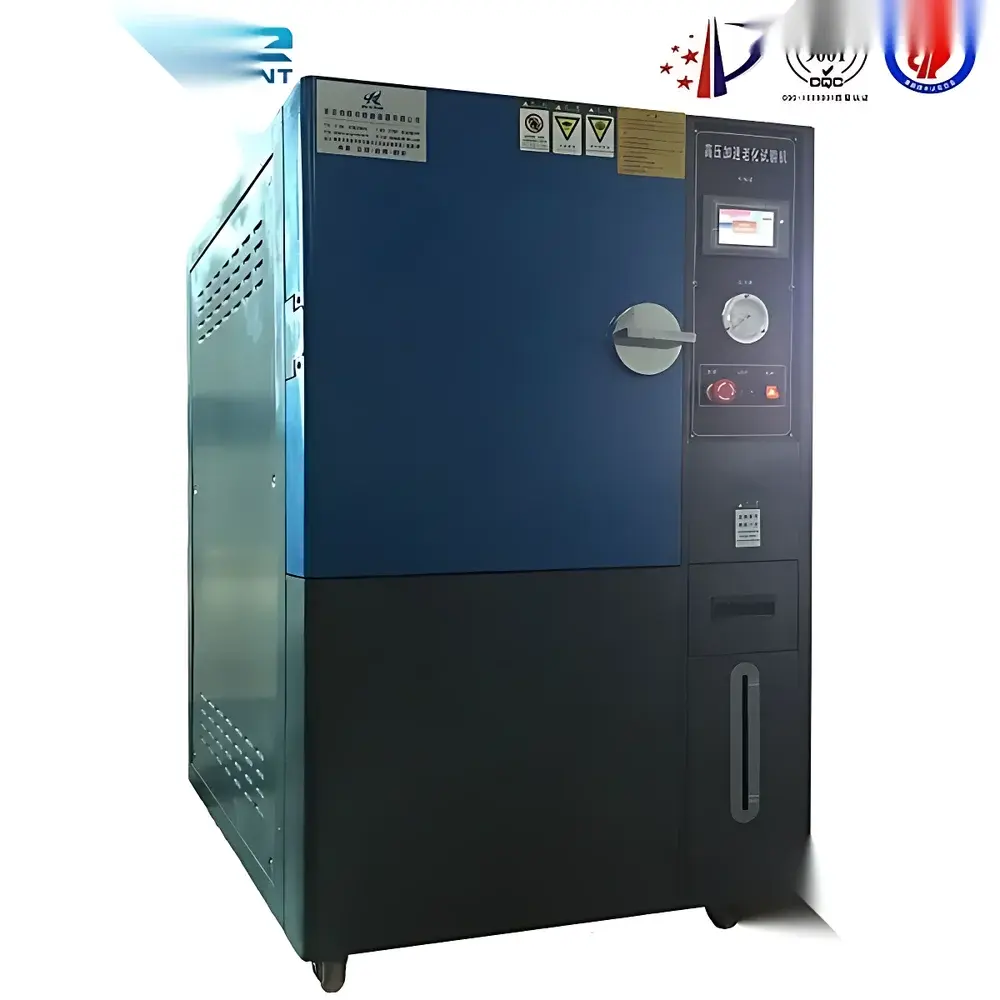
OK-PCT Series High-Pressure Saturated Steam Aging Chamber
| Brand | OK Instruments |
|---|---|
| Origin | Imported |
| Manufacturer Type | Authorized Distributor |
| Price | USD 3,950 (FOB) |
| Internal Dimensions (Φ×D, cm) | 30×45 |
| External Dimensions (W×H×D, cm) | 65×100×65 |
| Temperature Range | 121 °C, 132 °C, (143 °C optional) |
| Humidity | 100 % RH (saturated steam) |
| Operating Pressure | 0–200 kPa (gauge), up to 300 kPa (optional) |
| Temp. Uniformity | ±2 °C |
| Humidity Uniformity | ±3 % RH |
| Circulation Method | Natural convection of saturated steam |
| Safety Protections | Low-water cutoff, overpressure relief valve, overtemperature shutdown, automatic pressure interlock door lock |
| Power Supply | AC 220 V ±5 %, 50 Hz ±0.5 Hz |
Overview
The OK-PCT Series High-Pressure Saturated Steam Aging Chamber is an engineered environmental test system designed for accelerated aging and hermeticity evaluation under controlled high-pressure saturated steam conditions. Based on the fundamental principle of accelerated moisture diffusion under elevated temperature and pressure—governed by the Arrhenius equation and Fick’s second law—the chamber subjects sealed components and assemblies to thermodynamically intensified humidity stress. Unlike conventional humidity chambers, it operates exclusively with fully saturated steam at pressures exceeding ambient (0–200 kPa gauge), enabling rapid water vapor penetration into micro-gaps, polymer matrices, and encapsulated interfaces. This makes it essential for reliability qualification in aerospace, automotive electronics, medical device packaging, and advanced PCB manufacturing—where failure modes such as delamination, corrosion under fill (CUF), wire bond lift, and seal integrity degradation must be identified prior to field deployment.
Key Features
- Precise PID-controlled saturated steam temperature regulation via microprocessor-based controller, supporting standard test profiles at 121 °C (2 bar abs), 132 °C (3 bar abs), and optionally 143 °C (4 bar abs)
- Robust cylindrical stainless-steel inner chamber conforming to ASME BPVC Section VIII Div. 1 design standards for pressure vessels, eliminating condensate drip through optimized thermal gradient geometry
- Radially symmetric internal liner that deflects latent heat flux away from test specimens, ensuring uniform thermal exposure without localized steam impingement
- Pressure-actuated safety interlock: door remains mechanically locked when internal pressure exceeds 10 kPa above ambient; increased sealing force via self-tightening elastomeric gasket under rising pressure (patented differential compression design)
- Integrated auto-refill system with conductive water-level sensing and fail-safe shutoff; single fill supports uninterrupted operation for up to 200 hours at 132 °C/200 kPa
- Dual LED digital displays: independent real-time readouts for chamber temperature (±0.5 °C accuracy) and absolute pressure (±1 kPa resolution), synchronized with elapsed test time triggered only after thermal stabilization
- Steam quality optimization circuitry: continuous venting of non-condensable gases and sub-saturated vapor during ramp-up ensures >99.5 % dryness fraction per ISO 8573-1 Class 2
Sample Compatibility & Compliance
The OK-PCT chamber accommodates a broad range of sample geometries—including stacked PCBs, molded IC packages (QFN, BGA, WLCSP), hermetically sealed sensors, MEMS oscillators, LED modules, and pharmaceutical blister packs—within its cylindrical working volume. Its pressure-rated construction meets EN 61000-4-27 (electromagnetic immunity under pressure), and operational protocols align with JEDEC JESD22-A102 (Pressure Cooker Test), MIL-STD-883 Method 1008.3 (Moisture Resistance), and IPC-9701A (Performance Qualification of CCA Moisture Sensitivity). All control logic and data logging functions comply with FDA 21 CFR Part 11 requirements for electronic records and signatures when paired with validated software configurations.
Software & Data Management
While the base unit features embedded LED interface for manual operation, optional Ethernet-enabled firmware (OK-Link v3.2) provides remote monitoring, alarm logging, and CSV-exportable time-stamped datasets (temperature, pressure, runtime). Audit trails record operator ID, parameter changes, door events, and safety interventions with immutable timestamps—fully traceable for GLP/GMP audits. Calibration certificates (NIST-traceable RTD and pressure transducer) are supplied with each unit, and annual verification procedures follow ISO/IEC 17025-compliant checklists included in the technical manual.
Applications
This chamber is routinely deployed in: accelerated moisture sensitivity level (MSL) grading per J-STD-020; qualification of conformal coatings and underfill materials; validation of wafer-level chip-scale package (WLCSP) hermeticity; lifetime modeling of automotive ADAS radar housings; shelf-life assessment of sterile barrier systems; and failure analysis root cause isolation in multi-layer flex circuits exposed to tropical climatic conditions. Its reproducible stress profile enables direct correlation between laboratory PCT cycles and field failure rates in humid environments.
FAQ
What standards does the OK-PCT series comply with for reliability testing?
It supports JEDEC JESD22-A102, MIL-STD-883 Method 1008.3, IPC-9701A, and ASTM F1929 (leak detection)—with mechanical design certified to PED 2014/68/EU and ASME BPVC Section VIII.
Can the chamber operate continuously for extended durations?
Yes—integrated water reservoir and auto-refill system enable unattended operation up to 200 hours at 132 °C/200 kPa, provided external water supply is connected or reservoir is pre-filled.
Is third-party calibration support available?
OK Instruments provides NIST-traceable calibration services with accredited lab reports (ISO/IEC 17025), including on-site verification for large-volume installations.
How is steam dryness fraction maintained during long tests?
A dedicated purge cycle vents non-condensable gases and sub-saturated vapor at programmed intervals, maintaining dryness fraction ≥99.5 % throughout the test per ISO 8573-1 Class 2 specifications.
Does the system support automated test sequence programming?
Via optional OK-Link software: multi-step profiles (ramp-hold-vent cycles), email/SNMP alerts, and integration with LIMS via Modbus TCP or OPC UA.



