
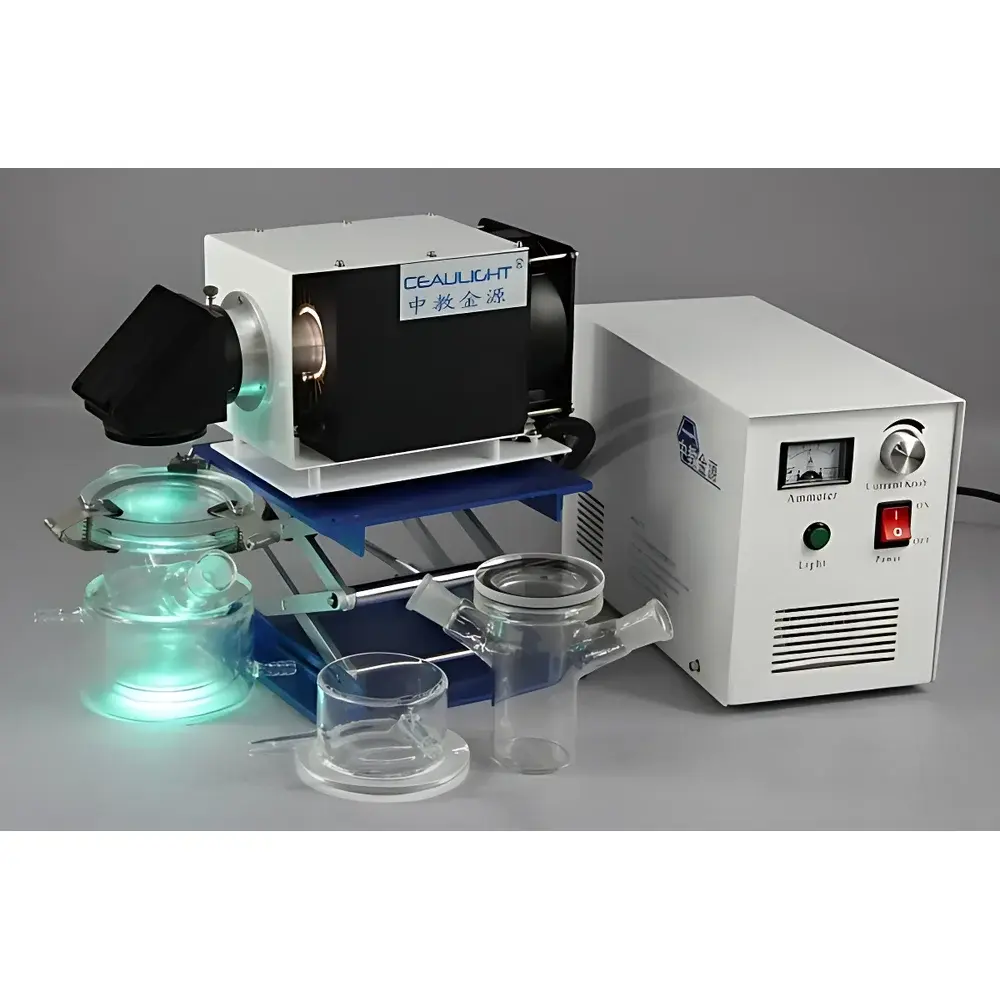
CEL-APR Atmospheric-Pressure Photochemical Reactor by CEAULIGHT
| Brand | CEAULIGHT |
|---|---|
| Model | CEL-APR |
| Type | Atmospheric-Pressure Glass Photochemical Reactor |
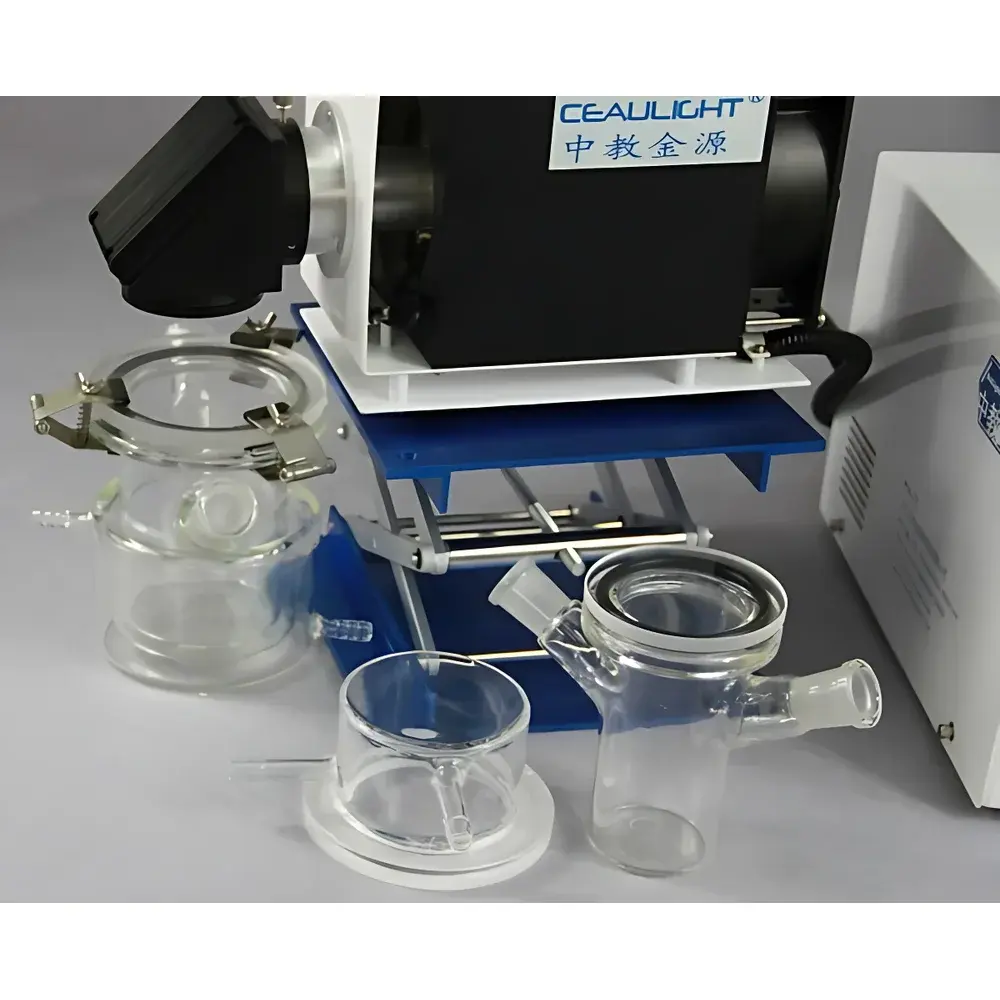
| Construction Material | Borosilicate Glass (with Quartz Lid) |
| Volumes Available | 50 mL, 100 mL, 250 mL, 500 mL |
| Operating Pressure | Ambient (0.1 MPa) |
| Vacuum Capability | None (Designed for Open/Controlled-Atmosphere Use) |
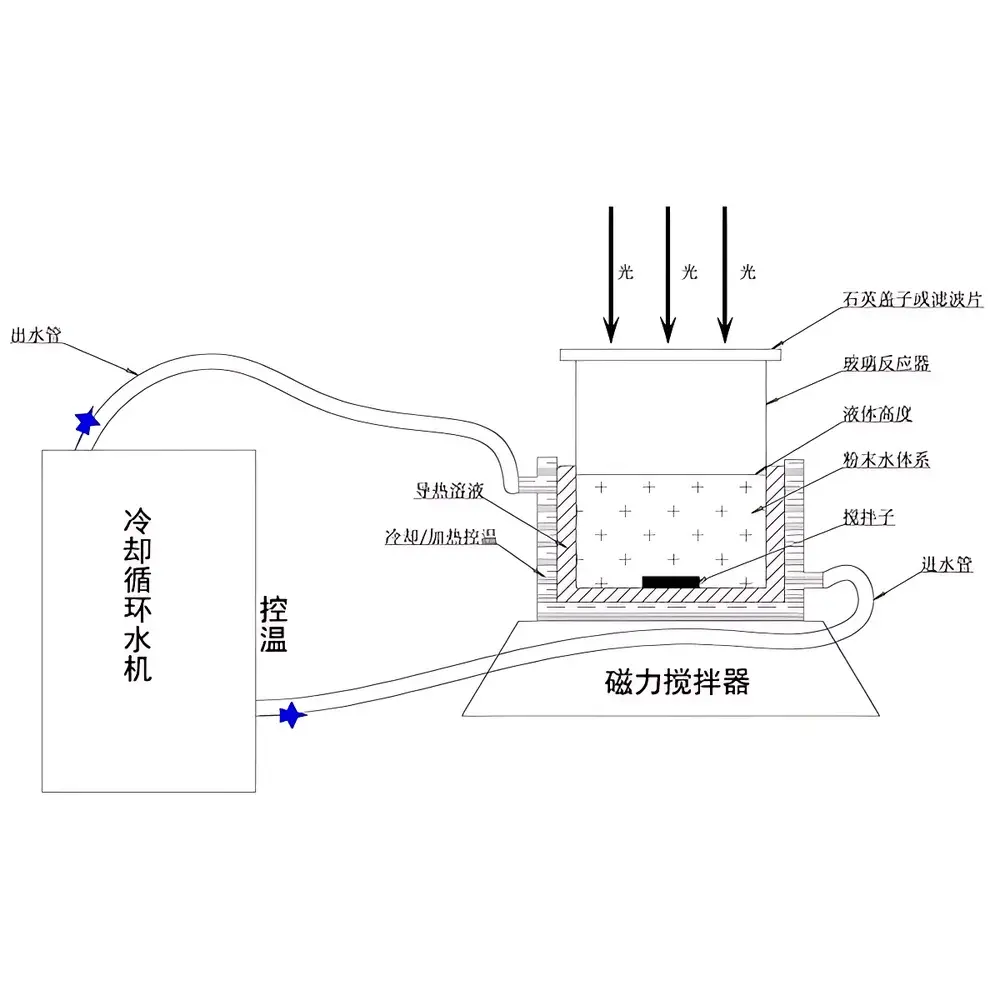
| Cooling Method | Dual-Layer Water Jacket with Circulating Thermostat |
| Stirring | Integrated Magnetic Stirring |
| Optical Interface | Standardized Flange-Mounted Quartz Window (Ø50 mm for 50/100 mL |
| Illumination Geometry | Top-Down Irradiation |
| Spectral Flexibility | Compatible with Interchangeable Optical Filters (e.g., UV cutoff, bandpass, longpass) |
| Compliance | Designed per GB/T 23762–2009 for Aqueous Photocatalytic Performance Testing |
| Sealing System | PTFE-Coated Ground-Glass Joints (19/22 Standard Taper), Viton O-Rings, and Precision Clamping Hardware |
Overview
The CEL-APR Atmospheric-Pressure Photochemical Reactor is an engineered platform for controlled, reproducible photochemical investigations under ambient pressure conditions. Designed around the fundamental principles of heterogeneous photocatalysis and solution-phase photoactivation, it enables precise irradiation of catalytic suspensions or gaseous–liquid reaction mixtures using broadband or spectrally filtered light sources (UV–vis, 254–780 nm). Its core architecture integrates a borosilicate glass reaction vessel with a high-transmittance fused quartz lid—optimized for >90% transmission across 185–2500 nm—ensuring minimal photon loss and thermal distortion during extended illumination. The dual-layer water-jacketed body permits active temperature regulation (±0.5 °C stability with external chiller), mitigating photothermal artifacts common in exothermic photocatalytic processes such as water splitting or organic pollutant degradation. Unlike pressurized or sealed autoclave-style reactors, the CEL-APR operates at nominal atmospheric pressure (101.3 kPa), eliminating safety constraints associated with high-pressure gas handling while retaining compatibility with inert-gas purging via standard Schlenk-line adapters.
Key Features
- Borosilicate glass construction (DIN/ISO-compliant) with chemical resistance to acids, bases, and organic solvents—validated per ASTM E438 Class I Type I specifications
- Standardized 19/22 ground-glass joints enabling modular integration with condensers, gas inlets, sampling ports, or vacuum manifolds
- Fused quartz optical lid with precision-machined flange interface—certified for UV-C transparency and thermal shock resistance up to 120 °C
- Dual-layer thermostatic jacket accommodating external coolant circulation (flow rate: 0.5–2.0 L/min; ΔT ≤ 15 °C)
- Integrated magnetic stirring mechanism with PTFE-coated stir bar—operable at 0–1200 rpm with torque stability ≥95% across speed range
- Top-down irradiation geometry with centered optical axis alignment—minimizes shadowing and ensures uniform photon flux distribution (measured irradiance homogeneity: ±8% over reactor base)
- Filter-mounting capability within optical path—supports ISO 10110-compliant interference filters for wavelength-selective excitation (e.g., 365 nm UV-A, 420 nm visible onset)
Sample Compatibility & Compliance
The CEL-APR supports liquid-phase, slurry-phase, and gas–liquid interfacial reactions—including TiO₂-mediated photocatalytic oxidation, Pt-loaded semiconductor hydrogen evolution, and CO₂ photoreduction in aqueous or mixed-solvent media. Its design conforms to the test methodology outlined in GB/T 23762–2009 for evaluating photocatalytic activity in aqueous systems, including standardized protocols for methylene blue degradation kinetics and sacrificial H₂ evolution quantification. While not intrinsically rated for explosion-proof operation, the reactor may be deployed within nitrogen- or argon-purged gloveboxes (O₂ < 1 ppm) when paired with Schlenk double-manifold adapters. All elastomeric seals meet USP Class VI biocompatibility requirements; glass components comply with ISO 3585 for laboratory apparatus.
Software & Data Management
The CEL-APR is a hardware-only platform requiring external instrumentation for irradiance monitoring (e.g., calibrated silicon photodiode radiometers traceable to NIST SRM 2257), temperature logging (PT100 sensor + DAQ system), and gas analysis (GC-TCD/FID for H₂, O₂, CH₄ quantification). No proprietary firmware or embedded control software is included. However, its mechanical modularity allows seamless integration into GLP-compliant workflows: digital logbooks may record batch-specific parameters (irradiance intensity, coolant setpoint, stirring speed, purge gas flow rate) using validated third-party LIMS or ELN platforms supporting 21 CFR Part 11 audit trails.
Applications
- Quantitative assessment of photocatalyst quantum efficiency under simulated solar irradiation
- Kinetic modeling of advanced oxidation processes (AOPs) for emerging contaminant abatement (e.g., pharmaceuticals, microplastics)
- Screening of co-catalyst loading effects on charge-carrier separation in metal–semiconductor heterojunctions
- In situ Raman or UV-Vis spectroelectrochemical coupling via side-arm optical ports
- Long-duration stability testing (>100 h) of photoanodes under continuous illumination and electrolyte circulation
- Method development for ISO/IEC 17025-accredited photocatalytic material certification
FAQ
Can the CEL-APR be used under vacuum or elevated pressure?
No—it is strictly rated for ambient-pressure operation (0.1 MPa absolute). Vacuum or overpressure use voids mechanical integrity guarantees and compromises quartz lid safety margins.
Is the quartz lid compatible with ozone-generating 185 nm UV lamps?
Yes, provided lamp housing includes appropriate cooling and the exposure duration remains within manufacturer-recommended limits to prevent quartz solarization.
What temperature range is supported by the water jacket?
With standard lab chillers/heaters, operational range is 5 °C to 60 °C; sustained operation above 60 °C requires custom silicone oil circulation.
Are replacement seals and ground-glass parts available as consumables?
Yes—CEAULIGHT supplies DIN-standard PTFE/Viton O-rings, 19/22 taper stoppers, and quartz lid gaskets with full lot traceability and CoA documentation.
Does the reactor include radiometric calibration data?
No—irradiance calibration must be performed externally using NIST-traceable sensors; reactor geometry is documented in the technical drawing package (available upon request).
Related Products



