
CEL-APR100H Photocatalytic Reaction System with Integrated Temperature Control
| Brand | CEA (Zhongjiaojinyuan) |
|---|---|
| Origin | Beijing, China |
| Manufacturer Type | Direct Manufacturer |
| Origin Category | Domestic |
| Model | CEL-APR100H |
| Price | USD 845 (FOB) |
| Sample Volume | Micro-scale |
| Construction Material | Borosilicate Glass (3.3) |
| Operating Pressure | Ambient / Low-Pressure Compatible |
| Capacity | 100 mL |
| Vacuum Capability | Atmospheric Operation Only |
| Optical Window | UV-Grade Fused Quartz (≥185 nm transmission) |
| Sealing | DIN Standard Flange with Viton/Grafoil Gasket |
| Gas Inlet | Bottom-Submerged Tubing with Integrated Glass Stopcock |
| Sampling Ports | 2 × Standardized Septum-Piercing Inlets (1/4"-28 UNF) |
Overview
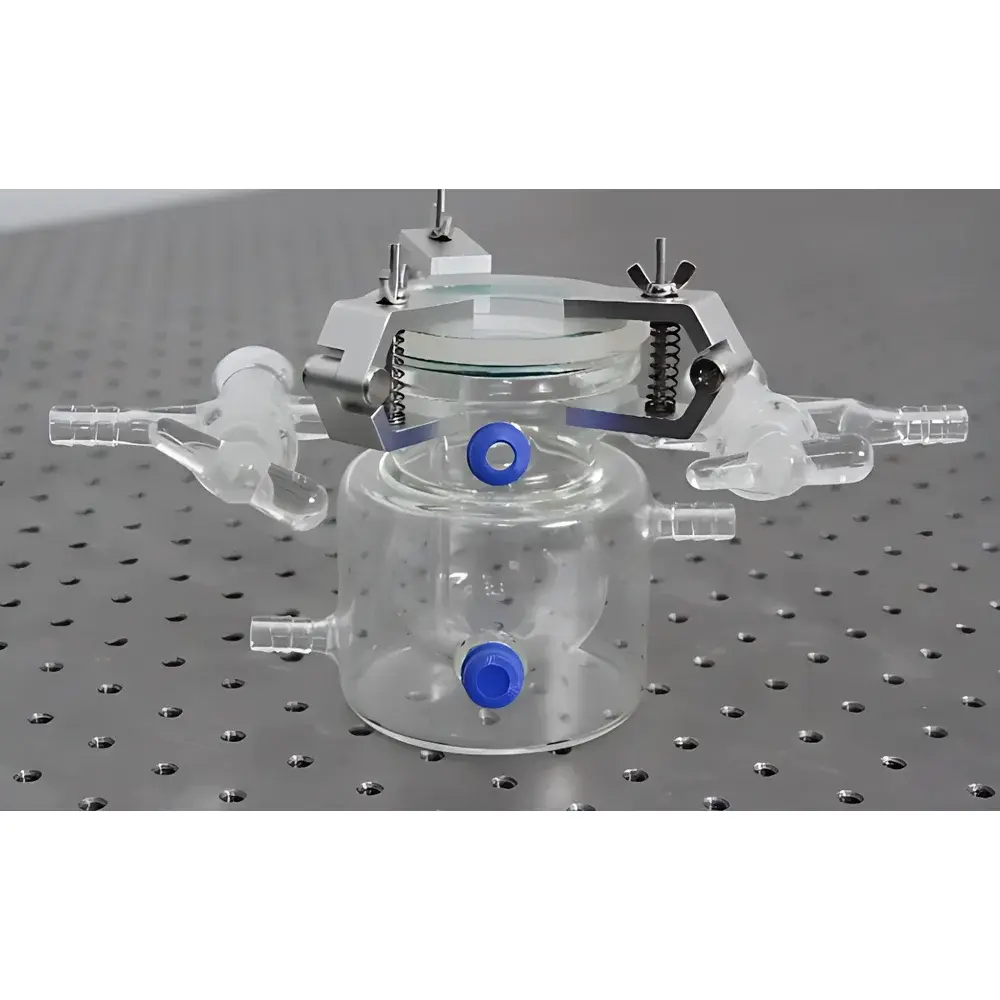
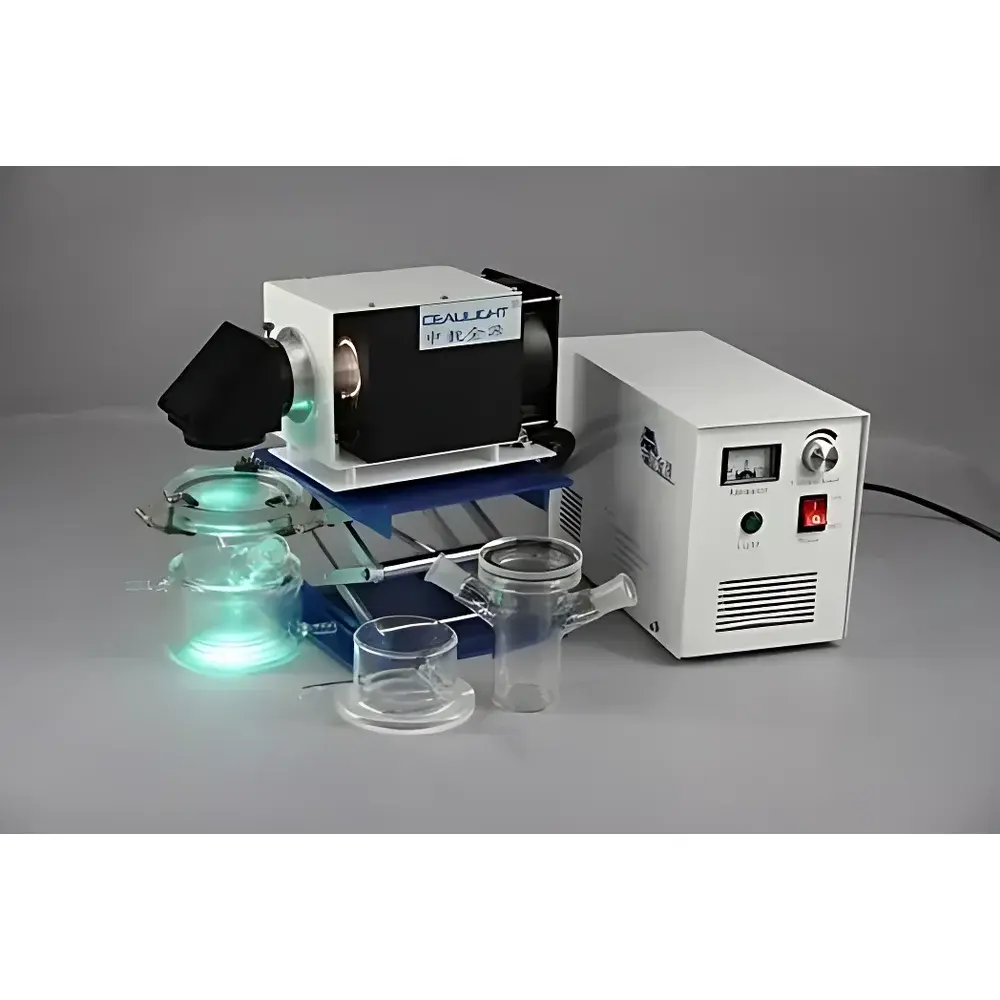
The CEL-APR100H Photocatalytic Reaction System with Integrated Temperature Control is a purpose-engineered benchtop reactor designed for reproducible, controlled photochemical synthesis and catalytic evaluation under ambient pressure conditions. Built on a monolithic borosilicate glass (Duran® 3.3 equivalent) architecture, the system integrates a double-walled jacketed vessel with precision-machined DIN-flanged interfaces, enabling simultaneous irradiation, thermal regulation, and gas-phase management in a single compact unit. Its operational principle relies on homogeneous photon delivery through a high-transmittance fused quartz window (cut-on <185 nm), coupled with convective heat exchange via thermostatted fluid circulation (e.g., water or ethylene glycol/water mixtures) through the outer jacket. This architecture supports fundamental studies in heterogeneous photocatalysis—including H₂ evolution, O₂ evolution, CO₂ photoreduction, and organic pollutant degradation—where strict control over light flux, temperature stability (±0.3 °C typical), and gas-phase composition is essential for kinetic modeling and mechanistic validation.
Key Features
- Monolithic borosilicate glass construction ensures chemical inertness toward acids, bases, and organic solvents, eliminating leaching artifacts common in coated or metallic reactors.
- Integrated thermostatic jacket enables precise temperature control from 5 °C to 80 °C using external circulators (not included), with real-time monitoring via embedded Pt100 sensor port (compatible with standard laboratory controllers).
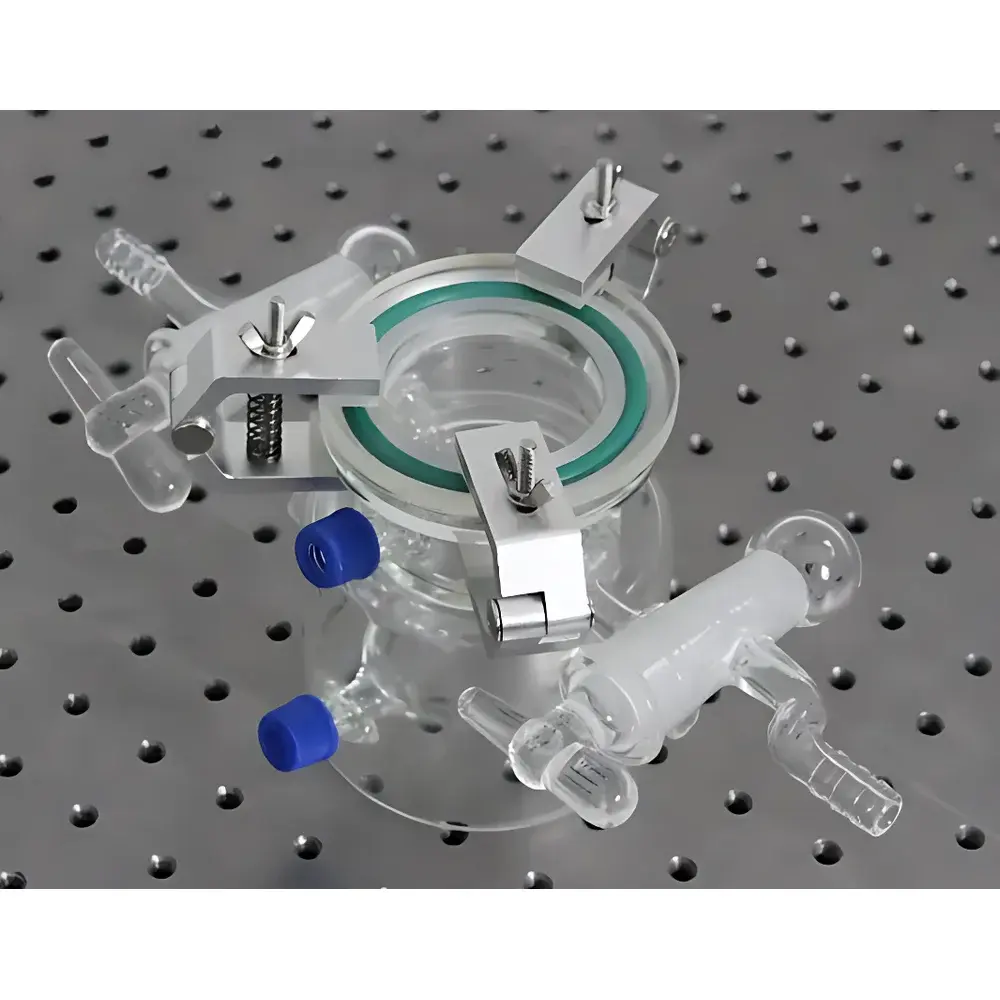
- UV-grade fused quartz optical window (Ø30 mm, thickness 6 mm) provides >90% transmittance across 185–400 nm, supporting both UVC-driven radical generation and visible-light photocatalyst activation.
- Bottom-submerged gas inlet with integrated glass stopcock allows quantitative sparging of inert (N₂, Ar), reactive (H₂, O₂, CO₂), or mixed atmospheres directly into the liquid phase, minimizing bubble coalescence and enhancing mass transfer efficiency.
- Two standardized 1/4″-28 UNF septum-piercing sampling ports support repeated in-situ liquid/gas sampling without system depressurization or exposure to ambient air—critical for time-resolved GC/FID or HPLC analysis.
- DIN 27 ISO-K flange interface (KF25 compatible) with replaceable Grafoil/Viton composite gasket guarantees leak-tight sealing up to 0.5 bar(g), meeting ASTM E2912-13 requirements for low-pressure photochemical apparatus integrity testing.
Sample Compatibility & Compliance
The CEL-APR100H accommodates aqueous suspensions, organic solvent-based colloids, and gas-saturated liquid phases containing suspended photocatalysts (e.g., TiO₂ P25, g-C₃N₄, MOFs, perovskite nanocrystals). It is compatible with catalyst loadings from 0.1 to 2.0 g·L⁻¹ and supports slurries with particle sizes ranging from sub-10 nm to >5 µm without clogging. The system conforms to ISO 17025:2017 general requirements for calibration traceability of temperature sensors and optical power meters used during reactor qualification. While rated for ambient pressure operation only, its design complies with GLP-relevant documentation standards for reaction setup logging (per OECD TG 117 and US EPA Method 405), including provision of serial-numbered component tags and as-built dimensional drawings upon request.
Software & Data Management
The CEL-APR100H operates as a hardware platform requiring integration with third-party instrumentation for full data acquisition. Temperature is monitored via optional Pt100 probe connected to a calibrated digital controller (e.g., Huber Ministat or Julabo F25); light intensity is quantified using NIST-traceable radiometers (e.g., International Light ILT2400) positioned at the quartz window plane. All operational parameters—including jacket inlet/outlet temperatures, gas flow rates (via mass flow controllers), and irradiance profiles—are logged externally using LabVIEW or Python-based SCADA frameworks compliant with FDA 21 CFR Part 11 when configured with electronic signatures and audit trails. Raw spectral irradiance data can be imported into photokinetic modeling tools such as PhotochemCAD or custom MATLAB scripts for quantum yield calculation (Φ) per IUPAC recommendations.
Applications
- Quantitative assessment of photocatalytic H₂ evolution kinetics under simulated solar illumination (AM 1.5G) or monochromatic LED sources.
- In situ monitoring of CO₂ photoreduction intermediates (e.g., CO, CH₄, CH₃OH) via online GC-TCD/FID coupling through the sampling ports.
- Comparative evaluation of visible-light-active photocatalysts in degrading pharmaceutical residues (e.g., carbamazepine, diclofenac) under controlled dissolved oxygen levels.
- Thermally assisted photo-oxidation studies where synergistic effects between 40–60 °C heating and 365 nm UV-A excitation are investigated.
- Method development for ISO 22197-1 (photocatalytic NO removal) and ISO 22197-2 (acetaldehyde decomposition) standard testing protocols.
FAQ
Is the CEL-APR100H suitable for high-pressure photochemical reactions?
No. The reactor is engineered exclusively for ambient pressure and low-pressure applications (≤0.5 bar gauge). For elevated pressure studies, we recommend the CEL-HPVR series with Hastelloy C-276 construction and ASME Section VIII Div. 1 certification.
Can the quartz window be replaced with other optical materials?
Yes—custom windows in MgF₂ (for deep-UV down to 110 nm) or sapphire (for enhanced mechanical durability) are available as OEM options; transmission curves and thermal expansion coefficients are provided for optical alignment validation.
Does the system include temperature or light-intensity calibration certificates?
Calibration documentation is supplied separately upon request and includes as-delivered verification of flange concentricity (±0.05 mm), quartz window parallelism (λ/4 @ 633 nm), and jacket volume tolerance (±1.5%). NIST-traceable calibrations require third-party service.
What maintenance is required for long-term reliability?
Annual inspection of gasket compression set, visual check for glass microfractures under UV lamp illumination, and verification of stopcock lubricity using Dow Corning High Vacuum Grease (HV-200) are recommended per ISO 13485 preventive maintenance guidelines.
Related Products



