
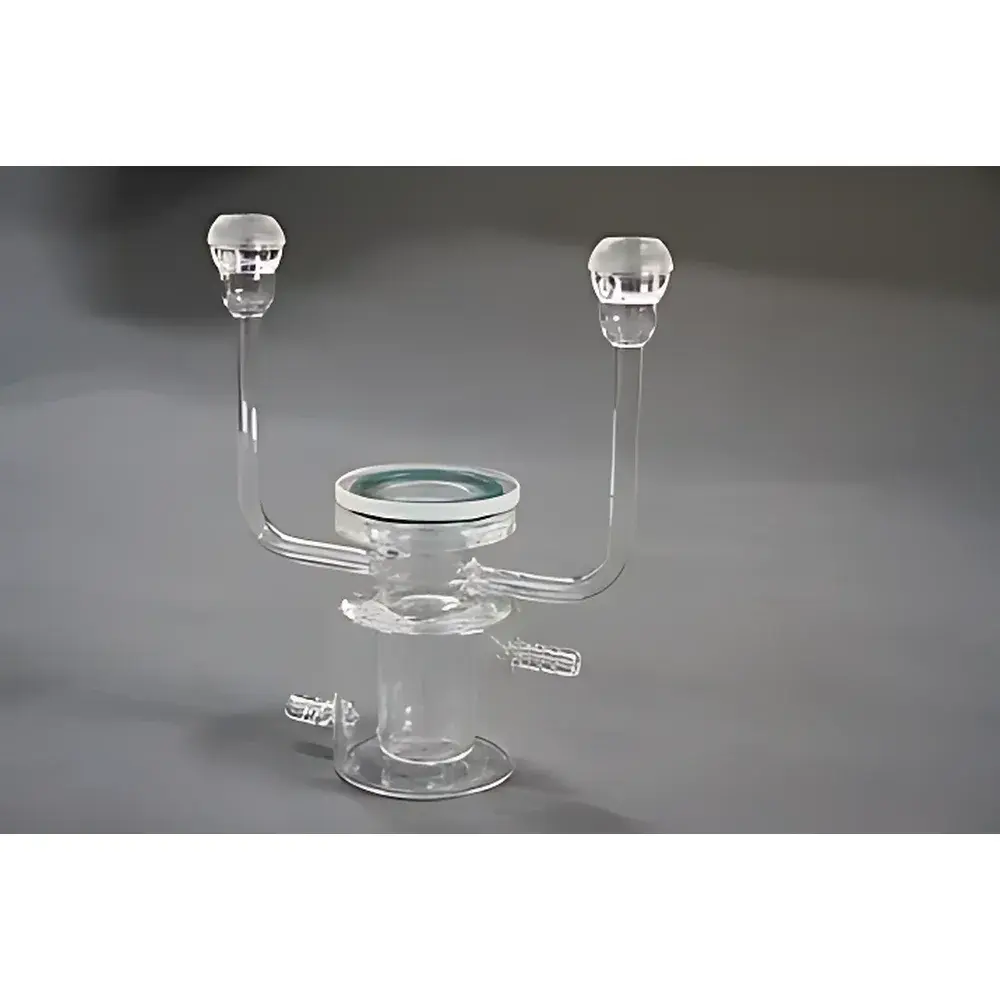
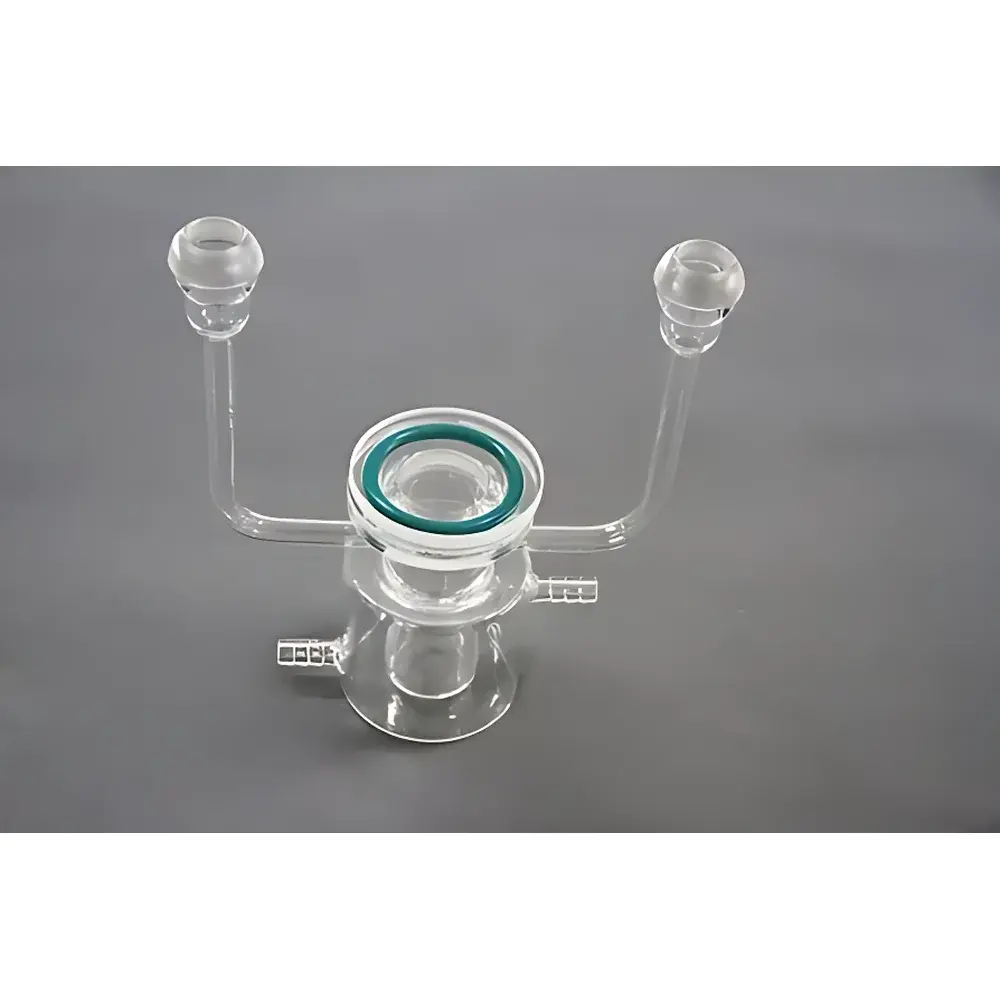
AULTT-TSP50 Online Photocatalytic Reactor (Standard Temperature-Controlled Integrated Model)
| Brand | AULTT |
|---|---|
| Origin | Beijing, China |
| Manufacturer | Zhongjiao Jinyuan |
| Model | AULTT-TSP50 (Standard Integrated Temperature-Controlled) |
| Vessel Capacity | 50 mL |
| Usable Reaction Volume | 20–30 mL |
| Construction Material | Borosilicate Glass (3.3) |
| Operating Pressure | Low-pressure (atmospheric to slight positive/negative bias) |
| Sealing Interface | Standard 28/30 Ground-Glass Joint with Viton O-ring |
| Cooling/Heating Port | Dual-layer water-jacket with 10 mm BSP inlet/outlet ports |
| Vacuum Capability | Not rated for vacuum operation |
| Compliance | Designed for laboratory-scale photocatalytic screening under ambient pressure |
Overview
The AULTT-TSP50 Online Photocatalytic Reactor is an integrated, benchtop-scale reaction vessel engineered for controlled photochemical evaluation of heterogeneous catalysts under ambient pressure conditions. It operates on the principle of suspended-phase photocatalysis, where incident UV–vis radiation activates semiconductor catalysts (e.g., TiO₂, g-C₃N₄, or MOFs) dispersed in liquid media, enabling quantification of reaction kinetics via real-time or intermittent sampling. The reactor features a coaxial double-wall glass jacket that accommodates circulating thermostatic fluid—enabling precise temperature regulation (±0.5 °C stability typical with external chiller/heater units). Its 50 mL nominal volume supports reproducible small-volume experiments (20–30 mL working volume), minimizing reagent consumption while maintaining sufficient optical path length for consistent irradiation geometry. Constructed entirely from high-purity borosilicate glass (DIN ISO 3585, Schott Duran®-equivalent), the system ensures chemical inertness toward common solvents (water, methanol, acetonitrile, aqueous buffers) and compatibility with both oxidative and reductive photocatalytic pathways.
Key Features
- Monolithic borosilicate glass construction with seamless dual-layer jacket design—no metal components in contact with reaction medium
- Standardized 28/30 ground-glass joint interface enables direct coupling with condensers, gas manifolds, reflux adapters, or online sampling valves per ASTM E2912 guidelines for photochemical apparatus assembly
- Viton®-based O-ring sealing system provides reliable low-pressure containment (up to +0.2 bar gauge or –0.1 bar absolute) and resistance to ozone and reactive oxygen species
- Dual 10 mm BSP-threaded ports for independent inlet/outlet circulation—compatible with standard laboratory peristaltic or diaphragm pumps and PID-controlled recirculating chillers
- Flat-bottom cylindrical geometry optimized for uniform irradiation from top-mounted collimated light sources (e.g., 300 W Xe lamps with AM1.5G filters or LED arrays at 365/405/450 nm)
- No internal baffles or stirrers—mixing achieved externally via magnetic stirring plate beneath the reactor base, preserving optical clarity and avoiding shadowing effects
Sample Compatibility & Compliance
The AULTT-TSP50 is validated for use with aqueous and organic photocatalytic suspensions, including nanoparticle dispersions, colloidal quantum dots, and immobilized catalyst coatings on glass substrates. It conforms to core requirements of ISO 10678:2010 (photocatalytic activity measurement using methylene blue degradation) and supports experimental protocols aligned with ASTM E2581 (standard guide for evaluating photocatalytic materials). As a non-pressurized, open-to-atmosphere (or optionally gas-purged) system, it does not require ASME BPVC Section VIII certification. All glass components meet DIN EN 15552:2018 specifications for laboratory glassware dimensional tolerances and thermal shock resistance (ΔT ≤ 120 °C). No vacuum rating is assigned; operation under reduced pressure requires supplemental engineering controls and is outside the device’s qualified operational envelope.
Software & Data Management
The AULTT-TSP50 is a hardware-only platform—no embedded electronics, sensors, or proprietary software are included. It is intended for integration into modular photocatalytic test benches where temperature, irradiance, and analyte concentration are monitored externally via calibrated instrumentation (e.g., Pt100 probes, spectroradiometers, HPLC/GC autosamplers). Experimental metadata—including irradiation time, temperature logs, sampling intervals, and analytical results—must be recorded manually or imported into LIMS-compliant platforms (e.g., LabWare, Thermo Fisher SampleManager) supporting 21 CFR Part 11 audit trails. For GLP/GMP-aligned workflows, users are advised to implement documented SOPs covering calibration frequency of ancillary equipment, glassware traceability, and raw data retention per ICH M7 and ISO/IEC 17025:2017 clause 7.5.
Applications
- Quantitative assessment of photocatalytic hydrogen evolution (HER) and CO₂ reduction rates using gas chromatography
- Kinetic profiling of organic pollutant degradation (e.g., phenol, rhodamine B, tetracycline) under simulated solar irradiation
- Structure–activity relationship studies for doped or heterojunction photocatalysts in batch-mode screening
- Photostability testing of catalysts under prolonged illumination with periodic TEM/XRD sampling
- Method development for ISO/ASTM reference protocols requiring standardized reactor geometry and thermal management
FAQ
Can the AULTT-TSP50 be operated under vacuum or elevated pressure?
No. It is designed exclusively for low-pressure operation at ambient atmospheric conditions. Vacuum or pressurized use voids safety compliance and risks mechanical failure.
Is the reactor compatible with aggressive oxidants such as H₂O₂ or persulfate solutions?
Yes—borosilicate glass and Viton seals exhibit excellent resistance to these reagents at concentrations typically used in photocatalytic studies (10 wt% H₂O₂ at elevated temperatures is not recommended.
What light sources are mechanically and optically compatible?
Top-irradiated configurations with collimated beams (≥30 mm diameter) from 300 W Xe arc lamps, 100–500 W LED arrays, or solar simulators meeting IEC 60904-9 Class AAA specifications are routinely employed.
Does the system include temperature sensing or control circuitry?
No. Temperature monitoring and regulation require external Pt100 probes and a standalone PID controller with circulating chiller/heater.
Are custom joint sizes or port configurations available?
Yes—Zhongjiao Jinyuan offers OEM modifications including 24/29 or 45/50 joints, side-arm sampling ports, and quartz-glass variants upon request and subject to minimum order quantities.



