
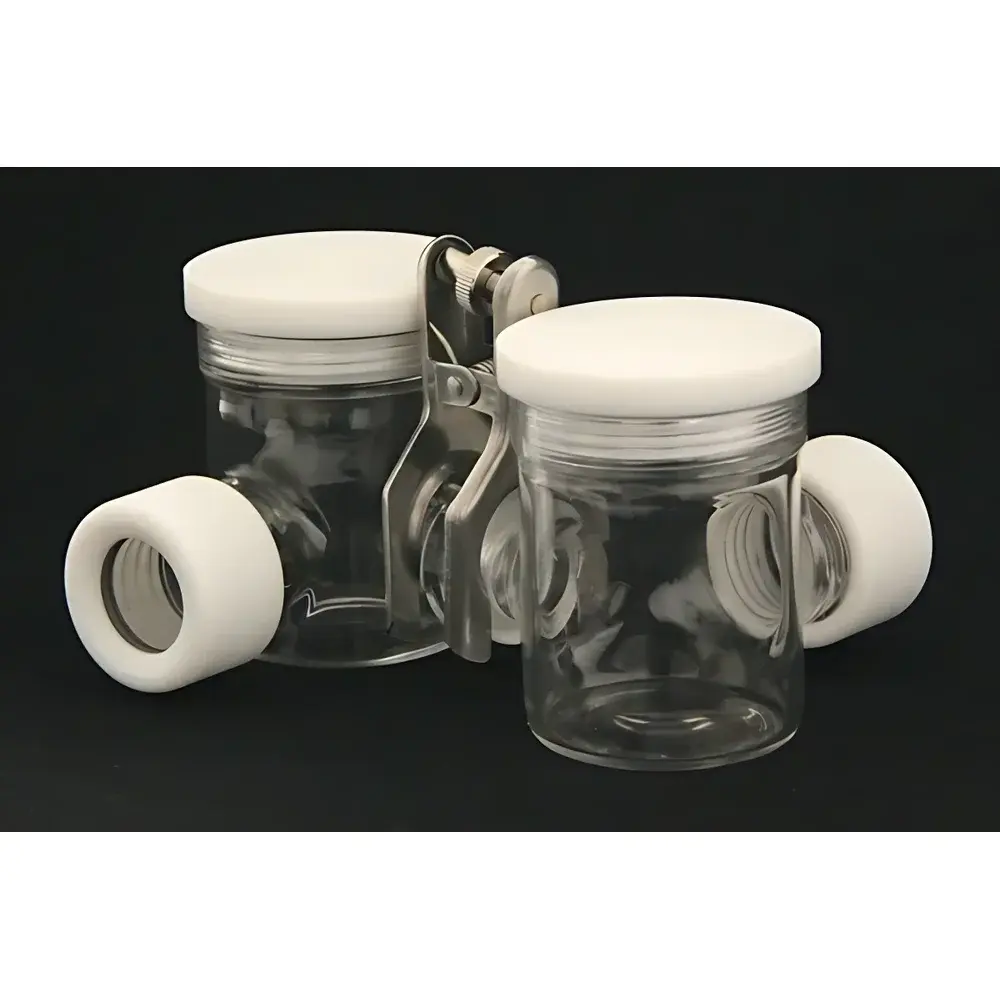
Zhongjiaojinyuan PECK13S Dual-Channel Sealed H-Type Photoelectrochemical Cell
| Brand | Zhongjiaojinyuan |
|---|---|
| Origin | Beijing, China |
| Manufacturer Type | Manufacturer |
| Product Category | Domestic |
| Model | PECK13S |
| Unit Price | USD 920 (FOB Beijing) |
| Component Type | Optical & Electrochemical Cell Assembly |
| Cell Volume per Compartment | 50 mL |
| Material | Borosilicate Glass Body, PTFE Caps, Fused Silica Optical Windows (Ø24 mm) |
| Optical Path Configuration | Dual Independent Irradiation Channels |
| Compartment Separation | Removable Ion-Exchange Membrane or Fritted Glass Disc (User-Provided) |
| Electrode Configuration | Two Working Electrode Ports with Pt Clamp Holders, Pt Wire Counter Electrode, Ag/AgCl Reference Electrode |
| Customization Options | Single-compartment volumes up to 200 mL |
Overview
The Zhongjiaojinyuan PECK13S is a precision-engineered dual-channel, sealed H-type photoelectrochemical (PEC) cell designed for controlled, quantitative investigation of light-driven interfacial charge transfer processes. Its architecture implements the classic H-cell configuration—two physically separated electrochemical compartments connected via a selective ion-conducting interface—to enable rigorous separation of photoanodic and photocathodic half-reactions under simultaneous or independent illumination. The cell operates on the principle of potentiostatically controlled three-electrode electrochemistry combined with calibrated optical excitation through high-transmittance fused silica windows (24 mm diameter), permitting incident photon flux quantification in accordance with ASTM E973 and ISO 9050 standards. This design eliminates cross-contamination between oxidation and reduction products, making it indispensable for mechanistic studies of water splitting, CO₂ photoreduction, and selective organic transformations where product analysis requires spatial compartmentalization.
Key Features
- Borosilicate glass main body with chemical resistance to aqueous electrolytes, strong acids/bases, and common organic solvents (pH 0–14, <80 °C continuous operation)
- Two identical 50 mL reaction compartments with independent gas-tight sealing via dual PTFE caps equipped with O-ring grooves and torque-controlled threaded engagement
- Dual orthogonal optical access paths: each compartment features a vertically aligned fused silica window (UV-VIS-NIR transmission >90% from 190–2500 nm), enabling symmetrical or asymmetric irradiation protocols
- Modular electrode interface system: two standardized M6 threaded ports per compartment accommodate Pt-clamp holders for working electrodes; pre-aligned alignment sleeves ensure reproducible electrode immersion depth and geometric consistency
- Removable separation interface: compatibility with user-supplied ion-exchange membranes (e.g., Nafion® 117) or sintered glass frits (porosity grade G3/G4) allows optimization of ionic conductivity vs. product crossover suppression
- Integrated法兰-style mechanical clamping system for rapid assembly/disassembly without tools; all wetted surfaces are non-metallic and electrochemically inert
Sample Compatibility & Compliance
The PECK13S supports a broad range of photoactive materials—including metal oxide semiconductors (TiO₂, BiVO₄, Fe₂O₃), perovskite thin films, molecular catalysts, and plasmonic nanostructures—mounted on conductive substrates (FTO, ITO, Au, Pt). Its geometry conforms to standard electrochemical cell dimensions compatible with rotating disk electrodes (RDE), spectroelectrochemical cuvette holders, and commercial solar simulators (AM1.5G, Class AAA). All materials comply with RoHS Directive 2011/65/EU and meet ISO 8502-3 surface cleanliness requirements for analytical-grade glassware. When operated with certified reference electrodes and calibrated light sources, data generated satisfies GLP documentation requirements for catalytic quantum yield (Φ) determination per ISO 12219-2 and ASTM E2051.
Software & Data Management
While the PECK13S is a passive cell requiring external instrumentation, its mechanical and electrical interfaces are fully compatible with industry-standard potentiostats (e.g., BioLogic SP-300, CHI 760E) and spectroscopic platforms (Ocean Insight QE Pro, Avantes AvaSpec). Electrochemical data acquisition supports time-resolved transient photocurrent measurements (TPC), intensity-modulated photocurrent spectroscopy (IMPS), and open-circuit potential decay (OCPD) protocols. When paired with validated instrument control software (e.g., EC-Lab v12+, AfterMath v2.1), raw datasets include full audit trails compliant with FDA 21 CFR Part 11 for electronic records and signatures—enabling traceable metadata tagging of illumination conditions, electrolyte composition, temperature, and electrode history.
Applications
- Quantitative assessment of apparent quantum efficiency (AQE) and solar-to-hydrogen (STH) conversion efficiency in tandem PEC systems
- Stability benchmarking of photoanodes under prolonged chronoamperometric stress (≥10 h) with real-time pH monitoring in both compartments
- Isotopic labeling experiments (e.g., H₂¹⁸O, ¹³CO₂) requiring strict product segregation for GC-MS or NMR analysis
- Electrocatalyst screening under controlled mass transport conditions using rotating ring-disk electrode (RRDE) integration
- In situ/operando UV-Vis absorption and Raman spectroelectrochemistry through side-mounted fiber-optic couplers
FAQ
Can the PECK13S be used with non-aqueous electrolytes?
Yes—its PTFE seals and borosilicate construction support anhydrous organic media including acetonitrile, DMF, and propylene carbonate, provided vapor pressure and swelling characteristics are within operational limits.
Is the quartz window included with the base unit?
Yes—the standard configuration includes two fused silica windows (Ø24 mm, 3 mm thickness, polished both sides) pre-installed and optically centered.
What is the maximum operating temperature and pressure rating?
The cell is rated for continuous use up to 80 °C at ambient pressure; short-term exposure to 100 °C is permissible with reduced seal lifetime. It is not rated for overpressure applications.
How is electrode alignment verified during assembly?
Each Pt clamp holder incorporates a depth-stop collar and laser-etched scale (±0.1 mm resolution); recommended immersion depth is 5–8 mm into electrolyte for optimal iR compensation and light penetration.
Are custom volume configurations validated for electrochemical performance?
Yes—100 mL and 200 mL single-compartment variants maintain identical electrode geometry, optical path length, and seal integrity; validation reports including ohmic drop characterization and background current profiles are available upon request.



