
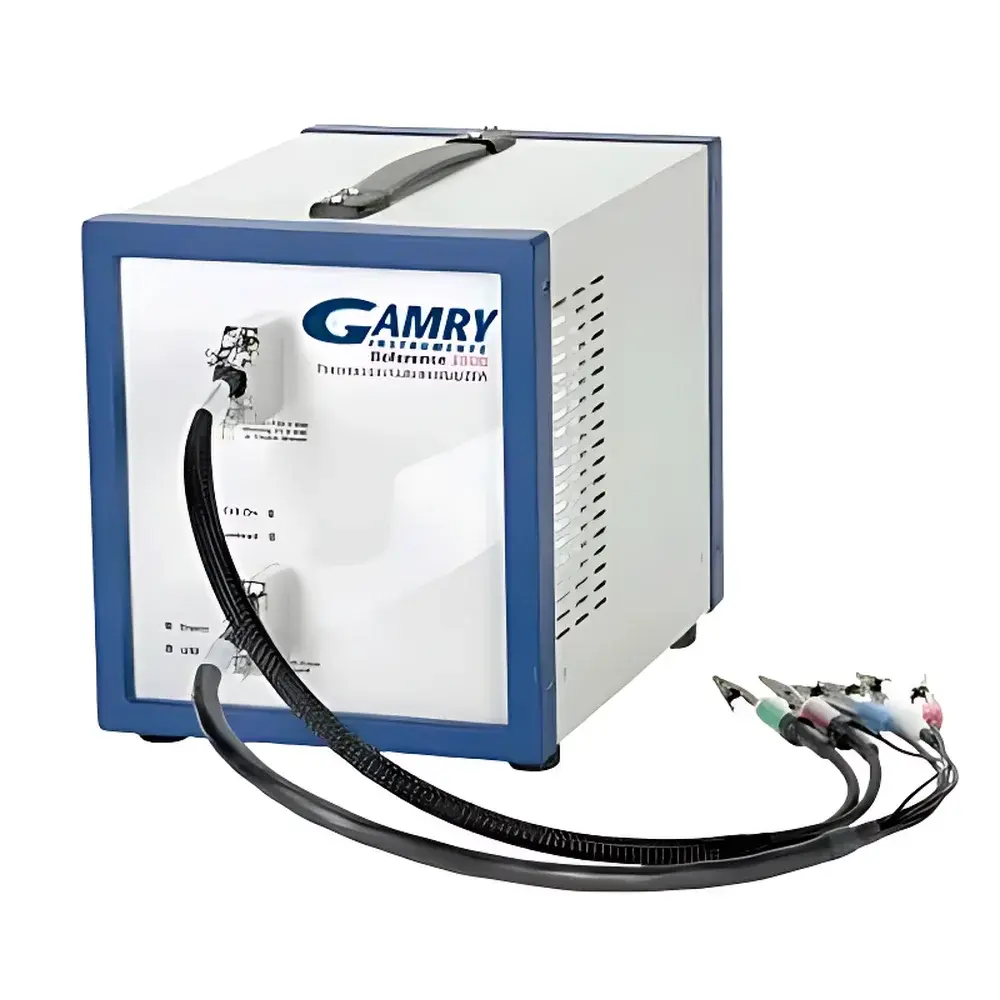
Gamry Reference 3000 Potentiostat/Galvanostat/ZRA
| Origin | USA |
|---|---|
| Manufacturer Type | Authorized Distributor |
| Origin Category | Imported |
| Model | REF3000 |
| Pricing | Upon Request |
Overview
The Gamry Reference 3000 is a high-performance, floating, dual-mode potentiostat/galvanostat with integrated zero-resistance ammeter (ZRA) functionality. Engineered for precision and robustness in demanding electrochemical environments, it operates on the principle of three-electrode potentiostatic control with real-time current feedback and high-fidelity analog signal conditioning. Its architecture supports simultaneous high-current (±3 A) and ultra-low-current (down to 300 pA) measurements without range switching artifacts—enabled by 13 internal current gain settings and auto-ranging firmware logic. With a maximum compliance voltage of ±32 V and a control amplifier bandwidth up to 1.1 MHz (depending on current range), the instrument is expressly designed for energy storage and conversion (ESC) applications including battery cycling under load, fuel cell stack monitoring, and supercapacitor impedance profiling under realistic operating conditions. Its fully isolated, floating design ensures safe and accurate operation with grounded or high-potential systems such as operating batteries, pressurized electrochemical cells, and industrial electrolyzers.
Key Features
- True floating architecture with >1014 Ω input impedance and <6 pA input bias current—enabling stable measurements in high-impedance systems (e.g., coated metals, biological interfaces, solid-state electrolytes).
- 11 programmable current ranges (300 pA to 3 A), extended to 13 with internal gain stages; minimum current resolution: 92 aA (attoampere) at 300 pA full scale.
- High-voltage potentiostatic control up to ±32 V with <250 ns rise time and <2 µVrms noise—critical for wide-window spectroelectrochemistry and corrosion testing in aggressive media.
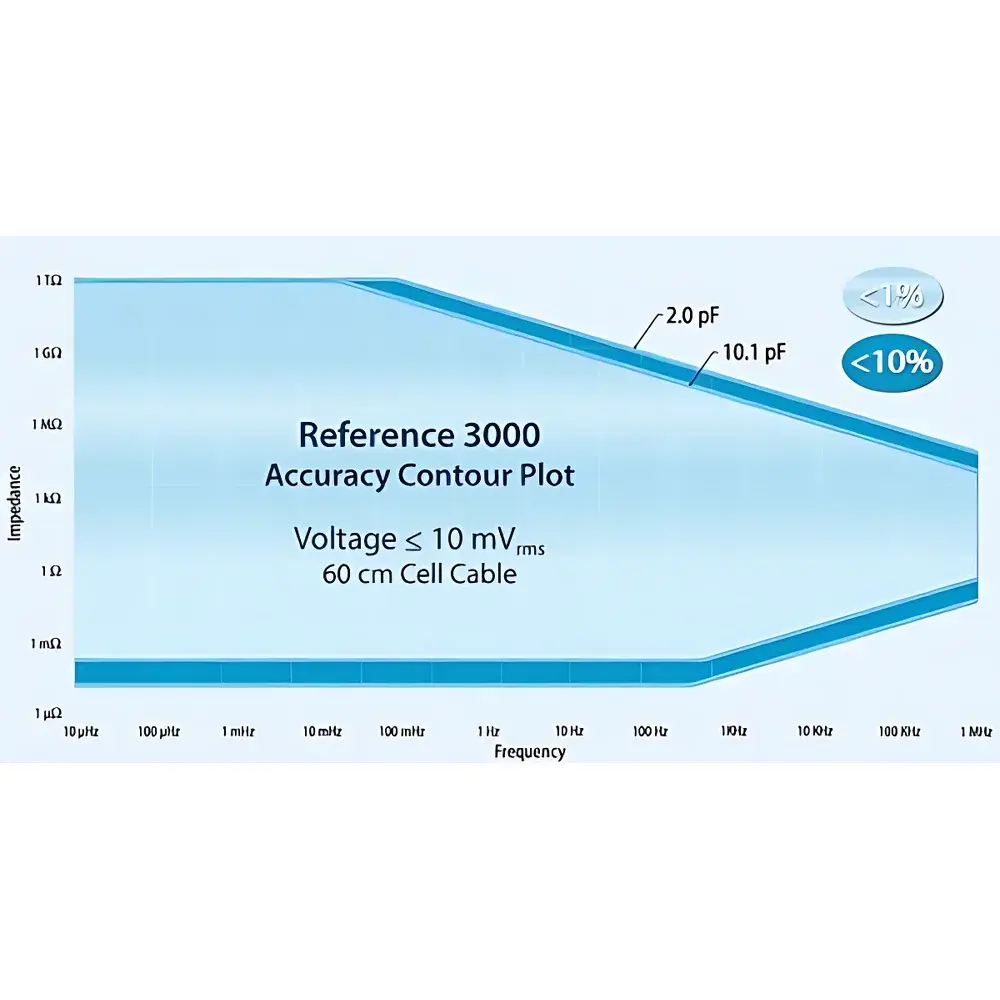
- Integrated EIS capability spanning 10 µHz to 1 MHz using direct digital synthesis (DDS); accuracy validated via published contour plots incorporating cable effects and cell configuration.
- Dual-channel auxiliary I/O: four analog inputs (±3 V, 0.1 mV resolution), two analog outputs (0–4 V, 1 mV resolution), TTL-triggered external sync, and dedicated ZRA monitor output.
- DSP-based oversampling and real-time filtering improve SNR in low-amplitude transient measurements (e.g., pulse voltammetry, SECM feedback mode).
- Simultaneous iR compensation via both current-interrupt (minimum 33 µs interrupt) and positive-feedback algorithms—fully configurable per experiment segment.
- USB 2.0 interface compatible with Windows 10/11; supports up to eight units per host via powered USB hub without driver conflicts.
Sample Compatibility & Compliance
The Reference 3000 supports standard 2-, 3-, and 4-electrode configurations—including dual working electrode (DWE), rotating disk electrode (RDE), and electrochemical quartz crystal microbalance (EQCM) setups. Its floating design complies with IEC 61010-1 safety requirements for measurement category CAT II 300 V, and its isolation barrier meets reinforced insulation standards for use with live high-voltage electrochemical systems. The instrument is routinely deployed in GLP-compliant laboratories performing ASTM D1148 (rubber aging), ASTM G59 (potentiodynamic polarization), ASTM G106 (electrochemical impedance for coatings), and ISO 16773-2 (EIS for fuel cell membranes). Firmware and software support FDA 21 CFR Part 11 audit trails when used with Gamry Framework’s electronic signature module.
Software & Data Management
Controlled exclusively via Gamry Framework v9.x (Windows-only), the system provides experiment sequencing, real-time data visualization, and automated post-processing modules for Tafel analysis, equivalent circuit fitting (EC-Lab®-compatible models), and differential capacitance mapping. All raw data are stored in open-format .DTA files containing metadata (timestamp, calibration ID, hardware revision, user-defined notes) and binary-acquired waveforms. The software includes built-in validation tools: automatic shunt resistor verification, open-circuit potential drift logging, and EIS Kramers-Kronig consistency checks. Export options include CSV, MATLAB (.mat), and MPT-compatible formats for third-party modeling (e.g., COMSOL Multiphysics coupling). Audit logs record operator login, method changes, calibration events, and data export actions—fully traceable for regulatory submissions.
Applications
- Battery R&D: galvanostatic intermittent titration technique (GITT), hybrid pulse power characterization (HPPC), and multi-step EIS on Li-ion, Na-ion, and solid-state cells.
- Fuel cell diagnostics: single-cell and short-stack polarization curve acquisition with simultaneous anode/cathode EIS under humidified H2/air flow.
- Corrosion science: electrochemical noise analysis (ENA), localized corrosion mapping, and long-term immersion testing per ASTM G199.
- Electrocatalysis: rotating ring-disk electrode (RRDE) studies with dual-channel current collection and kinetic parameter extraction (k0, α, n).
- Materials synthesis: controlled-potential electrodeposition of nanostructured alloys, conductive polymers, and MOF thin films.
- Sensor development: amperometric biosensor calibration, redox polymer characterization, and interference rejection testing.
- Supercapacitors: cyclic voltammetry at scan rates up to 10 V/s, galvanostatic charge/discharge with coulombic efficiency tracking, and frequency-dependent capacitance profiling.
FAQ
Can the Reference 3000 perform true 4-electrode (Luggin capillary) measurements?
Yes—it supports independent counter and reference electrode connections with separate high-impedance sense leads, enabling uncompensated resistance minimization in high-conductivity electrolytes.
Is EIS accuracy affected by cable length or shielding?
Accuracy contour plots provided in the manual explicitly include contributions from standard 1-m triaxial cables; performance degrades predictably beyond 2 m unless active guarding is employed.
How does the instrument handle grounding conflicts in multi-cell battery testers?
Its galvanically isolated design eliminates ground loops; each unit operates independently with no shared earth reference—ideal for parallel cell cycler integration.
What is the warranty coverage and service support model?
Gamry offers a 24-month limited warranty covering parts and labor; extended service plans include annual calibration verification and on-site technical support contracts.
Does the system meet electromagnetic compatibility (EMC) standards for laboratory use?
Yes—certified to EN 61326-1:2013 (industrial environment) for emission and immunity, including electrostatic discharge (IEC 61000-4-2) and burst immunity (IEC 61000-4-4).



