
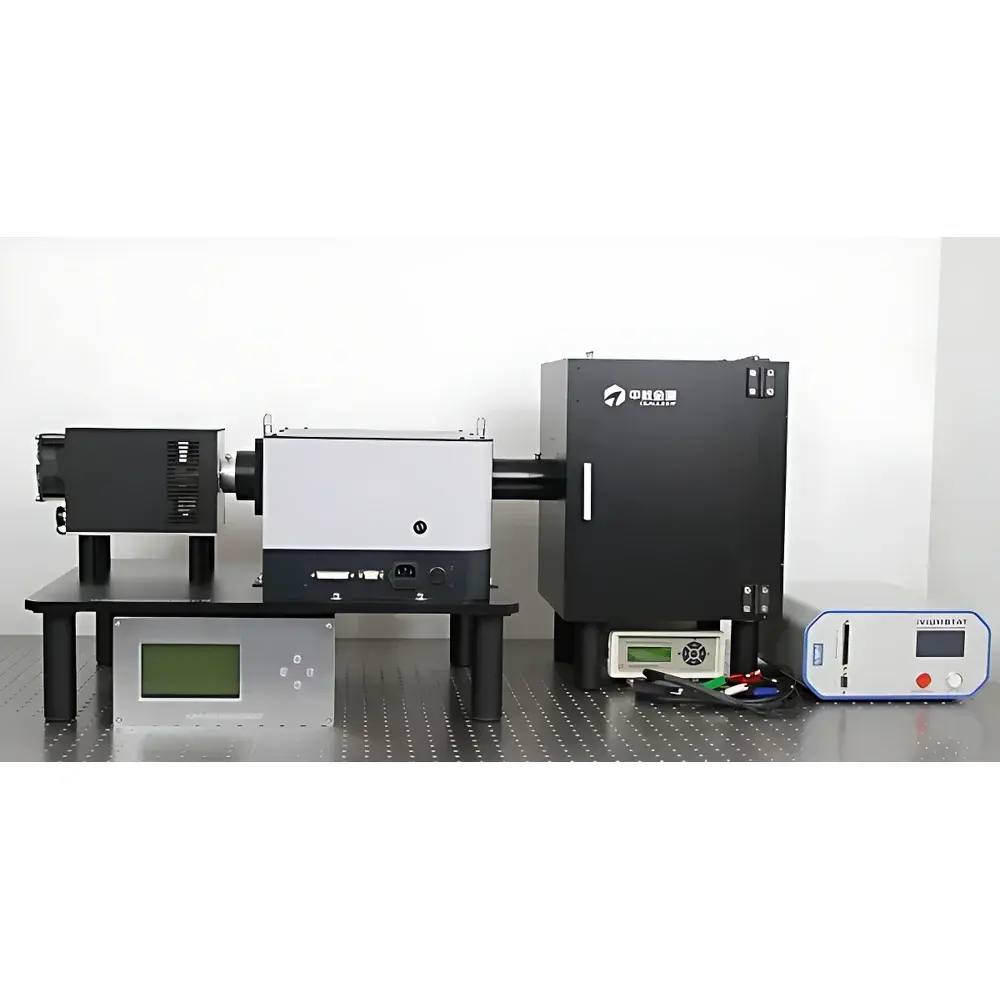
CEL-SLF300 Tunable Monochromatic Light Source System
| Brand | CEL (China Education Goldsource) |
|---|---|
| Origin | Beijing, China |
| Manufacturer Type | OEM Manufacturer |
| Product Origin | Domestic (China) |
| Model | CEL-SLF300 |
| Light Source Type | 300 W Xenon Arc Lamp |
| Illumination Mode | External Irradiation |
| Output Spectral Range | 200–2500 nm |
| Spectral Bandwidth Tunability | 0.1–30 nm |
| Optical Stability | < ±0.5% (RMS, over 8 h) |
| Output Irradiance | ≥50 mW/cm² (at focal plane, typical configuration) |
| Monochromator Type | Dual-Grating Scanning Monochromator (e.g., CEL-IS151 or CEL-IS302) |
| Optical Design | Asymmetric Horizontal Czerny–Turner, Achromatic & Stray-Light Suppressed |
| Grating Interface | RS232 & USB 2.0 Motorized Control |
| Slit Mechanism | Symmetrical Precision Slit with Blade Protection |
| Enclosure Architecture | Optically Isolated Chamber (Separated Optical & Mechanical Compartments) |
| Purge Port | Dedicated N₂ Inlet for UV/NIR Atmospheric Absorption Compensation |
| Detector Compatibility | Single-point photodetectors, linear/area-array CCD/CMOS sensors (vertical output port), fiber-coupled interfaces (SMA905/FC) |
| Software Control | Full Wavelength Scan, Delayed Triggering, and Automated Filter Wheel Sequencing via USB 2.0 |
Overview
The CEL-SLF300 Tunable Monochromatic Light Source System is an engineered optical platform designed for high-fidelity spectral selectivity in advanced photophysical, photoelectrochemical, and materials characterization laboratories. Built around a stabilized 300 W xenon arc lamp—emitting a continuous spectrum from 200 nm (deep UV) to 2500 nm (short-wave infrared)—the system integrates a dual-grating scanning monochromator (e.g., CEL-IS151 or CEL-IS302) with motorized filter wheel, precision slit assembly, and optomechanical stabilization architecture. Its core principle relies on wavelength dispersion via diffraction gratings followed by spatial filtering at the exit slit, enabling narrowband irradiance delivery with tunable bandwidth (0.1–30 nm FWHM). Unlike broadband illumination systems, the CEL-SLF300 delivers spectrally resolved excitation essential for quantum yield determination, incident photon-to-current efficiency (IPCE) mapping, action spectrum analysis, and wavelength-dependent kinetic studies under controlled irradiance conditions.
Key Features
- Optical stability better than ±0.5% RMS over 8 hours—achieved through thermal management of the xenon lamp housing, rigid optical baseplate integration, and active power regulation.
- Asymmetric horizontal Czerny–Turner monochromator design with coma-corrected optics and secondary dispersion suppression—ensuring high spectral fidelity, symmetrical line profiles, and reduced stray light (<10⁻⁵ relative intensity beyond ±50 nm from central wavelength).
- Motorized dual-grating turret with RS232/USB 2.0 interface—enabling automated grating selection optimized for UV, VIS, or NIR spectral regions without realignment.
- Electronically actuated slit mechanism with symmetrical blade drive and automatic edge protection—guaranteeing long-term repeatability (±0.01 mm positional accuracy) and minimal mechanical drift.
- Dedicated N₂ purge port—facilitating operation below 190 nm (vacuum UV proxy) and above 1400 nm where atmospheric H₂O/O₂ absorption bands dominate.
- Physically segregated optical and mechanical compartments—preventing lubricant outgassing contamination of mirrors/gratings and eliminating vibration-induced beam wander.
- Vertical CCD output port with standard C-mount interface—supporting direct coupling to scientific-grade area detectors for spectrograph mode operation.
- Fiber-optic coupling compatibility (SMA905 or FC connectors)—enabling remote sample irradiation, integration into gloveboxes, or multi-channel parallel testing setups.
Sample Compatibility & Compliance
The CEL-SLF300 supports diverse sample geometries and environmental configurations, including flat substrates, electrochemical cells (e.g., CEL-CPE50 photoelectrochemical reactor), gas-phase reaction chambers, and thin-film coated optical windows. Its external irradiation architecture permits non-invasive illumination of samples housed in custom dark enclosures (e.g., DK25 30×30×30 cm shielded chamber), Faraday cages, or temperature-controlled stages. The system complies with fundamental laboratory safety standards for Class 3B optical radiation (IEC 60825-1:2014) and meets electromagnetic compatibility requirements per EN 61326-1. While not certified for GMP or FDA 21 CFR Part 11 out-of-the-box, its programmable control log, timestamped wavelength scan records, and deterministic hardware triggering support audit-ready data acquisition when integrated with validated third-party DAQ software (e.g., LabVIEW-based GLP-compliant modules).
Software & Data Management
Control is executed via native Windows-compatible software with USB 2.0 communication protocol, supporting full parameter scripting—including wavelength sweep direction, step size (0.01 nm minimum), dwell time per point (1 ms–60 s), filter wheel position sequencing, and shutter trigger delay (0.1 ms resolution). All operational parameters are logged in CSV/ASCII format with UTC timestamps, enabling traceable correlation between spectral input and detector response. The software architecture permits API-level integration with Python (via PySerial) or MATLAB for custom automation pipelines—essential for high-throughput IPCE mapping or transient photocurrent analysis synchronized with potentiostat triggers. No cloud connectivity or proprietary binary formats are employed; raw spectral irradiance data remains fully exportable for post-processing in Origin, Igor Pro, or Python-based analysis stacks.
Applications
- Photoelectrochemical characterization: Wavelength-resolved photocurrent action spectra, bandgap estimation, and charge-transfer kinetics in metal oxides, perovskites, and covalent organic frameworks.
- Quantum efficiency quantification: Incident photon-to-current conversion efficiency (IPCE) and external quantum efficiency (EQE) measurements compliant with ASTM E2537 and IEC 60904-8 standards.
- Photocatalytic activity screening: Monochromatic irradiation-driven degradation kinetics (e.g., methylene blue, phenol) with precise dosimetry control across UV–VIS–NIR ranges.
- Optoelectronic device testing: Spectral responsivity calibration of photodiodes, solar cells, and image sensors under calibrated monochromatic flux.
- Fundamental photophysics: Time-resolved fluorescence excitation spectroscopy, triplet sensitization thresholds, and singlet oxygen quantum yield determination using matched reference standards.
FAQ
What spectral range is covered by the CEL-SLF300 system?
The system delivers tunable monochromatic output from 200 nm to 2500 nm, contingent upon grating selection, detector sensitivity, and atmospheric transmission limitations. With nitrogen purging, usable output extends below 190 nm; with appropriate NIR-optimized gratings and InGaAs detectors, coverage reaches 2500 nm.
Can the system be used for absolute irradiance calibration?
Yes—when paired with a NIST-traceable power meter (e.g., CEL-NP2000) and calibrated spectroradiometer (e.g., AULTT-P4000), the system supports radiometric calibration per ISO/IEC 17025-accredited procedures. Calibration certificates for individual components are available upon request.
Is the monochromator vacuum-compatible?
No—the CEL-IS151/IS302 monochromators are sealed dry-air units. For vacuum ultraviolet (VUV) applications below 190 nm, a separate differential-pumping interface or synchrotron beamline coupling is required.
How is order-sorting contamination mitigated?
Integrated motorized filter wheel (e.g., IFW6) houses long-pass and bandpass filters selected automatically based on target wavelength. Software enforces filter-grating-wavelength interlocks to suppress higher-order diffraction artifacts without manual intervention.
Does the system support synchronization with external instruments?
Yes—TTL-compatible shutter trigger output and analog/digital I/O ports enable hardware-level synchronization with electrochemical workstations, oscilloscopes, or pulsed laser systems for pump-probe or transient absorption experiments.




