
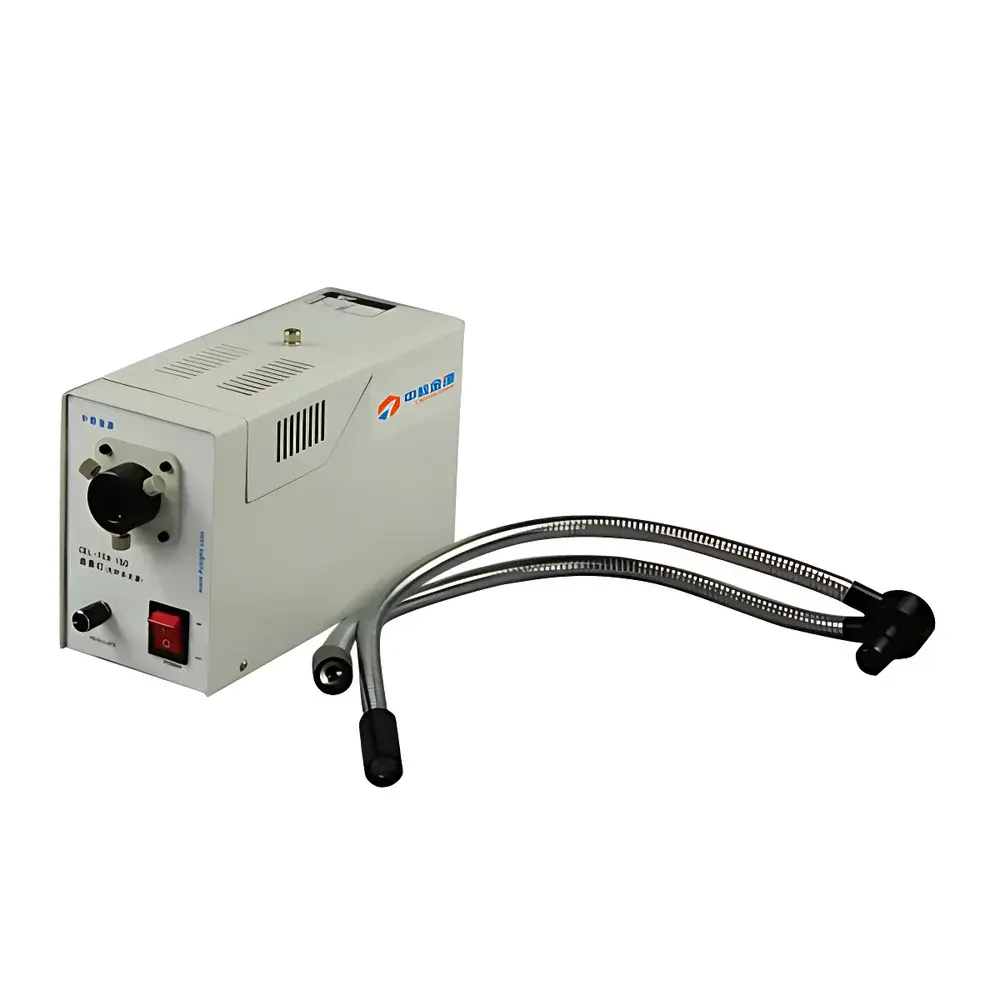
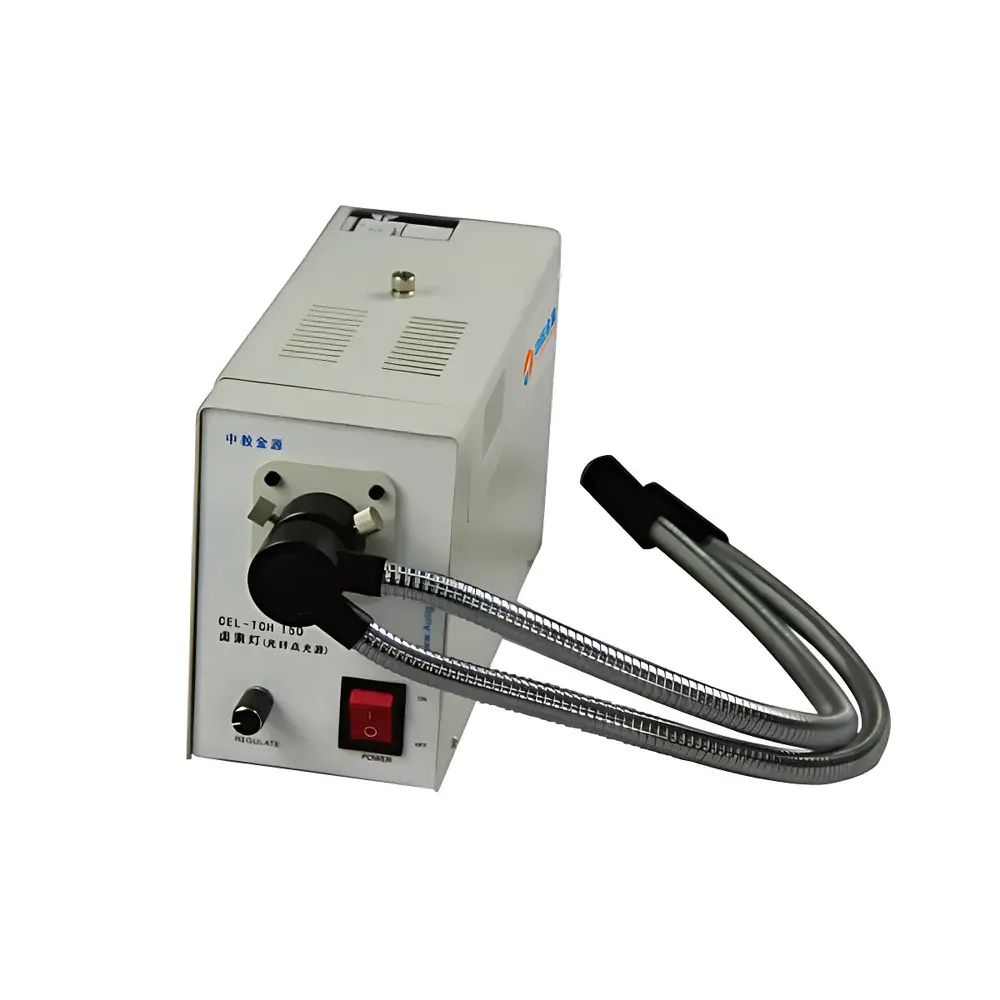
CEL-TCH150 Halogen Fiber-Coupled Light Source
| Brand | CEL (China Education Goldsource) |
|---|---|
| Origin | Beijing, China |
| Manufacturer Type | Direct Manufacturer |
| Origin Category | Domestic (PRC) |
| Model | CEL-TCH150 |
| Light Source Type | Halogen Lamp |
| Illumination Mode | External Irradiation |
| Power Supply | AC 220 V ±20%, 50 Hz ±1 Hz |
| Lamp Power | 150 W |
| Lamp Operating Voltage | 24 V DC (adjustable current) |
| Output Irradiance (at sample plane) | 0–1000 mW/cm² |
| Fiber-Coupled Output Irradiance | 0–400 mW/cm² |
| Color Temperature | ≥3200 K |
| Ground Leakage Current | ≤0.5 mA |
| Noise Level | ≤55 dB(A) |
| Operating Ambient Temperature | −10 °C to +45 °C |
| Protection Features | Overvoltage, Overcurrent, Short-Circuit Auto-Protection |
| Voltage Regulation Stability | ≤0.05 V under full/no-load conditions |
| Fiber Configuration | Dual-branch SMA-terminated quartz optical fiber (standard 600 µm core, NA 0.22) |
Overview
The CEL-TCH150 Halogen Fiber-Coupled Light Source is a precision-engineered optical instrument designed for controlled, stable, and spectrally continuous illumination in visible-light-driven photochemical research. Unlike pulsed or line-emission sources (e.g., mercury or xenon arc lamps), the CEL-TCH150 employs a high-stability 150 W tungsten-halogen lamp operating at 24 V DC with regulated current drive—ensuring consistent radiometric output and color temperature (≥3200 K) across extended operational periods. Its integrated dual-branch optical fiber delivery system enables spatially flexible, non-contact irradiation of reaction vessels—critical for avoiding thermal interference, maintaining sealed reactor environments, and enabling parallel multi-sample configurations. The system operates without water cooling, relying instead on intelligent forced-air thermal management that maintains lamp junction temperature within optimal range while minimizing acoustic noise (<55 dB) and mechanical vibration—key requirements for sensitive spectroscopic coupling or long-duration kinetic studies.
Key Features
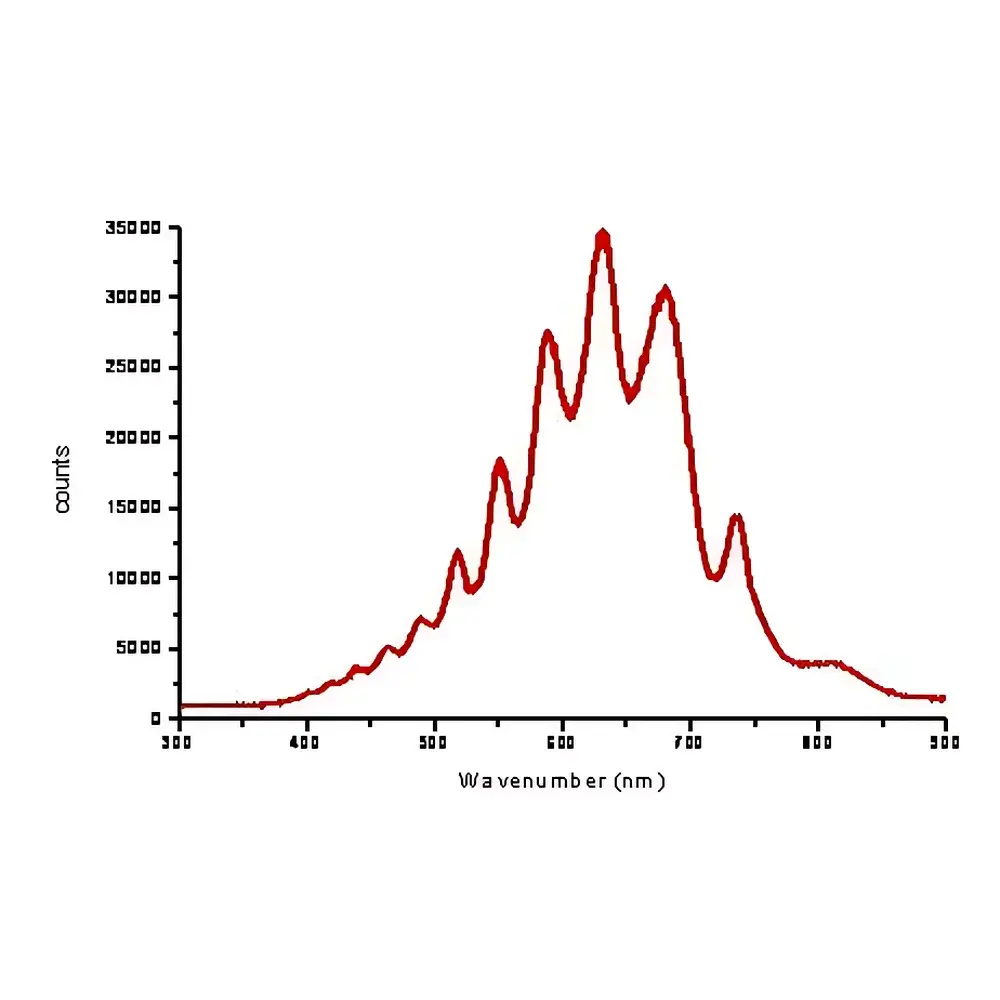
- Stable halogen-based broadband emission (350–2500 nm), ideal for action spectrum analysis and visible-light photocatalysis (e.g., TiO₂, g-C₃N₄, MOFs)
- Dual-SMA optical fiber output (standard 600 µm core, NA 0.22) supporting bifurcated or split-beam experimental geometries
- Continuously adjustable irradiance (0–1000 mW/cm² at sample plane; 0–400 mW/cm² at fiber output) via precision current regulation—not dimming circuits—ensuring linear photonic flux control and repeatability
- Integrated switch-mode power supply with wide-input tolerance (180–240 V AC), eliminating need for external voltage stabilizers and extending lamp lifetime through constant-voltage/current operation
- No water cooling required: compact fan-cooled architecture reduces lab infrastructure dependencies and eliminates risks associated with coolant leakage or pump failure
- Comprehensive electrical safety: ground leakage current ≤0.5 mA, automatic overvoltage/overcurrent/short-circuit protection, and reinforced insulation per IEC 61010-1
- EMI-hardened design: low-noise switching topology minimizes electromagnetic interference with adjacent analytical instruments (e.g., potentiostats, lock-in amplifiers, CCD detectors)
- Modular filter compatibility: accepts standard 25 mm or 50 mm diameter bandpass, longpass, and shortpass interference filters for spectral selectivity (e.g., λ > 420 nm for visible-only photocatalysis)
Sample Compatibility & Compliance
The CEL-TCH150 supports reaction volumes from 1 mL to 50 mL in standard quartz or borosilicate photoreactors (e.g., top-irradiated cylindrical cells, side-irradiated flat-bottom cuvettes). Its fiber-coupled design ensures uniform irradiance distribution across small-area samples while enabling integration into glovebox-contained or vacuum-sealed systems. The device complies with IEC 61010-1 (Safety Requirements for Electrical Equipment for Measurement, Control, and Laboratory Use) and meets CE marking requirements for EMC Directive 2014/30/EU and Low Voltage Directive 2014/35/EU. While not intrinsically rated for Class I Div 1 hazardous locations, its low surface temperature (<60 °C during continuous operation) and absence of ignition-capable arcs make it suitable for general laboratory use under GLP-compliant photochemical testing protocols.
Software & Data Management
The CEL-TCH150 operates as a stand-alone analog-controlled source with front-panel digital display of output current and status indicators. For traceable irradiance calibration and audit-ready documentation, users may integrate it with third-party radiometric systems (e.g., Thorlabs PM100D with S120VC sensor) or fiber-coupled spectroradiometers (e.g., Ocean Insight QE Pro). When deployed in regulated environments (e.g., ISO/IEC 17025-accredited labs), irradiance stability data (recorded hourly over 100-h burn-in cycles) can be archived alongside instrument log files to satisfy FDA 21 CFR Part 11 requirements for electronic records—provided the host data acquisition system implements appropriate user access controls and audit trails.
Applications
- Quantitative photocatalytic degradation kinetics (e.g., methylene blue, phenol, Cr(VI) reduction) under standardized visible irradiance
- Action spectrum determination for semiconductor photocatalysts using sequential bandpass filtering
- Photoelectrochemical cell (PEC) characterization under AM1.5G-mimicking visible spectra
- Photopolymerization initiation studies requiring stable, non-UV-intensive illumination
- Bio-photoactivation assays where UV-free, low-heat irradiation preserves protein conformation
- Calibration reference source for spectrophotometer validation in the 400–800 nm range
FAQ
What is the spectral output range of the CEL-TCH150?
The tungsten-halogen lamp emits continuously from ~350 nm (near-UV edge) to >2500 nm (mid-IR), with peak intensity near 1000 nm. For visible-range work (400–700 nm), typical radiant exitance is ~120–180 mW/cm²/nm at maximum output.
Can the CEL-TCH150 be used with liquid light guides or liquid-core fibers?
No—only solid-core silica optical fibers with SMA-905 terminations are supported. Liquid light guides introduce significant transmission loss (>40% at 400 nm) and thermal instability incompatible with the system’s calibrated output specifications.
Is radiometric calibration included with the instrument?
No factory calibration certificate is supplied; however, the system includes a NIST-traceable irradiance measurement protocol using the CEL-NP2000 power meter, and users may request optional third-party calibration (ISO/IEC 17025) at time of order.
How often should the halogen lamp be replaced?
Rated lifetime is 2000 hours at nominal current. Actual service life depends on thermal cycling frequency and operating current—reducing drive current by 10% extends lifetime by ~35% with <3% irradiance loss.
Does the unit support TTL or analog modulation for time-resolved experiments?
No—this is a DC-stable source only. For pulsed or modulated illumination, pairing with an external mechanical chopper (e.g., Thorlabs MC2000B) or electro-optic modulator is recommended.




