
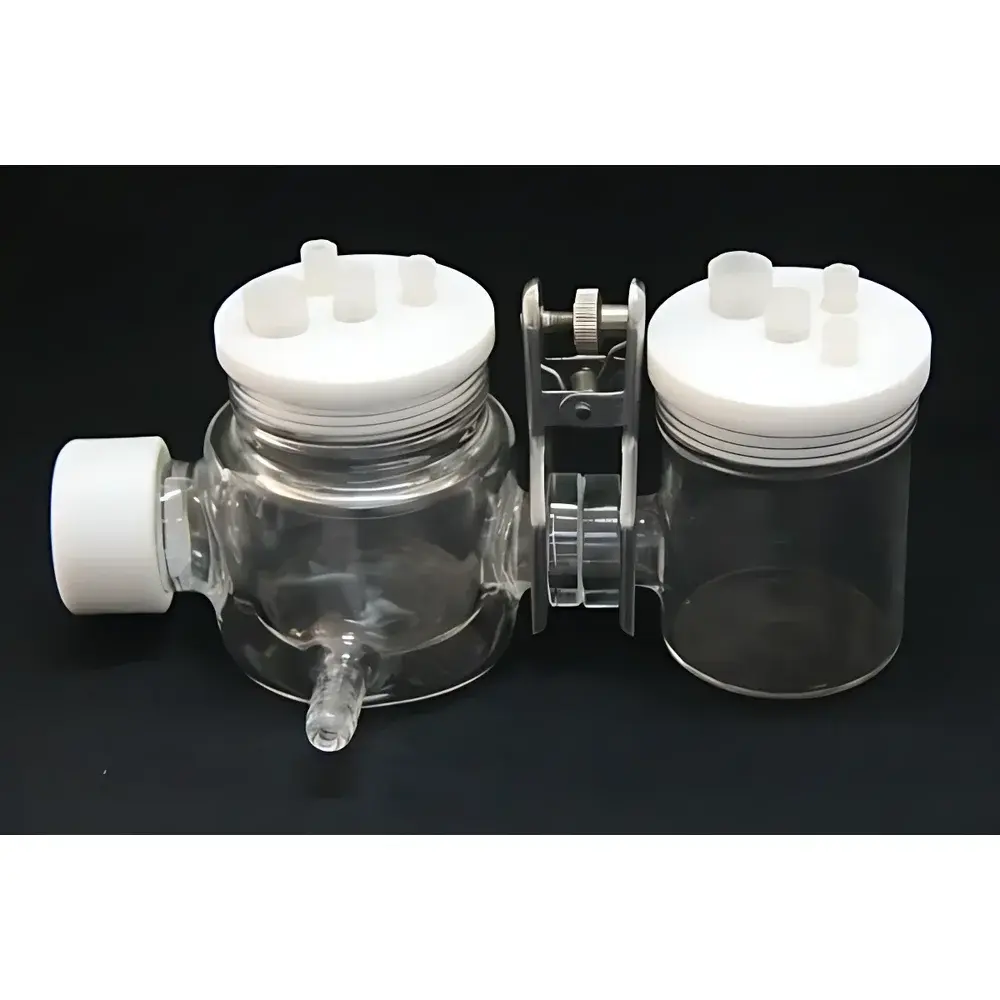
PECK11S Dual-Port Temperature-Controlled Photoelectrochemical H-Cell (Sealed)
| Brand | Cinch Photonics |
|---|---|
| Origin | Beijing, China |
| Manufacturer Type | OEM Producer |
| Origin Category | Domestic (China) |
| Model | PECK11S |
| Unit Price | USD 1,280 |
| Component Category | Optical & Electrochemical Cell Assembly |
| Cell Volume | 50 mL |
| Construction | Borosilicate Glass Body |
| Top Seals | Two PTFE Caps with Threaded Electrode Ports |
| Quartz Optical Windows | Ø24 mm, UV-Grade Fused Silica |
| Electrode Compartment Isolation | Removable Ion-Exchange Membrane or Fritted Glass Disc (Porosity: #3–#4) |
| Temperature Control Method | Double-Jacketed Water Circulation (Compatible with LX/HX Series Recirculating Chillers) |
| Standard Electrodes | Pt Wire Counter Electrode, Ag/AgCl (3 M KCl) Reference Electrode, Pt Electrode Holder for Working Electrode |
| Customization Options | Adjustable Port Diameter/Quantity, Single-Compartment Volumes up to 150 mL, Optional Quartz or CaF₂ Windows |
Overview
The PECK11S Dual-Port Temperature-Controlled Photoelectrochemical H-Cell is a precision-engineered optical-electrochemical reaction vessel designed for rigorous photoelectrocatalytic and interfacial charge-transfer studies under controlled thermal and illumination conditions. Its sealed H-type architecture physically separates the anodic and cathodic compartments using either a replaceable ion-exchange membrane or a sintered glass frit—enabling independent electrolyte composition, pH control, and redox environment management while maintaining electrochemical continuity. The cell operates on the principle of spatially resolved photoelectrochemical impedance spectroscopy (PEIS), transient photocurrent analysis, and wavelength-resolved action spectrum measurement. Constructed from high-purity borosilicate glass (e.g., Pyrex®-equivalent), it ensures chemical inertness toward common aqueous and non-aqueous electrolytes (e.g., 0.1–1.0 M Na₂SO₄, LiPF₆ in EC/DMC, or CH₃CN-based redox mediators). The dual quartz optical windows (UV-grade fused silica, Ø24 mm, transmission range: 190–2500 nm) permit collimated or focused illumination from either side, supporting both front-side and back-side irradiation configurations in three-electrode potentiostatic setups.
Key Features
- Borosilicate glass body with chemically resistant PTFE threaded caps ensuring long-term sealing integrity and minimal outgassing under vacuum or inert atmosphere (N₂/Ar glovebox compatible)
- Double-jacketed thermal control design enabling precise temperature regulation (±0.2 °C stability) via external recirculating chiller (LX-100 or HX-300 series recommended)
- Modular electrode port system: two independently sealable ports accommodate standard 6 mm OD electrodes; port diameter and thread pitch customizable per user-specified electrode geometry
- Interchangeable isolation elements: pre-aligned ion-exchange membrane holder (Nafion® 117 compatible) or removable sintered glass disc (porosity #3–#4, pore size 10–16 µm) for controlled ion diffusion rates
- Integrated electrode mounting hardware: corrosion-resistant Pt electrode clamp (spring-loaded, adjustable torque), Pt wire counter electrode (10 cm length, 0.5 mm diameter), and Ag/AgCl reference electrode (3 M KCl filling solution, 200 mV vs. SHE calibration traceable to NIST SRM 1290)
- Optical alignment compatibility: flange-mounted design with ISO-KF 25 vacuum flange interface option available for integration into UHV-compatible photoelectrochemical chambers
Sample Compatibility & Compliance
The PECK11S cell supports heterogeneous photoelectrode substrates including FTO-, ITO-, or Au-coated glass slides (up to 25 × 75 mm), Si nanowire arrays, BiVO₄ thin films, and perovskite-coated conductive ceramics. It accommodates viscous electrolytes (up to 100 cP) and low-volatility solvents (e.g., DMSO, ethylene glycol) without leakage. All wetted materials comply with USP Class VI biocompatibility standards and meet ISO 10993-5 cytotoxicity requirements. The cell design conforms to ASTM E1711 (standard test method for photoelectrochemical efficiency evaluation) and supports GLP-compliant experimental documentation when used with FDA 21 CFR Part 11–enabled potentiostats (e.g., BioLogic SP-300 or Metrohm Autolab PGSTAT302N).
Software & Data Management
While the PECK11S is a passive cell component, its mechanical and thermal specifications are fully integrated into standard electrochemical software platforms (EC-Lab®, NOVA®, GPES). Temperature setpoints from external chillers can be logged synchronously with current/potential data via analog voltage output (0–10 V = 0–50 °C). All customization records—including port configuration, window material selection, and volume modification—are archived in the manufacturer’s QC database with unique serial-number traceability. Calibration certificates for included reference electrodes are supplied with NIST-traceable uncertainty budgets (< ±1.5 mV at 25 °C).
Applications
- Quantitative quantum yield determination of photoanodes (e.g., α-Fe₂O₃, WO₃) under AM 1.5G illumination
- In situ Raman spectroelectrochemistry of catalyst surface intermediates during CO₂ reduction
- Thermally activated charge recombination kinetics in dye-sensitized solar cells (DSSCs)
- pH-dependent flat-band potential measurements via Mott-Schottky analysis
- Long-term stability testing of protective coatings on Si photocathodes (100+ h continuous operation)
- Multi-wavelength incident photon-to-current efficiency (IPCE) mapping across UV–Vis–NIR ranges
FAQ
Can the PECK11S be operated under positive pressure or vacuum?
Yes—the glass body and PTFE seals are rated for ±0.5 bar differential pressure; optional Viton O-rings and reinforced flange kits extend compatibility to ±1.0 bar.
Is the quartz window bonded or mechanically clamped?
Mechanically clamped with PTFE gaskets; no adhesives are used to preserve UV transmission integrity and enable field replacement.
What is the maximum operating temperature with standard PTFE caps?
80 °C continuous; for >80 °C applications, optional PEEK caps and Kalrez® gaskets are available (up to 200 °C).
How is electrical shielding achieved for low-noise photocurrent measurements?
The cell includes grounded copper mesh shielding sleeves for electrode leads and optional Faraday cage mounting brackets.
Does the manufacturer provide validation protocols for GMP-relevant experiments?
Yes—custom IQ/OQ documentation packages (including dimensional inspection reports, leak-test logs, and optical transmission spectra) are available upon request.




