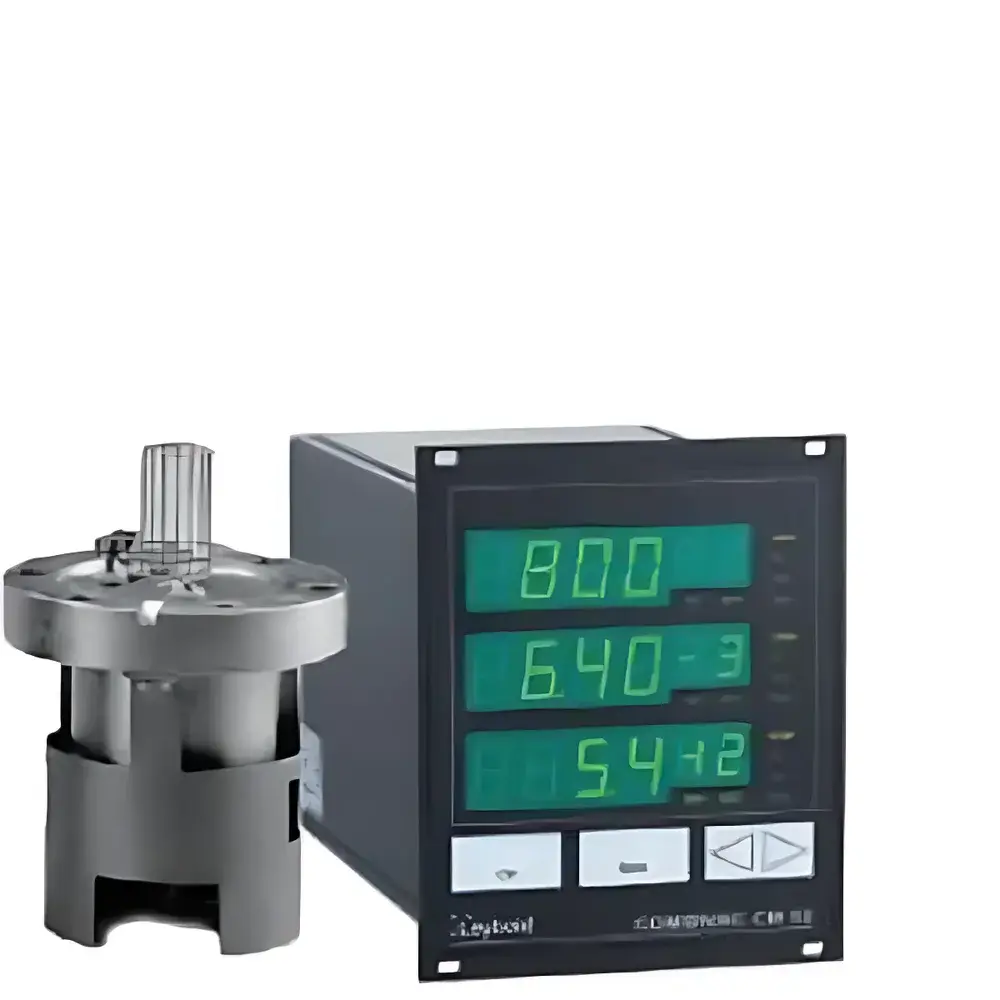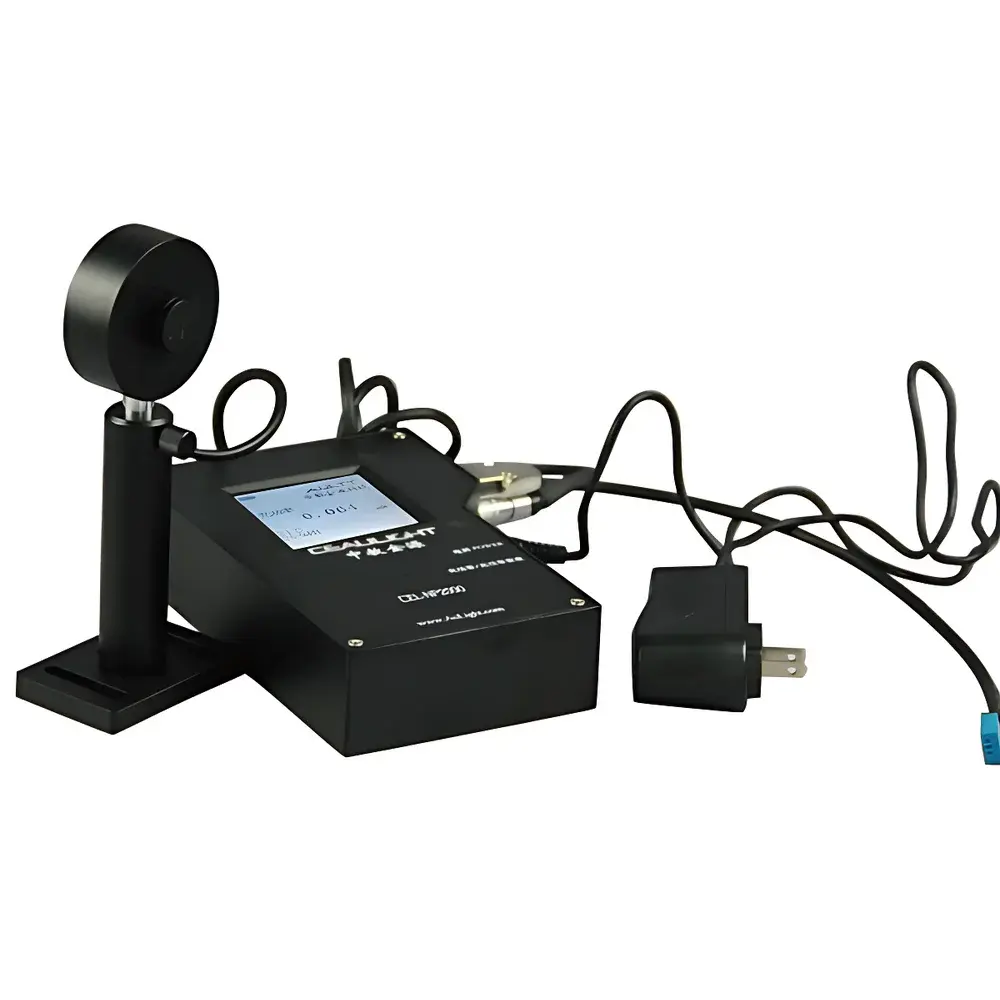
CEL-NP2000 Full-Spectrum High-Intensity Optical Power Meter
| Brand | CEL (Zhongjiao Jin Yuan) |
|---|---|
| Origin | Beijing, China |
| Manufacturer Type | OEM Manufacturer |
| Model | CEL-NP2000-2 |
| Measurement Range | 0–2,000 mW/cm² |
| Spectral Range | 190 nm – 2.5 µm (uniform response), extendable to 11,000 nm with calibration correction |
| Resolution | 1 µW |
| Response Time | < 0.4 s |
| Thermal Drift | < ±1% FS over 10 min |
| Accuracy | ±5% |
| Detector Active Area | Ø10 mm (0.75 cm²) |
| Max Power Density Tolerance | 200 W/cm² |
| Auto-ranging | 4 ranges (2 mW / 20 mW / 200 mW / 2000 mW) |
| Output | Digital LCD + Analog (1–1999 mV) |
| Power Supply | Rechargeable Li-ion battery + AC adapter (220 V, 50 Hz) |
Overview
The CEL-NP2000 Full-Spectrum High-Intensity Optical Power Meter is a precision radiometric instrument engineered for quantitative measurement of continuous-wave (CW) optical power and irradiance across an exceptionally broad spectral domain—from deep ultraviolet (190 nm) through visible light to near- and mid-infrared (up to 2.5 µm with flat spectral uniformity; extended calibration support available up to 11,000 nm). Based on thermopile and calibrated photodiode hybrid detection architecture, the system delivers high linearity, low thermal drift, and rapid transient response—critical for applications demanding stable, repeatable irradiance quantification under high-flux illumination conditions. Unlike conventional photometers limited to narrow bands or requiring frequent filter swaps, the CEL-NP2000 series integrates a proprietary wideband absorber coating and temperature-compensated signal conditioning circuitry to maintain ±5% measurement uncertainty across its primary operational range (190 nm–2.5 µm), without manual wavelength correction within this band. It is designed for laboratory-grade deployment in photobiological safety testing, laser processing monitoring, solar simulator validation, optical material damage threshold assessment, and medical phototherapy dosimetry.
Key Features
- Full-spectrum coverage from 190 nm to 11,000 nm, with factory-calibrated flatness ≤ ±2.7% across 190–2500 nm
- High-power-density tolerance: detector head rated for continuous exposure up to 200 W/cm²
- Auto-ranging digital measurement with four selectable full-scale ranges (2 mW, 20 mW, 200 mW, 2000 mW) ensuring optimal resolution for both weak and intense sources
- Sub-millisecond response time (< 0.4 s) and minimal thermal drift (< ±1% of full scale over 10 minutes at 25 °C)
- Dual-mode output: real-time LCD display of absolute power (mW) and irradiance (mW/cm²), plus analog voltage output (1–1999 mV) compatible with DAQ systems and oscilloscopes
- Integrated environmental sensing: simultaneous on-screen display of ambient temperature and relative humidity during operation
- Portable design with rechargeable lithium-ion battery and universal AC adapter (220 V, 50 Hz), enabling field-deployable measurements under GLP-compliant conditions
Sample Compatibility & Compliance
The CEL-NP2000 supports direct irradiance measurement of collimated and divergent beams from lasers, arc lamps, LED arrays, solar simulators, and broadband thermal sources. Its Ø10 mm active-area detector (CEL-NP2000-2) ensures spatial uniformity and minimizes edge effects for beam diameters ≥ 8 mm. The instrument complies with core radiometric traceability principles aligned with ISO/IEC 17025 requirements for calibration laboratories. While not certified to IEC 62471 (Photobiological Safety) or ANSI Z136.1 out-of-the-box, its documented spectral responsivity, uncertainty budget (±5%), and NIST-traceable calibration certificate (provided with each unit) enable end users to establish compliant measurement protocols per FDA guidance for phototherapy devices, ASTM E927-21 (Standard Specification for Solar Simulation for Photovoltaic Testing), and ISO 17025-accredited internal QA procedures. All firmware and calibration data are stored in non-volatile memory to support audit-ready documentation.
Software & Data Management
The CEL-NP2000 features bidirectional RS232/USB communication for live data streaming to host PCs. Optional CEL-DataLog software (Windows-compatible) provides real-time plotting, time-stamped data logging, batch export to CSV/Excel, and user-defined alarm thresholds. Software-generated reports include metadata such as timestamp, ambient conditions, detector serial number, and calibration expiration date—supporting 21 CFR Part 11 compliance when deployed with electronic signature modules and audit trail configuration. Raw analog outputs may be integrated into LabVIEW, MATLAB, or Python-based control environments via standard ADC interfaces. Firmware updates are delivered via secure HTTPS download and validated using SHA-256 checksums.
Applications
- Calibration and verification of solar simulators (Class AAA, ABA, AAB per IEC 60904-9)
- UV-C germicidal lamp output monitoring in biosafety cabinets and disinfection systems
- Laser-induced damage threshold (LIDT) pre-screening of optical coatings and substrates
- Quantitative dosimetry in dermatological and ophthalmic photomedicine
- Radiation stability testing of photovoltaic materials and perovskite solar cells
- Optical safety assessments per EN 62471 and ANSI RP-27.1 for high-intensity lighting systems
- In-process irradiance control during UV-curing, laser annealing, and additive manufacturing
FAQ
What is the difference between CEL-NP2000-2 and CEL-NP2000-10?
The CEL-NP2000-2 uses a Ø10 mm detector (0.75 cm² active area) optimized for irradiance up to 2,000 mW/cm², while the CEL-NP2000-10 employs a larger Ø20 mm detector (3 cm²) supporting up to 10,000 mW/cm²—both share identical spectral response, resolution (1 µW), and thermal stability specifications.
Can the instrument measure pulsed lasers?
No—it is designed exclusively for continuous-wave (CW) or quasi-CW sources with duty cycles > 95%. Pulse energy or peak power measurement requires a dedicated pyroelectric or fast photodiode-based meter.
Is NIST-traceable calibration included?
Yes—each unit ships with a factory calibration certificate referencing NIST-traceable standards, valid for 12 months under normal use conditions.
How is spectral correction handled outside 190–2500 nm?
For wavelengths beyond 2.5 µm (e.g., CO₂ laser at 10.6 µm), users apply manufacturer-provided correction factors derived from monochromator-based calibration data; these are embedded in the optional software.
Does the device meet GLP/GMP documentation requirements?
When used with CEL-DataLog configured for electronic signatures, audit trails, and version-controlled calibration files, it satisfies core GLP and GMP data integrity expectations per ALCOA+ principles.