CEL-RCCN & CEL-RCCO Single-Crystal and Multi-Crystal Silicon Reference Solar Cells
| Brand | CEL (Zhongjiao Jinyuan) |
|---|---|
| Model | CEL-RCCN (monocrystalline), CEL-RCCO (polycrystalline) |
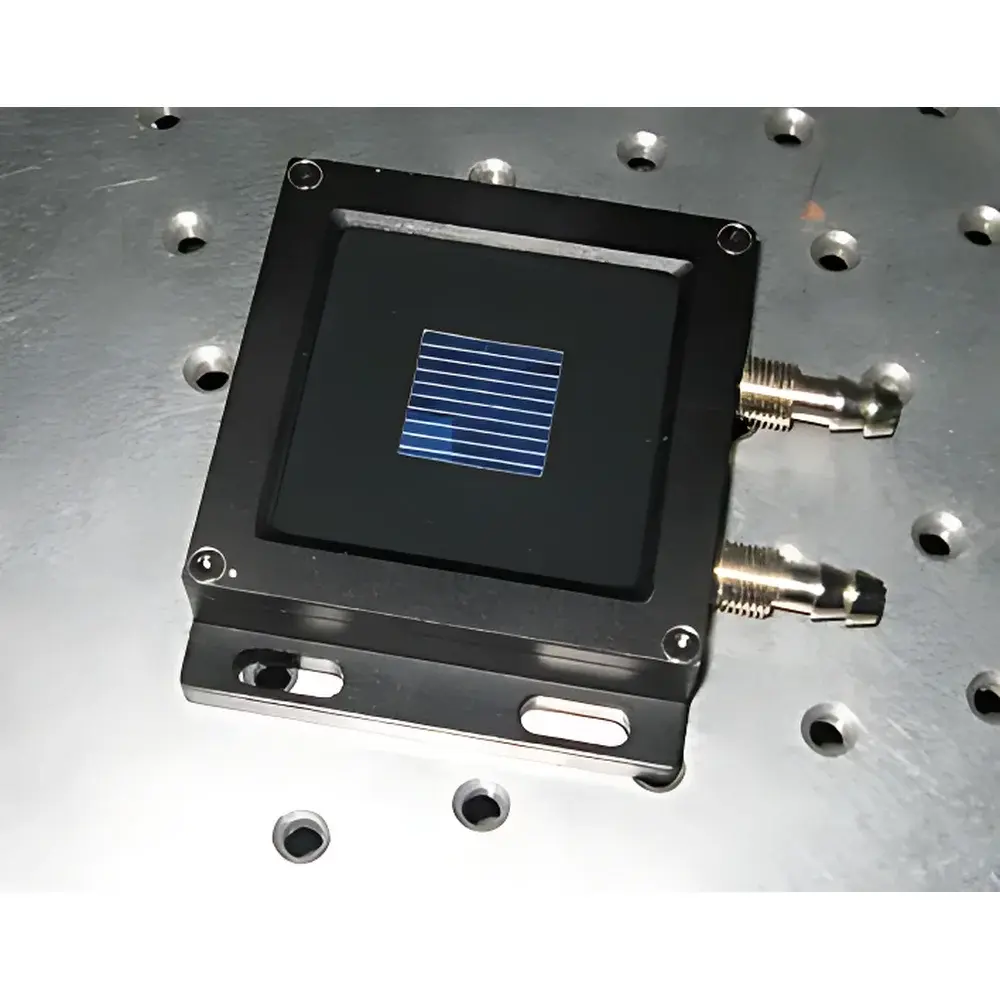
| Active Area | 20 mm × 20 mm |
| Spectral Response Range | 400–1100 nm |
| Calibration Irradiance | 1000 W/m² (AM1.5G) |
| Calibration Temperature | 25 °C ± 0.1 °C |
| Temperature Sensor | Calibrated Pt100 RTD (4-wire Kelvin connection) |
| Window Material | Space-grade radiation-hardened glass with refractive-index-matched optical adhesive |
| Enclosure Dimensions | 70 mm × 70 mm × 20 mm (aluminum baseplate) |
| CV Value Unit | A/(W·m⁻²) |
| Short-Circuit Current Temperature Coefficient α | typical –0.05 to –0.07 mA/°C |
| Open-Circuit Voltage Temperature Coefficient β | typical –2.0 to –2.5 mV/°C |
| Max Operating Current | 200 mA |
| Operating Temperature Range | 10–40 °C |
| Stability | Short-circuit current drift ≤ ±0.5% over 1,000 h under continuous illumination |
| Efficiency (STC) | ≥16% (monocrystalline), ≥15.2% (polycrystalline) |
| Fill Factor (FF) | ≥0.70 |
| Traceability | NIST-traceable calibration per ISO/IEC 17025-accredited laboratory |
| Certification | Individual test report with expanded uncertainty (k=2), full metrological traceability statement, and compliance documentation for IEC 60904-2, IEC 60904-3, and ASTM E1021 |
Overview
The CEL-RCCN and CEL-RCCO reference solar cells are primary irradiance transfer standards engineered for high-accuracy, long-term stability in photovoltaic (PV) calibration laboratories and solar simulator validation workflows. These devices operate on the fundamental principle of photovoltaic quantum conversion: incident photons within the 400–1100 nm spectral band generate electron-hole pairs in crystalline silicon, producing a short-circuit current (Isc) linearly proportional to irradiance under controlled thermal conditions. Each unit is fabricated from spectrally characterized monocrystalline (CEL-RCCN) or multicrystalline (CEL-RCCO) silicon wafers, subjected to accelerated aging and rigorous electro-optical screening to select only those exhibiting <±0.5% Isc drift over 1,000 hours of stabilized illumination. The active area—precisely 20 mm × 20 mm—is hermetically sealed within an aluminum housing featuring a space-qualified, radiation-resistant cover glass bonded using index-matched UV-curable optical adhesive to minimize Fresnel losses and spectral distortion. This architecture ensures minimal spectral responsivity deviation across AM1.5G reference spectra and enables reliable use in Class AAA solar simulators, xenon arc sources, and LED-based spectral irradiance systems.
Key Features
- Two certified variants: CEL-RCCN (monocrystalline Si) and CEL-RCCO (polycrystalline Si), both calibrated to IEC 60904-2 and ASTM E1021 requirements
- Integrated, factory-calibrated Pt100 platinum resistance thermometer (4-wire Kelvin configuration) for real-time temperature compensation with ±0.1 °C uncertainty at 25 °C
- Hermetic aluminum enclosure (70 × 70 × 20 mm) with thermal mass optimization to suppress transient temperature gradients during rapid irradiance changes
- Space-grade anti-radiation cover glass window with AR coating, transmitting >92% across 400–1100 nm and maintaining spectral fidelity under prolonged UV exposure
- Kelvin-connected LEMO connectors for both current/voltage (I/V) and temperature measurement circuits—eliminating lead resistance errors in low-impedance Isc measurement
- Traceable calibration certificate issued by an ISO/IEC 17025-accredited laboratory, including expanded uncertainty (k = 2), measurement conditions, and full metrological chain to NIST SRM 2231
Sample Compatibility & Compliance
These reference cells are compatible with all standard PV testing configurations requiring irradiance monitoring or source uniformity verification—including flash testers, continuous-output solar simulators, and spectral radiometers. Their AM1.5G spectral response aligns with IEC 60904-3 Ed. 3 (2023) and ASTM G173-03 reference spectra. The mechanical design conforms to IEC 60904-2 mounting specifications for reference device interchangeability. All units undergo environmental stress screening per MIL-STD-883H Method 1008 (thermal cycling) and Method 1019 (humidity bias). Certificates explicitly state compliance with ISO/IEC 17025:2017 clause 6.5 (traceability), GLP-relevant audit trails for calibration history, and data integrity provisions aligned with FDA 21 CFR Part 11 for electronic records in regulated PV R&D environments.
Software & Data Management
Each cell ships with a digital calibration record in PDF and CSV formats, containing raw Isc, Voc, FF, and temperature-compensated CV values at 1000 W/m². The CV value (A·m²/W) is reported with full uncertainty budgeting—including Type A (statistical repeatability) and Type B (reference standard, temperature sensor, spectral mismatch) components. Integration-ready metadata supports automated import into LabVIEW, Python (via PyVISA), MATLAB, and commercial PV characterization platforms (e.g., PVsyst, PVMismatch). Optional API access enables direct synchronization with LIMS systems for audit-compliant calibration log management, including version-controlled revision history and electronic signature fields compliant with 21 CFR Part 11.
Applications
- Primary irradiance calibration of Class A+, B+, and C solar simulators per IEC 60904-9
- Real-time feedback control loop input for closed-loop irradiance stabilization systems
- Validation of spectral mismatch corrections in multi-junction or perovskite-Si tandem cell testing
- Reference transfer between national metrology institutes (NMIs) and accredited PV labs
- Long-term stability monitoring of light sources in accelerated lifetime testing chambers (e.g., IEC 61215-2 MQT 10)
- Uncertainty propagation modeling in PV module power rating accreditation (IEC 61853-1)
FAQ
What is the difference between CEL-RCCN and CEL-RCCO?
CEL-RCCN uses float-zone monocrystalline silicon with higher carrier lifetime and narrower spectral responsivity variation; CEL-RCCO employs cast multicrystalline silicon with broader grain-boundary-induced spectral response—both calibrated independently to their respective AM1.5G quantum efficiency curves.
Can these cells be used outdoors?
No. They are designed strictly for controlled indoor calibration environments. Outdoor exposure violates IEC 60904-2 handling protocols and voids calibration validity due to uncontrolled temperature, soiling, and spectral shift effects.
How often does recalibration recommended?
Annual recalibration is advised for ISO/IEC 17025 compliance; however, stability monitoring via quarterly Isc checks against baseline is required under GLP/GMP PV testing protocols.
Is the CV value temperature-dependent?
Yes—the published CV is valid only at 25 °C. The certificate includes α and β coefficients for real-time correction using the integrated Pt100 sensor output.
Do these cells meet FDA or EU regulatory requirements for PV medical device testing?
While not medical devices themselves, their calibration traceability satisfies Annex I MDR (EU 2017/745) requirements for measurement infrastructure used in photobiomodulation or solar-powered implantable charger validation when deployed within a validated QMS.