
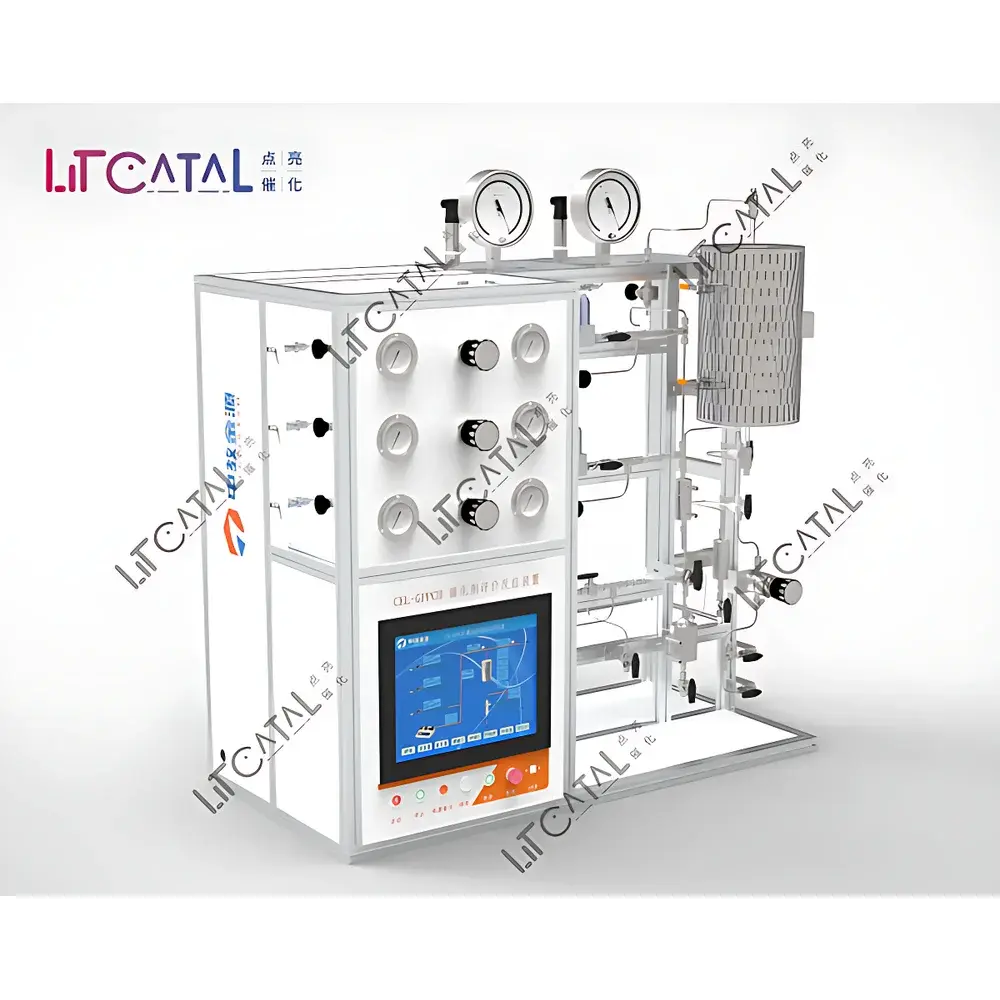
CEL-GPPCH Fixed-Bed Catalyst Evaluation Reactor System (Custom-Engineered)
| Brand | CEAULIGHT |
|---|---|
| Origin | Beijing, China |
| Manufacturer Type | Direct Manufacturer |
| Region of Origin | Domestic (China) |
| Model | CEL-GPPCH Fixed-Bed Catalyst Evaluation Reactor System (Custom-Engineered) |
| Pricing | Upon Request |
| Frame Dimensions | 1130 mm × 550 mm × 1000 mm |
| Construction Material | ASTM A240 Grade 316L Stainless Steel |
| Reactor Temperature Range | 0–800 °C |
| Vaporization Zone Temperature Range | 0–300 °C |
| Tubing Trace Heating Range | 0–200 °C |
| Maximum Operating Pressure | < 10 MPa |
| Liquid Flow Rate Range | 0.1–5 mL/min |
| Catalyst Bed Volume Capacity | < 5 mL |
| Gas Flow Channels (Configurable) | 0–5 sccm |
Overview
The CEL-GPPCH Fixed-Bed Catalyst Evaluation Reactor System is a modular, custom-engineered laboratory-scale catalytic testing platform designed for rigorous kinetic assessment, activity screening, and stability evaluation of heterogeneous catalysts under controlled gas-phase, liquid-phase, or simultaneous gas–liquid feed conditions. It operates on the fundamental principle of steady-state and transient-state fixed-bed reactor kinetics, enabling precise control over reaction thermodynamics (temperature), hydrodynamics (mass flow), and thermobaric boundary conditions (pressure). The system supports both isothermal and programmed temperature ramping (linear heating profiles), with programmable hold times—critical for TPR, TPD, and accelerated deactivation studies. Its integrated architecture accommodates seamless coupling with external analytical instrumentation—including GC, GC-MS, HPLC, and online MS—enabling real-time, time-resolved product speciation across variable pressure–temperature–space velocity domains.
Key Features
- Full automation via embedded industrial touchscreen PC running proprietary reactor control software with PID-based closed-loop regulation of temperature, pressure, and flow parameters.
- Dual-pressure architecture: independent low-pressure (<1 MPa) and high-pressure (<10 MPa) subsystems, each equipped with proportional relief valves, calibrated pressure transducers (0.1% FS accuracy), and Class 1.6 stainless steel Bourdon-tube gauges.
- Multi-zone thermal management: independently controlled reactor furnace (0–800 °C), vaporizer (0–300 °C), and trace-heated stainless-steel tubing (0–200 °C) to prevent condensation and ensure plug-flow integrity.
- Safety-critical interlocks: hardware-level over-temperature and over-pressure cutoffs with automatic valve isolation, audible/visual alarms, and fail-safe shutdown protocols compliant with IEC 61511 SIL 1 requirements.
- Compact benchtop footprint (1130 × 550 × 1000 mm) with structural frame fabricated from anodized 6063-T5 aluminum extrusions and load-bearing 316L SS components—optimized for vibration damping and long-term mechanical stability.
- Scalable gas delivery: up to three independent mass flow controllers (MFCs) supporting ranges from 0–5 sccm (high-precision microflow) to 0–100 sccm (macroflow), all traceable to NIST standards.
Sample Compatibility & Compliance
The CEL-GPPCH system is validated for use with powdered, pelletized, or monolithic solid catalysts (bed volume ≤ 5 mL), accommodating both supported and unsupported formulations (e.g., Pt/Al2O3, Ni/SiO2, Co-Mo/γ-Al2O3). It supports ASTM D3226 (catalyst activity testing), ISO 11717-1 (high-temperature reactor safety), and USP (chromatographic method transfer compatibility). All wetted parts conform to ASME B31.3 process piping standards; pressure vessels are CE-marked per PED 2014/68/EU. Data acquisition and audit trails comply with FDA 21 CFR Part 11 requirements when operated with optional electronic signature modules and time-stamped raw data logging.
Software & Data Management
The system runs on a deterministic real-time control kernel interfaced with a Windows-based HMI application. It records timestamped process variables (T, P, Fgas, Fliq, ΔPbed) at ≥1 Hz resolution, stores metadata (operator ID, batch ID, protocol version), and exports structured CSV/Excel reports with customizable templates. Integrated OPC UA server enables bidirectional communication with LIMS and ELN platforms. Raw signal logs include full sensor diagnostics (e.g., RTD resistance, MFC voltage output, transducer mV readings), supporting GLP-compliant root-cause analysis during regulatory audits.
Applications
- Hydrogenation/dehydrogenation kinetics (e.g., selective alkyne semi-hydrogenation)
- Acid-catalyzed reactions (e.g., methanol-to-hydrocarbons, MTG)
- CO2 hydrogenation to methanol or higher alcohols
- Ammonia synthesis and decomposition modeling
- Transient response analysis (step-change experiments, pulse chemisorption)
- Long-term stability testing under cyclic thermal/pressure stress
- Integration with TPR/TPD modules for surface characterization
FAQ
Can the CEL-GPPCH system be configured for corrosive feedstocks such as HCl or H2S?
Yes—upon specification, the system can be upgraded with Hastelloy C-276 tubing, Inconel 600 heaters, and fluoropolymer-sealed valves to ensure compatibility with halogenated and sulfur-containing streams.
Is remote monitoring and control supported?
Standard Ethernet/IP connectivity enables secure remote access via VPN; optional VNC-based supervision and alarm forwarding via SMTP/SNMP are available.
Does the system support integration with third-party GC or MS instruments?
Yes—digital I/O ports and Modbus TCP interfaces allow synchronized start/stop triggering, retention time alignment, and automated peak integration mapping within the control software.
What validation documentation is provided with delivery?
Each unit ships with Factory Acceptance Test (FAT) report, calibration certificates for all MFCs and pressure sensors (NIST-traceable), material test reports (MTRs) for 316L SS components, and a complete IQ/OQ protocol package.
Can catalyst bed geometry be modified for radial-flow or multi-tubular configurations?
As a custom-engineered system, CEL-GPPCH supports bespoke reactor insert designs—including annular beds, segmented zones, and thermocouple-integrated cartridges—subject to mechanical and thermal feasibility review.






