
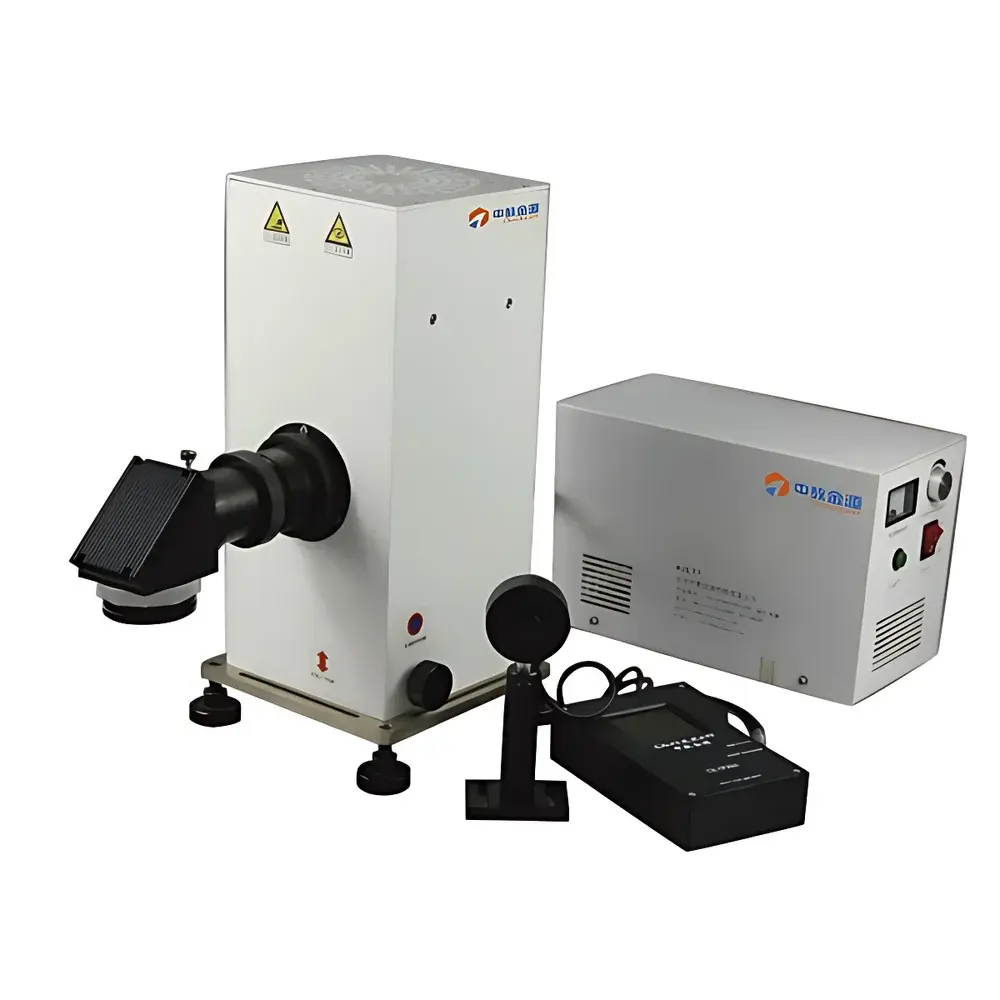
CEL-S350 Solar-Simulating Xenon Arc Lamp Source
| Brand | CEAULIGHT (Zhongjiaojinyuan) |
|---|---|
| Origin | Beijing, China |
| Manufacturer Type | OEM Manufacturer |
| Light Source Type | Short-Arc Xenon Lamp (350 W) |
| Illumination Mode | External Irradiation |
| Cooling Method | Forced-Air Convection |
| Color Temperature | 6000 K |
| Spectral Match | AM1.5G Standard (IEC 60904-9 Ed. 3, ASTM G173-03) |
| Optical Output | Collimated Parallel Beam or Fiber-Coupled Output |
| Compatible Mounting Threads | SM25.4, SM50.8, M52, M62 |
| Safety Compliance | IEC 61000-4 Series (EMC), IEC 62471 (Photobiological Safety) |
Overview
The CEL-S350 Solar-Simulating Xenon Arc Lamp Source is a research-grade optical instrument engineered for high-fidelity solar spectrum replication in controlled laboratory environments. It employs a 350 W short-arc xenon lamp — a stable, high-brightness point source with a compact arc gap (85% in visible-NIR range), while eliminating external high-voltage cabling via an internal solid-state igniter—reducing electrical hazards and EMI coupling.
Key Features
- High-stability 350 W short-arc xenon lamp with <±0.5% intensity drift over 8 h (measured at 1000 nm, 100 mW/cm²)
- Optimized optical train featuring UV-grade fused silica lenses and ellipsoidal aluminum-coated reflector for enhanced collimation and spectral uniformity
- Integrated electronic igniter operating at ≤25 kV peak, fully enclosed within the lamp housing to meet IEC 61000-4-5 surge immunity requirements
- Forced-air thermal management with dual-speed PWM-controlled fans ensuring lamp junction temperature remains below 120°C during continuous operation
- AM1.5G spectral match certified per IEC 60904-9:2020 Annex D; spectral deviation <±5% across 350–1100 nm band (unfiltered)
- Modular mechanical interface supporting SM25.4, SM50.8, M52, and M62 optical mounts for universal compatibility with commercial filters, lenses, and beam-shaping accessories
Sample Compatibility & Compliance
The CEL-S350 is designed for use with standard photovoltaic test platforms, monochromator-coupled spectroscopic systems, and custom-built photochemical reactors. It supports direct irradiation of planar samples up to Ø100 mm and enables fiber-optic delivery (via optional SMA905 or FC/PC adapters) for remote or confined-space illumination. All optical components comply with ISO 10110 surface quality standards (scratch-dig 20–10), and the quartz envelope meets USP Class VI biocompatibility for light-exposure bioassays. The system satisfies essential safety and electromagnetic compatibility requirements per IEC 62471 (Risk Group 3 classification for UV exposure), IEC 61000-4-2 (ESD immunity), and IEC 61000-4-3 (radiated RF immunity). Full traceable calibration reports—including spectral irradiance (W/m²/nm), spatial uniformity (±3% over Ø50 mm), and temporal stability—are available upon request for GLP-compliant labs.
Software & Data Management
While the CEL-S350 operates as a standalone analog source, it features a 0–5 V analog control input for external intensity modulation and TTL-compatible trigger output for synchronization with data acquisition systems (e.g., lock-in amplifiers, oscilloscopes, or spectrometer gating). Optional USB-to-analog interface modules enable integration into LabVIEW, Python (PyVISA), or MATLAB-based automation frameworks. All accessory configurations—including AM1.5G filter sets, collimating lens assemblies, and adjustable spot size apertures—are documented in machine-readable XML configuration files compliant with the IEEE 1851-2012 metadata standard for optical instrumentation.
Applications
- Quantum efficiency and external quantum efficiency (EQE) mapping of silicon, perovskite, organic, and tandem solar cells
- Photoelectrochemical impedance spectroscopy (PEIS) and transient photocurrent analysis of photoanodes/cathodes
- Time-resolved surface photovoltage (SPV) and Kelvin probe force microscopy (KPFM) excitation
- Photocatalytic degradation kinetics studies (e.g., TiO₂, g-C₃N₄, MOFs) under standardized solar irradiance
- UV–vis–NIR reflectance/transmittance measurements of anti-reflective coatings and transparent conductive oxides
- Biological photostimulation assays requiring reproducible broadband irradiance (e.g., circadian rhythm studies, photodynamic therapy screening)
FAQ
What is the spectral irradiance output at 1 sun (1000 W/m²) equivalent?
The CEL-S350 delivers up to 120 mW/cm² (1200 W/m²) at the exit port with collimating optics; precise 1-sun irradiance is achieved using calibrated neutral density filters or programmable attenuators.
Can the source be used with monochromators for action spectrum measurements?
Yes—its high radiance and point-source geometry ensure efficient coupling into 1/4 m or 1/8 m monochromators with typical throughput >65% in the 300–1000 nm range.
Is the AM1.5G filter included by default?
No—the AM1.5G spectral correction filter is an optional accessory (part number: CEL-AM15G-FIL); unfiltered output provides native xenon continuum for broad-band applications.
What maintenance is required for long-term stability?
Lamp replacement every 1000–1500 hours (depending on duty cycle); annual recalibration of spectral irradiance recommended for metrology-critical applications.
Does the system support remote monitoring of lamp voltage/current?
Analog monitoring outputs (0–5 V proportional to lamp current and cathode-anode voltage) are accessible via DB9 connector for real-time health diagnostics and predictive maintenance logging.





