
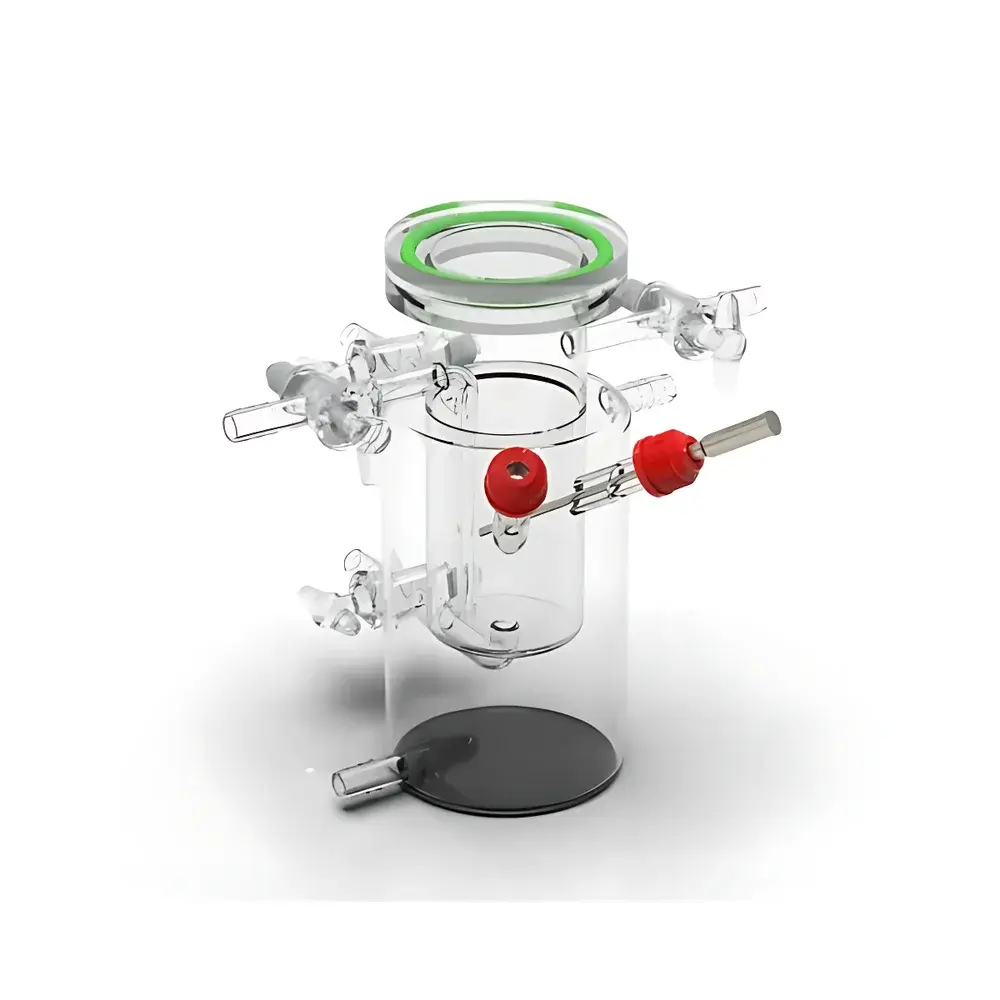
CEL-CTLC100 Circulating Photochemical Reactor with Integrated Temperature Control
| Brand | CEA (China Education Goldsource) |
|---|---|
| Origin | Beijing, China |
| Manufacturer Type | Direct Manufacturer |
| Country of Origin | China |
| Model | CEL-CTLC100 |
| Light Source Type | External Irradiation System (Xenon or Mercury Lamp Compatible) |
| Illumination Mode | External Irradiation |
| Reactor Volume | 250 mL |
| Reactor Material | Borosilicate Glass (一体成型 / monolithic construction) |
| Optical Window | UV-Grade Fused Quartz, Ø100 mm |
| Temperature Control | Integrated Liquid Circulation Jacket (±0.5 °C stability typical) |
| Sensor Port Diameter | 10–12 mm |
| Thermocouple Port Diameter | 3 mm |
| Gas Inlet | Bottom-submerged tube |
| Sampling/Instrumentation Ports | 2 × side-mounted NPT-threaded ports |
| Circulation Interface | Dedicated inlet/outlet for liquid or gas recirculation |
| Pressure Rating | Ambient (1 atm) operation only |
| Sealing | Dual O-ring flange assembly with corrosion-resistant elastomers |
Overview
The CEL-CTLC100 Circulating Photochemical Reactor with Integrated Temperature Control is an engineered platform designed for reproducible, temperature-stabilized photochemical experimentation under visible and ultraviolet irradiation. It operates on the principle of external irradiation—where high-intensity light sources (e.g., 300 W xenon arc lamps or medium-pressure mercury vapor lamps) are positioned outside the reactor vessel, delivering photons through a large-diameter UV-grade fused quartz window (Ø100 mm). This optical architecture minimizes thermal load on the reaction mixture while maximizing photon flux transmission across 190–400 nm (UV) and 400–800 nm (visible) spectral ranges. The reactor features a monolithic borosilicate glass body with an integrated double-wall circulation jacket, enabling precise thermal regulation via external chiller or thermostat units. Temperature uniformity is maintained within ±0.5 °C across the active reaction zone under steady-state conditions—a critical parameter for kinetic studies, photocatalytic quantum yield determination, and comparative catalyst screening.
Key Features
- Monolithic borosilicate glass construction ensures chemical inertness, thermal shock resistance, and optical clarity for real-time visual monitoring.
- UV-transmitting fused quartz window (Ø100 mm) provides >90% transmittance from 190 nm to 2.5 µm, compatible with both broadband and filtered excitation setups.
- Integrated liquid circulation jacket supports connection to external temperature control units (TCUs) for active heating or cooling; compatible with ethylene glycol/water or silicone oil media.
- Two side-mounted NPT-threaded ports (¼” NPT) accommodate insertion of calibrated Pt100 thermocouples (Ø3 mm), pH/ORP probes, dissolved oxygen sensors, or fiber-optic spectrometers.
- Bottom-submerged gas inlet tube enables efficient sparging of reactant gases (e.g., H₂, O₂, CO₂, Ar) directly into the reaction slurry or solution, minimizing bubble coalescence and enhancing mass transfer.
- Dual-purpose ports serve as sampling interfaces or in situ probe mounts—enabling time-resolved analysis without system depressurization or interruption.
- Gas and liquid recirculation capability via dedicated inlet/outlet fittings supports continuous-flow photoreactor configurations and closed-loop gas-phase catalysis studies.
- Corrosion-resistant fluorocarbon O-rings (FKM) are supplied for all sealing interfaces—including flange joints, sensor sleeves, and thermocouple bushings—ensuring long-term integrity under acidic, basic, or oxidative environments.
Sample Compatibility & Compliance
The CEL-CTLC100 accommodates heterogeneous photocatalytic suspensions (e.g., TiO₂, g-C₃N₄, MOFs), homogeneous molecular systems (e.g., Ru(bpy)₃²⁺, Ir(ppy)₃), and gas–liquid interfacial reactions (e.g., CO₂ photoreduction, water splitting). Its ambient-pressure design complies with standard laboratory safety protocols per IEC 61010-1. All wetted components meet USP Class VI and ISO 10993 biocompatibility criteria. While not certified for explosive atmospheres, the reactor may be operated inside ventilated fume hoods when handling volatile organics or H₂. Documentation supports GLP-compliant experimental recordkeeping when paired with validated temperature loggers and irradiance calibrators traceable to NIST standards.
Software & Data Management
The CEL-CTLC100 is hardware-native—no proprietary software is required for operation. However, it integrates seamlessly with third-party data acquisition systems (e.g., LabVIEW, MATLAB, or Python-based DAQ platforms) via analog voltage outputs from connected sensors. Users commonly deploy USB thermocouple interfaces (e.g., Omega HH309A) or industrial-grade PLCs to log temperature, pressure, and gas composition in real time. For regulatory environments requiring audit trails, integration with 21 CFR Part 11–compliant electronic lab notebooks (e.g., LabArchives, Benchling) is supported through CSV export and timestamped metadata tagging.
Applications
- Photocatalytic hydrogen evolution (HER) and oxygen evolution (OER) under simulated solar illumination.
- CO₂ photoreduction to CH₄, CO, or CH₃OH using plasmonic or doped semiconductor catalysts.
- Advanced oxidation processes (AOPs) for organic pollutant degradation (e.g., phenol, rhodamine B, pharmaceuticals).
- Photoinduced C–C coupling, [2+2] cycloadditions, and radical-mediated transformations in synthetic photochemistry.
- Stability and leaching studies of nanocatalysts under prolonged irradiation and thermal cycling.
- Quantum efficiency benchmarking (AQY) via actinometry (e.g., potassium ferrioxalate) at defined wavelengths.
FAQ
Is the CEL-CTLC100 compatible with high-pressure photochemical experiments?
No—it is rated exclusively for ambient-pressure operation (1 atm). For elevated pressure studies, consult the CEL-PTR series of sealed high-pressure photoreactors.
Can the quartz window be replaced with other optical materials?
Only UV-grade fused quartz is supplied and validated; alternatives (e.g., CaF₂, MgF₂) require custom machining and compromise mechanical integrity and thermal expansion matching.
What is the maximum recommended operating temperature?
The borosilicate glass body is rated to 150 °C; however, sustained operation above 80 °C requires verification of O-ring thermal limits and coolant compatibility.
Does the reactor include irradiance calibration tools?
No—irradiance measurement is performed externally using NIST-traceable power meters (e.g., Thorlabs S120VC) placed at the quartz window surface.
How is gas tightness verified prior to use?
Users perform helium leak testing via residual gas analyzer (RGA) or soap-bubble method on all flange joints and port seals before initial operation.



