
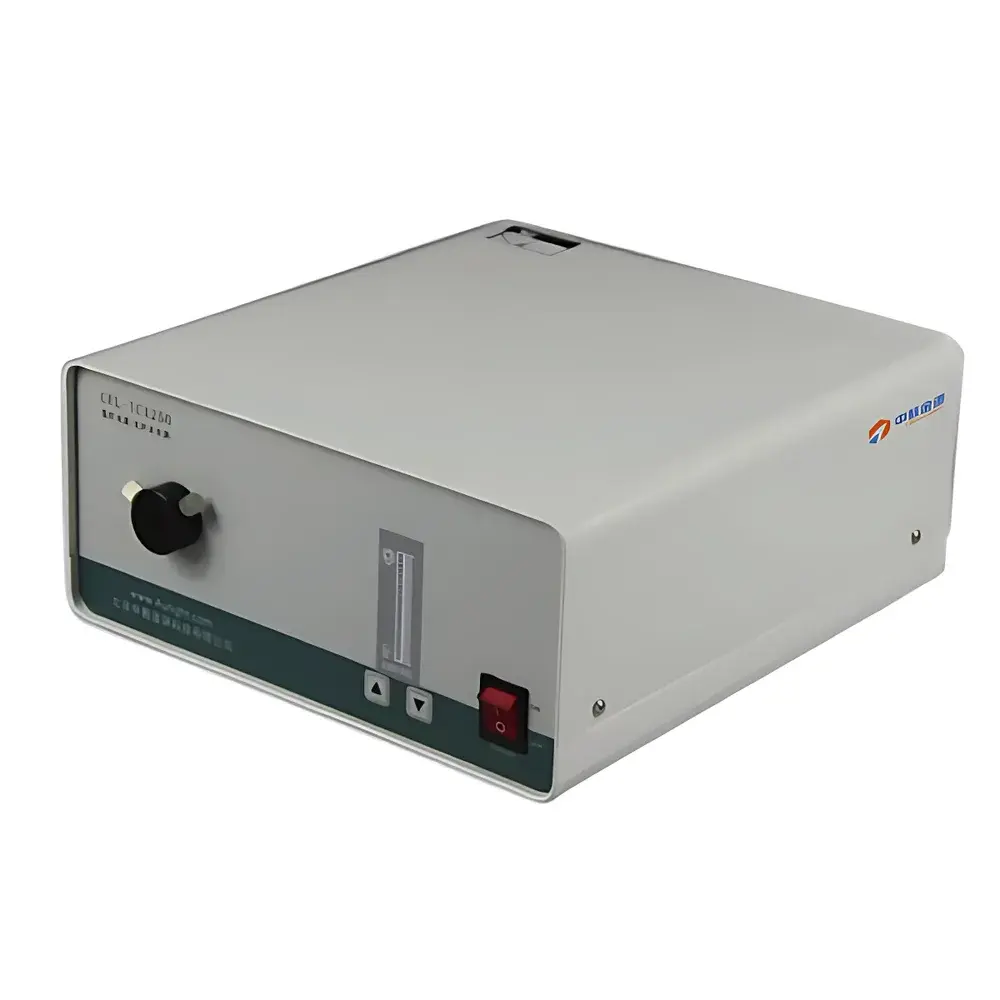
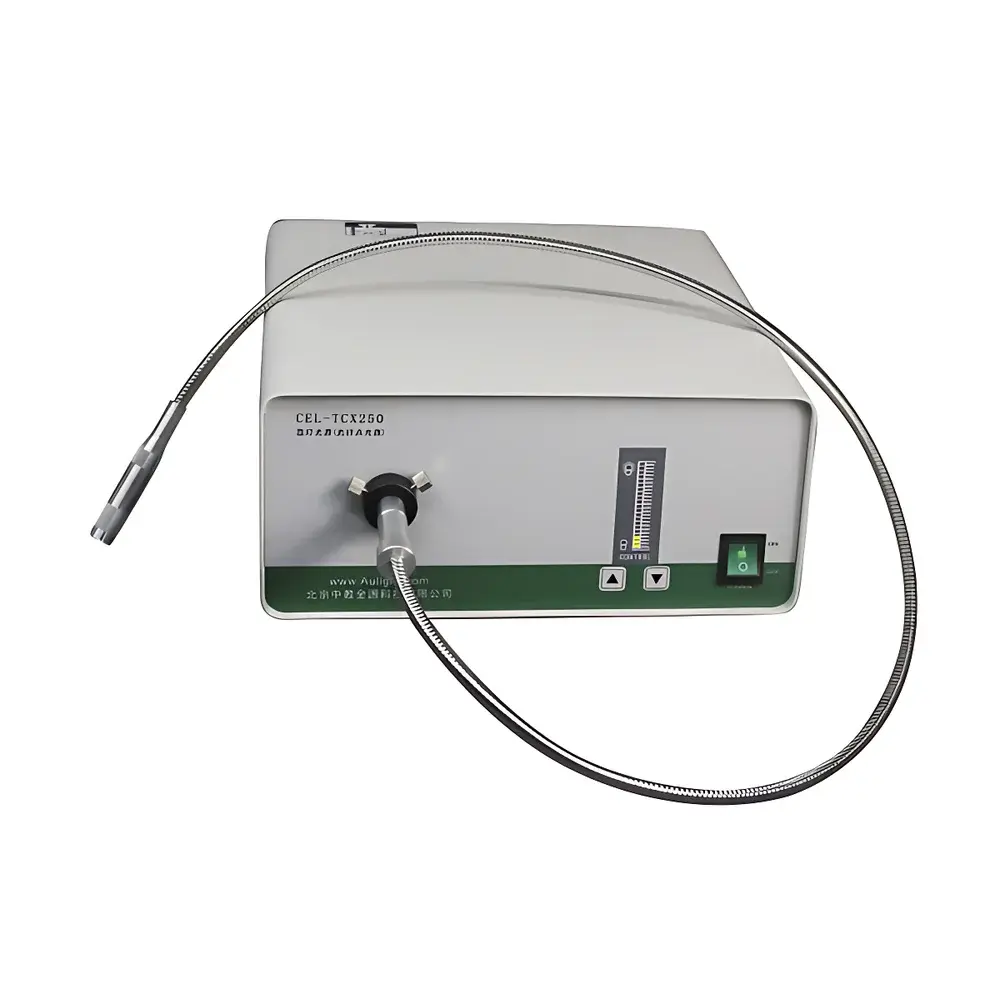
CEL-TCX250 Series Xenon Light Source
| Brand | CEL (China Education Goldsource) |
|---|---|
| Origin | Beijing, China |
| Manufacturer Type | Direct Manufacturer |
| Product Category | Domestic |
| Model | CEL-TCX250 |
| Light Source Type | Xenon Arc Lamp |
| Illumination Mode | External Irradiation |
| Power Rating | 250 W |
| Spectral Range | UV–Visible–NIR (200–1100 nm) |
| Color Temperature | ≥5600 K |
| Output Stability | <±1.5% over 8 h |
| Optical Output (Free-Space) | 0–1000 mW/cm² (measured with CEL-NP2000 radiometer) |
| Fiber-Coupled Output | 0–400 mW/cm² |
| Current Ripple | <0.3% RMS |
| Ground Leakage Current | ≤0.5 mA |
| Operating Ambient Temperature | −10 °C to +45 °C |
| Noise Level | ≤55 dB(A) |
| Protection Features | Overvoltage, Overcurrent, Short-Circuit Auto-Protection |
| Safety Class | IEC 60601-1 Class I BF |
| Input | AC 220 V ±20 V, 50 Hz ±1 Hz |
Overview
The CEL-TCX250 Series Xenon Light Source is a high-intensity, broadband external irradiation source engineered for precision optical applications requiring stable, solar-simulated illumination across the ultraviolet, visible, and near-infrared spectral regions (200–1100 nm). It employs a high-pressure short-arc spherical xenon lamp as its emission core—operating under controlled high-frequency, high-voltage ignition and regulated constant-current drive. This architecture ensures minimal arc wander, low temporal intensity fluctuation (<±1.5% over 8 hours), and excellent color fidelity (CCT ≥5600 K), closely approximating natural daylight in both spectral distribution and spatial coherence. Unlike continuous-wave halogen or LED sources, the TCX250 delivers true blackbody-like continuum output with strong UV emission—critical for photochemical activation, spectral calibration, and photobiological studies. Its robust electromagnetic compatibility design includes an integrated low-pass EMI filter at the AC input stage, mitigating interference from adjacent laboratory equipment and ensuring signal integrity during synchronized imaging, spectroscopy, or real-time dosimetry.
Key Features
- High-stability constant-current power supply with <0.3% RMS current ripple, enabling arc stability essential for quantitative irradiance applications
- Manually adjustable iris diaphragm (light baffle) for continuous, non-digital optical attenuation—preserving spectral balance without introducing diffraction artifacts
- Front-panel incremental control interface for precise luminous flux regulation; no software dependency required for basic operation
- Dual-output configuration: free-space collimated beam (0–1000 mW/cm²) and SMA-905 fiber-coupled port (0–400 mW/cm²), both calibrated traceably to NIST-traceable radiometers (CEL-NP2000)
- Forced-air thermal management via series-connected axial fans, maintaining lamp envelope temperature below critical thresholds for >500-hour rated lifetime
- Compliance with IEC 60601-1 Class I BF safety requirements—suitable for clinical environments involving patient proximity or fiber-delivered illumination
- Integrated protection circuitry: auto-shutdown on overvoltage (>264 V), overcurrent (>15 A), or output short-circuit events; load regulation error ≤0.05 V between no-load and full-load conditions
Sample Compatibility & Compliance
The TCX250 is compatible with standard 1/2-inch collimation optics, reflective ellipsoidal condensers, and modular filter wheels accommodating Ø25 mm and Ø50 mm interference, bandpass, and longpass filters (e.g., UG11, BG38, SCHOTT KG3). Its external irradiation geometry supports integration into custom optical tables, environmental chambers, and reactor manifolds without internal light-path constraints. From a regulatory standpoint, the system meets CE marking requirements for EMC Directive 2014/30/EU and Low Voltage Directive 2014/35/EU. Its BF-type insulation rating satisfies essential requirements for medical electrical equipment per ISO 13485–certified manufacturing processes. While not FDA 510(k)-cleared as a standalone device, it is routinely deployed in GLP-compliant photochemical reaction validation protocols aligned with ASTM E2584 (Standard Practice for Determining Photocatalytic Activity) and ISO 10678 (Photocatalysis — Determination of Photocatalytic Activity).
Software & Data Management
The TCX250 operates as a stand-alone analog instrument with no embedded firmware or USB/RS-232 interfaces—intentionally minimizing attack surface and eliminating driver dependencies. Radiometric calibration data (spectral irradiance curves measured with AULTT-P4000 fiber-optic spectrometer) are supplied in CSV and .jdx formats for import into MATLAB, Python (NumPy/Pandas), or OriginLab. Users may log irradiance values manually or integrate external photodiode sensors (e.g., Thorlabs S120VC) with DAQ systems supporting IEEE 1451.4 TEDS for traceable time-series acquisition. Audit trails for operational parameters (on/off cycles, runtime hours, fault logs) are maintained via mechanical hour meter—sufficient for ISO/IEC 17025 clause 7.7 record-keeping where electronic logging is not mandated.
Applications
- Quantitative photocatalytic activity assessment (e.g., TiO₂ degradation kinetics, H₂ evolution under simulated AM1.5G illumination)
- Fiber-optic illumination for endoscopic and dental surgical lighting systems requiring high CRI (>90) and uniform spectral power distribution
- Microscopy illumination—especially for fluorescence excitation requiring broad UV-A (320–400 nm) and blue-rich visible output
- Calibration reference source for spectroradiometers, integrating spheres, and solar simulator classification (per IEC 60904-9 Ed. 3)
- Photo-biological safety testing per IEC 62471 (photocarcinogenicity, retinal blue-light hazard assessment)
- Accelerated weathering pre-screening in polymer degradation studies where spectral match to terrestrial sunlight is essential
FAQ
What is the typical lifetime of the CEL-TCX250 xenon lamp under continuous operation?
Rated lamp life is 500 hours at nominal current; actual longevity depends on thermal cycling frequency and ambient cooling efficiency.
Can the TCX250 be used with liquid light guides or large-core multimode fibers?
Yes—compatible with Ø6 mm, Ø8 mm, and Ø10 mm liquid light guides when paired with optional focusing couplers (sold separately); maximum NA accepted is 0.55.
Is spectral filtering mandatory for UV-sensitive applications?
Not mandatory, but strongly recommended; unfiltered output contains significant 254 nm and 365 nm lines—use UG11 or WG320 cut-on filters to suppress ozone-generating UV-C.
Does the unit support remote analog control (e.g., 0–10 V or 4–20 mA)?
No—only front-panel manual control is provided; for automated intensity modulation, users must implement external neutral density wheel or shutter synchronization.
How is radiometric calibration validated for this source?
Each unit ships with a factory-issued calibration certificate referencing measurements performed using a NIST-traceable thermopile-based radiometer (CEL-NP2000), with uncertainty stated per GUM (Guide to the Expression of Uncertainty in Measurement).





