
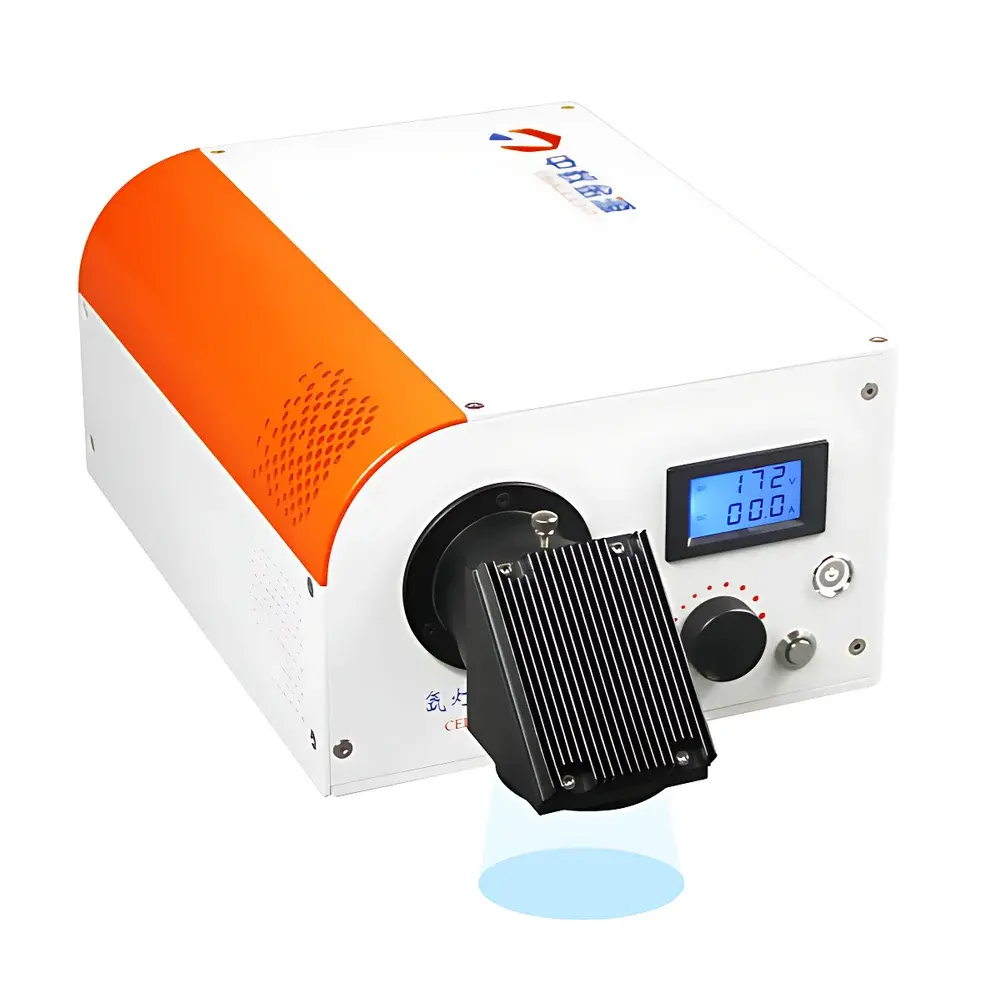
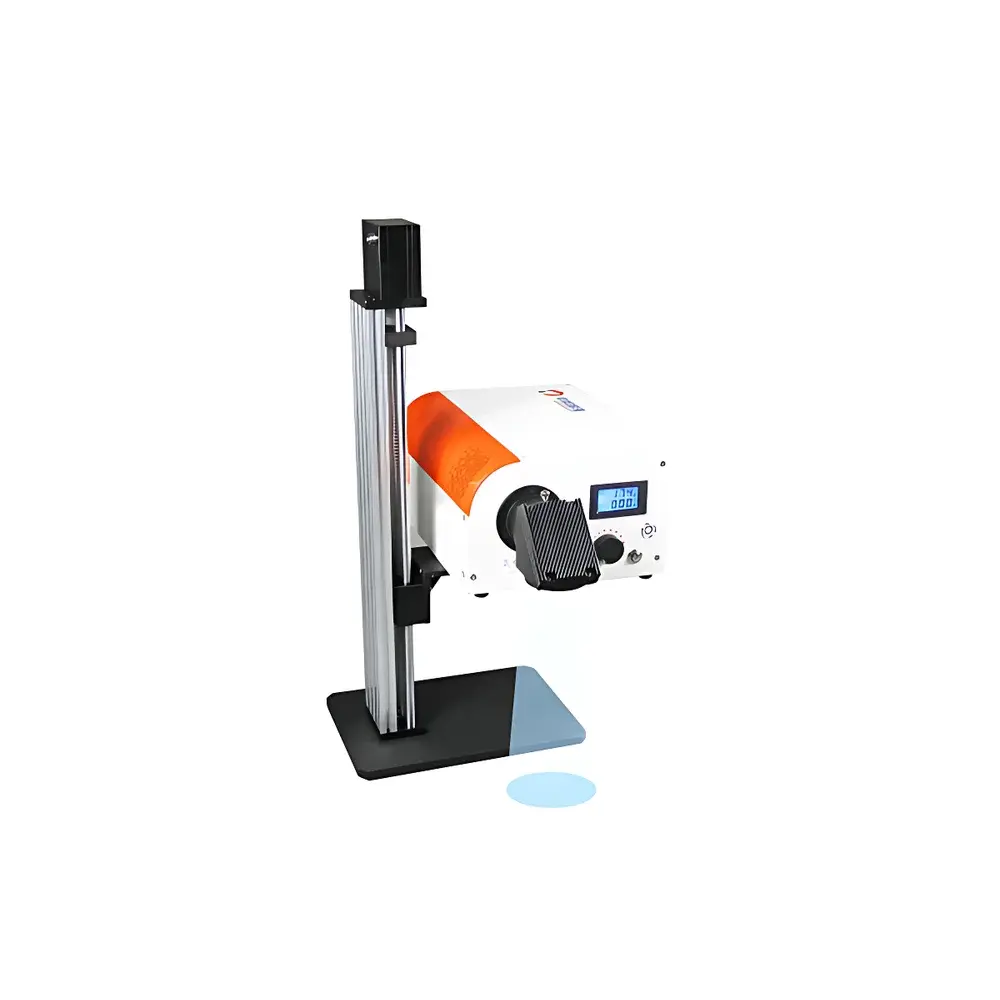
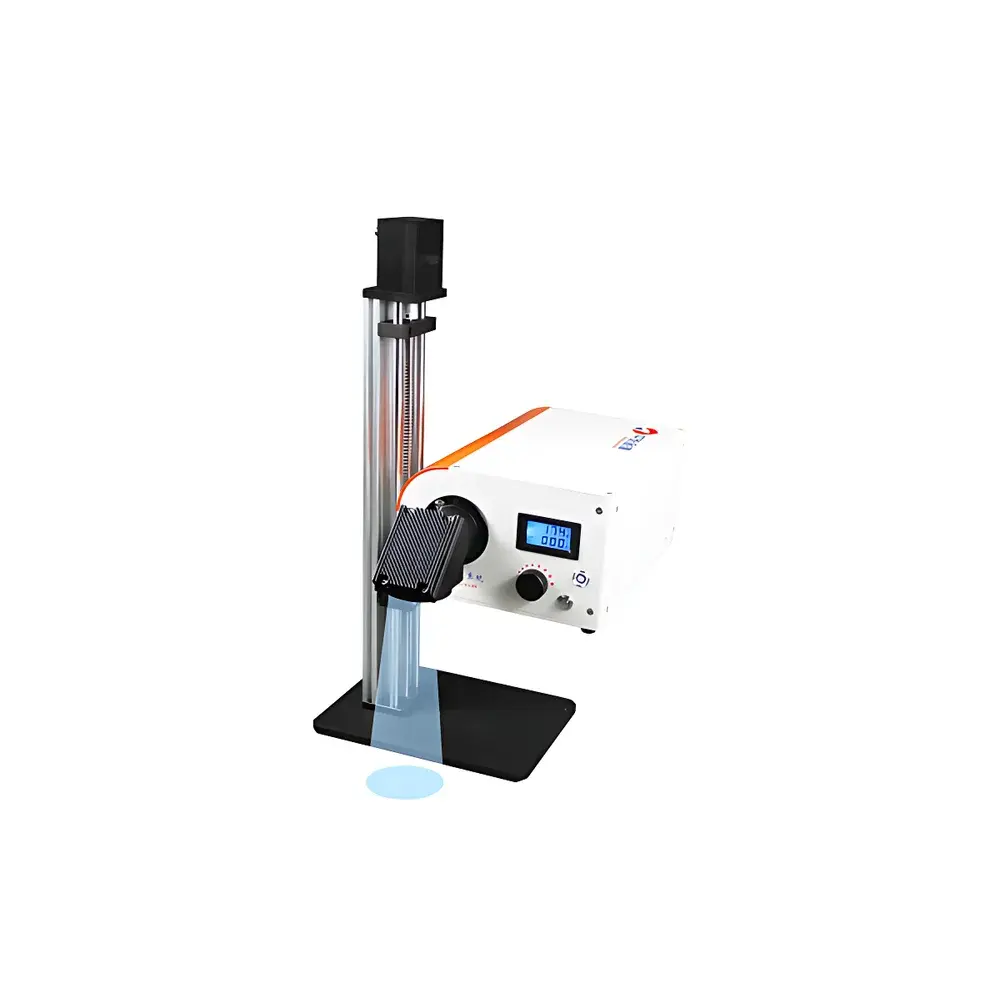
CEL-PF300-T9 Integrated High-Performance Xenon Light Source System
| Brand | CEL (China Education Goldsource) |
|---|---|
| Origin | Beijing, China |
| Manufacturer Type | OEM Manufacturer |
| Product Category | Domestic |
| Model | CEL-PF300-T9 |
| Light Source Type | Xenon Arc Lamp |
| Illumination Mode | External Irradiation |
| Dimensions | 320 × 243 × 150 mm |
| Input Power | 300 W (Ignition Voltage: 15 kV, Operating Voltage: 14 V DC) |
| Operating Current | 21 A (13–22 A range) |
| Total Radiant Output | 50 W |
| Spectral Range (Ozone-Free) | 300–2500 nm |
| UV Output (<390 nm) | 2.6 W |
| Visible Output (390–770 nm) | 18.6 W, 5000 lm, CCT ≈ 5600 K |
| IR Output (>770 nm) | 28.8 W |
| Beam Diameter (Adjustable) | ≥60 mm |
| Irradiance Range | 0–20 Sun (1 Sun = 1000 W/m², measured with CEL-NP2000) |
| Lamp Life | >1000 h (up to 6000 h under optimal conditions) |
| Lamp Replacement | PE300 modular xenon lamp, tool-free hot-swap capable |
| Thermal Management | Multi-point temperature feedback control with adaptive fan speed regulation |
| Optical Interface | M62/M52 threaded filter mount, compatible with stacked broadband and bandpass filters |
| Optional Accessories | CEL-LMP400 motorized height-adjustable stage, CEL-NP2000-2 high-intensity optical power meter, quartz-coated interference filters (e.g., UVIRCut400, AM1.5G, AREF, QD-series bandpasses from 254 nm to 940 nm) |
Overview
The CEL-PF300-T9 is an integrated, high-stability xenon arc light source engineered for precision photonic applications in research laboratories and industrial R&D settings. Based on a sealed, air-cooled short-arc xenon lamp (PE300), the system operates on the principle of thermal plasma emission—producing a continuous spectrum closely approximating natural solar irradiance across ultraviolet, visible, and near-infrared regions (300–2500 nm). Its compact monoblock architecture integrates power supply, ignition module, lamp housing, and thermal management into a single chassis (320 × 243 × 150 mm), eliminating inter-unit cabling and reducing electromagnetic interference (EMI) by halving the required ignition voltage to 15 kV. This design supports long-term radiometric stability (±1% intensity drift over 8 h), essential for quantitative photochemical kinetics, quantum yield determination, and accelerated aging studies compliant with ISO 4892-2, ASTM G154, and IEC 61215 standards.
Key Features
- Monolithic integration of 300 W constant-current DC power supply and high-voltage trigger circuit—no external ballast or separate igniter required.
- Modular PE300 xenon lamp with quick-release mechanical interface: lamp replacement completed in <60 seconds without tools or electrical disconnection.
- Multi-zone thermal monitoring system with closed-loop fan speed control ensures consistent junction temperature and minimizes spectral drift during extended operation.
- Optically aligned coaxial architecture: lamp filament, heat sink, UV-blocking quartz envelope, and output flange share a common mechanical axis—improving beam collimation and filter throughput reproducibility.
- M62/M52 dual-standard filter thread enables seamless stacking of up to four interference filters (e.g., AM1.5G + QD365 + UVIRCut400) without vignetting or misalignment.
- Low EMI signature due to embedded high-frequency suppression and shielded internal routing—critical for co-location with sensitive detectors, lock-in amplifiers, or mass spectrometers.
Sample Compatibility & Compliance
The CEL-PF300-T9 is designed for external illumination of planar and volumetric samples in controlled environments: photoelectrochemical cells, gas-phase photocatalytic reactors (e.g., CO₂ reduction microreactors), thin-film degradation test chambers, and biological exposure platforms. Its ozone-free spectral output (300–2500 nm) complies with ISO 105-B02 for textile lightfastness testing and supports GLP-aligned experimental protocols requiring traceable irradiance calibration (NIST-traceable CEL-NP2000-2 power meter optional). The system meets CE/EMC Directive 2014/30/EU and RoHS 2011/65/EU requirements. For regulated pharmaceutical photostability studies (ICH Q1B), optional AM1.5G and UVREF filters enable compliance with USP <1000> and FDA 21 CFR Part 11 data integrity requirements when paired with validated software logging.
Software & Data Management
While the CEL-PF300-T9 operates as a standalone analog source, it is fully compatible with third-party digital control ecosystems. Analog 0–5 V input allows external modulation of irradiance intensity via programmable power supplies or PLCs. When integrated with the optional CEL-NP2000-2 optical power meter, real-time irradiance values can be logged via USB/RS-232 into LabVIEW, MATLAB, or Python-based acquisition frameworks. All filter configurations, lamp operating hours, and thermal logs are manually recorded per GLP Annex 11 guidelines; audit trails may be generated using timestamped CSV exports from connected instrumentation. No proprietary firmware or cloud dependency is involved—ensuring full data sovereignty and compatibility with air-gapped laboratory networks.
Applications
- Photocatalytic hydrogen evolution and oxygen evolution reactions (HER/OER) using TiO₂, g-C₃N₄, or MOF-based catalysts.
- CO₂ photoreduction to CH₄, CO, or C₂H₄ under simulated AM1.5G illumination.
- Photo-thermal synergy studies requiring simultaneous UV–vis–NIR excitation and infrared thermography.
- Accelerated weathering of polymer composites, coatings, and OLED encapsulation layers per ISO 4892-2 Cycle 1.
- UV-A/UV-B photobiology assays—including microbial inactivation, plant photomorphogenesis, and circadian rhythm entrainment.
- Calibration of spectroradiometers, solar simulators, and quantum efficiency measurement systems (e.g., IPCE, APCE).
FAQ
What is the spectral mismatch compared to AM1.5G reference?
The CEL-PF300-T9 achieves Class AAA spectral match (per IEC 60904-9:2020) when used with the optional AM1.5G filter; unfiltered output shows ±15% deviation in 350–400 nm and 800–1100 nm bands.
Can the system operate continuously for 24 hours?
Yes—provided ambient temperature remains ≤25°C and relative humidity <60%; continuous operation beyond 8 h requires active airflow management around the chassis.
Is the PE300 lamp compatible with older CEL-PF300 models?
Mechanically and electrically identical—full backward compatibility with PF300, PF300-T, and PF300-T8 series.
Does the T9 support TTL or analog modulation?
No internal modulation capability; however, external 0–5 V analog dimming is supported via the “INTENSITY” input port on the rear panel.
How is irradiance calibrated and traceable?
Calibration is performed using the NIST-traceable CEL-NP2000-2 power meter (±3% uncertainty at 300–1100 nm); certificate of calibration included with each unit.




