
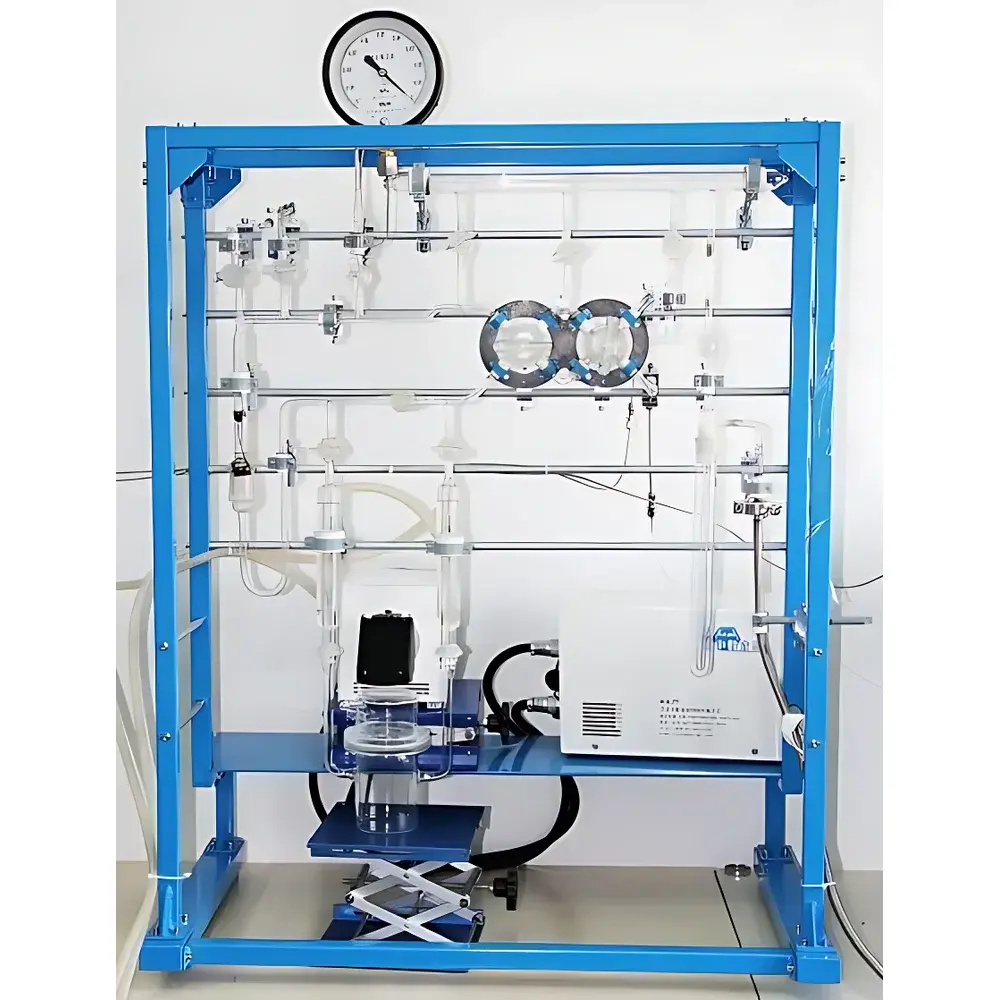
IPCE Quantum Efficiency Measurement System by CME (China Education Goldsource)
| Brand | CME |
|---|---|
| Origin | Beijing, China |
| Manufacturer Type | Direct Manufacturer |
| Country of Origin | China |
| Model | IPCE Quantum Efficiency Measurement System |
| Price | USD 9,800 (FOB Beijing) |
Overview
The IPCE Quantum Efficiency Measurement System by CME is a dedicated laboratory-grade instrumentation platform engineered for the precise determination of Incident Photon-to-Current Conversion Efficiency (IPCE) in photoelectrochemical and photocatalytic research. Based on monochromatic light excitation coupled with calibrated photodiode reference detection and synchronized current–voltage acquisition, the system quantifies the wavelength-resolved external quantum efficiency (EQE) of photoactive materials and devices—including photoanodes, photocathodes, powder catalysts on conductive substrates, and thin-film heterostructures. It operates under controlled illumination conditions (typically AM 1.5G-filtered or monochromator-scanned), enabling rigorous evaluation of spectral response characteristics essential for solar fuel generation, environmental remediation, and advanced photochemical synthesis.
Key Features
- Integrated monochromator with grating-based wavelength selection (300–1100 nm range, ±0.5 nm resolution) and motorized slit control for adjustable bandwidth (1–10 nm)
- Traceable NIST-calibrated silicon photodiode reference detector with real-time photon flux monitoring
- Low-noise source-measure unit (SMU) capable of sub-picoampere current resolution and four-quadrant operation for both photoanodic and photocathodic characterization
- Programmable LED or xenon lamp light source with optical chopper (f = 17–250 Hz) for lock-in amplification compatibility
- Rigid optical bench design with kinematic mounts, beam alignment verification ports, and stray-light suppression baffles
- Modular architecture supporting optional integration with electrochemical workstations (e.g., via analog trigger I/O) for simultaneous EIS or Mott–Schottky analysis
Sample Compatibility & Compliance
The system accommodates standard three-electrode photoelectrochemical cells (quartz or Pyrex), powder-catalyst-coated FTO/ITO electrodes (≥1 cm² active area), and planar solid-state devices mounted on XYZ-adjustable stages. Sample holders comply with ASTM E2684–20 (Standard Practice for Calibration of Photocurrent Response Measurements) and support reproducible incident-angle control (0°–15° normal incidence). All optical and electronic subsystems are designed to meet IEC 61000-4 electromagnetic compatibility requirements. Data acquisition protocols align with GLP principles, including user-accessible audit trails, timestamped metadata embedding, and export formats compatible with ISO/IEC 17025-accredited lab reporting workflows.
Software & Data Management
CME’s proprietary QEMSoft v3.2 provides intuitive instrument control, automated wavelength sweep sequencing, and real-time IPCE/EQE calculation per ASTM G173–12 spectral irradiance reference. The software enforces traceable calibration workflows—requiring operator authentication before loading detector responsivity files or electrode area inputs. Raw data (photocurrent, photon flux, bias voltage) are stored in HDF5 format with embedded units, provenance tags, and version-controlled processing scripts. Export options include CSV, MATLAB .mat, and PDF reports compliant with FDA 21 CFR Part 11 requirements (electronic signatures, audit logs, and data integrity safeguards enabled upon configuration).
Applications
- Quantitative benchmarking of photocatalysts for solar-driven H₂ evolution (e.g., TiO₂, g-C₃N₄, MOF-derived composites)
- Spectral responsivity mapping of photoelectrodes in PEC water-splitting cells
- Structure–activity correlation studies in visible-light-mediated organic transformations (e.g., selective oxidation, C–N coupling)
- Performance validation of tandem photoelectrochemical systems under simulated solar spectra
- Stability assessment via time-resolved IPCE tracking under constant illumination (up to 24 h continuous operation)
- Support for ISO 10678:2010 (Photocatalysis — Determination of photocatalytic activity) test protocols
FAQ
What is the minimum detectable photocurrent resolution of this system?
The integrated SMU achieves ≤50 fA RMS noise floor at 1 s integration time, enabling reliable IPCE measurement down to ~0.1% at 400 nm for 1 cm² electrodes.
Can the system be used for powder catalysts deposited on conductive substrates?
Yes—standard sample stage includes spring-loaded contact pins and pressure-adjustable clamping for reproducible ohmic contact with slurry-cast or drop-cast films.
Is calibration traceable to national standards?
All photodiode detectors ship with NIST-traceable calibration certificates (wavelength and responsivity), valid for 12 months from date of shipment.
Does the software support automated batch testing across multiple samples?
QEMSoft supports script-based automation via Python API; users can define multi-sample sequences with variable bias, dwell time, and wavelength step parameters.
What safety features are implemented for UV illumination operation?
Interlocked quartz light-tight enclosure, automatic shutter activation during lid opening, and UV-blocking viewing window compliant with IEC 62471 (Photobiological Safety).



