
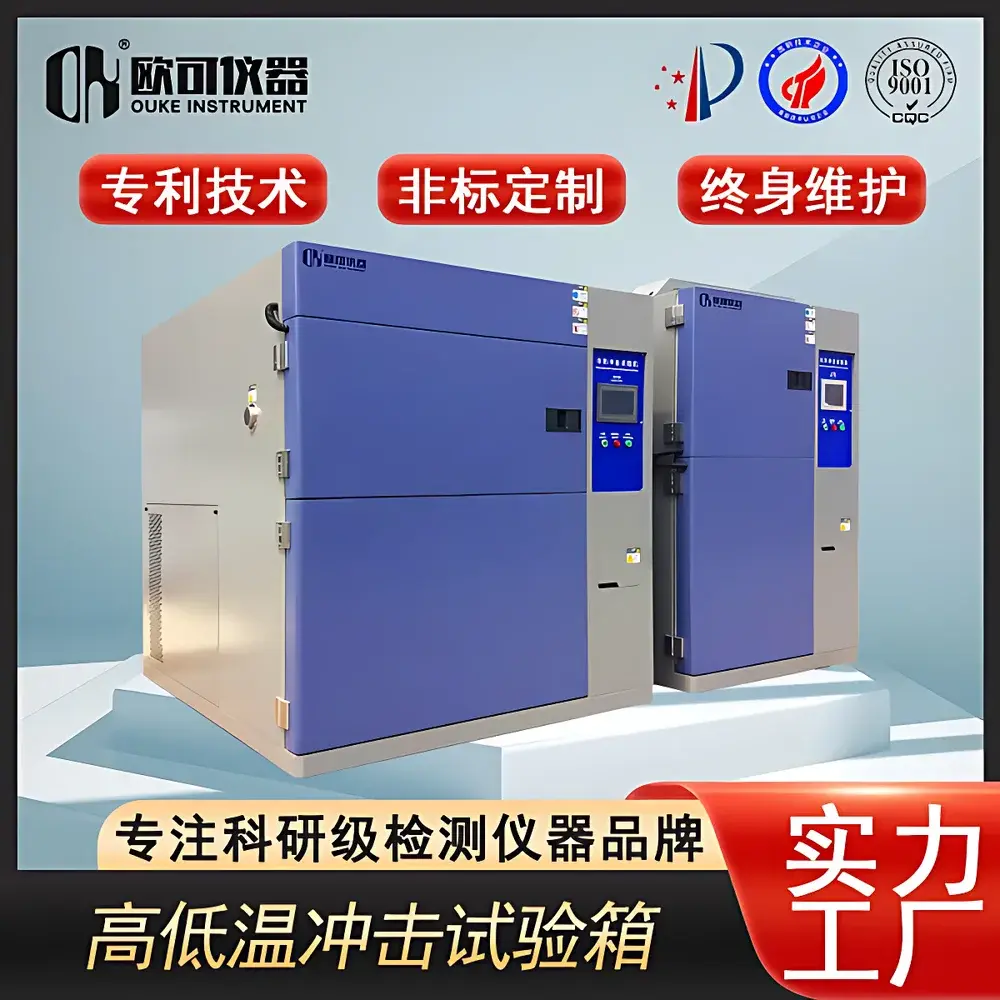
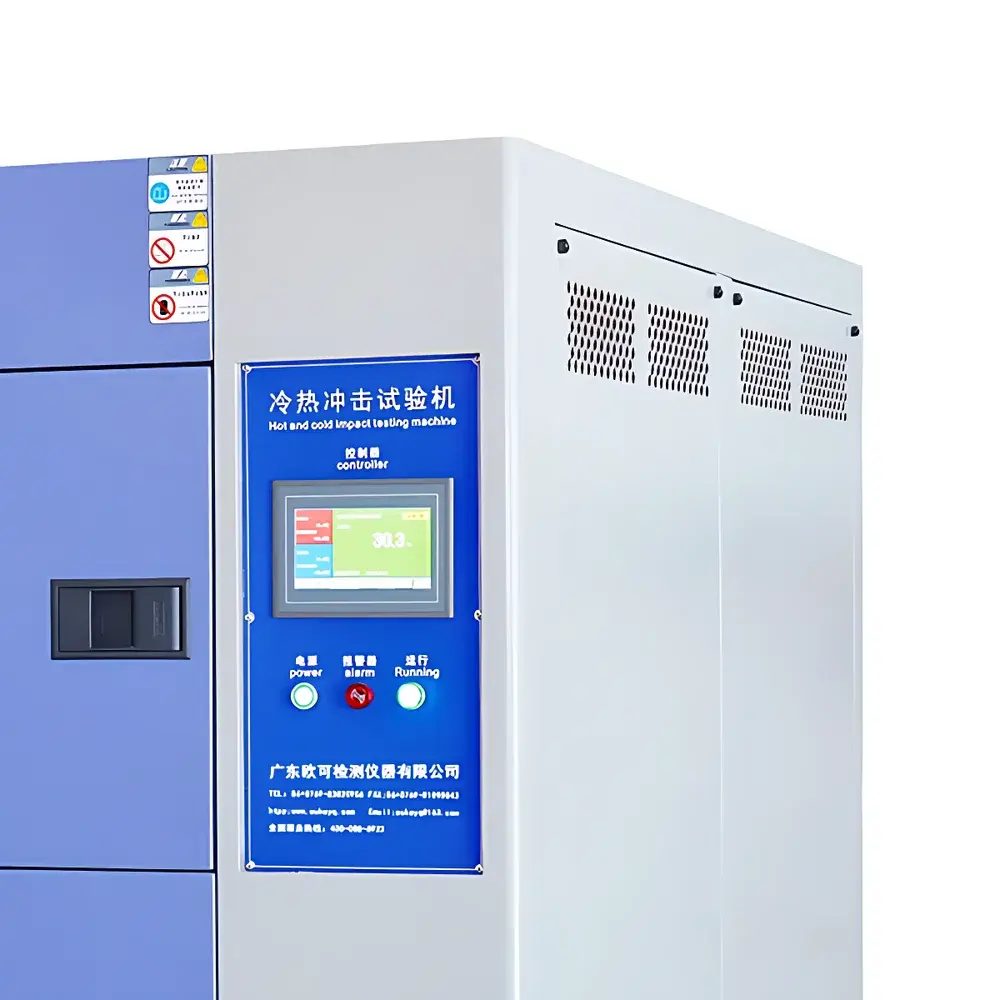
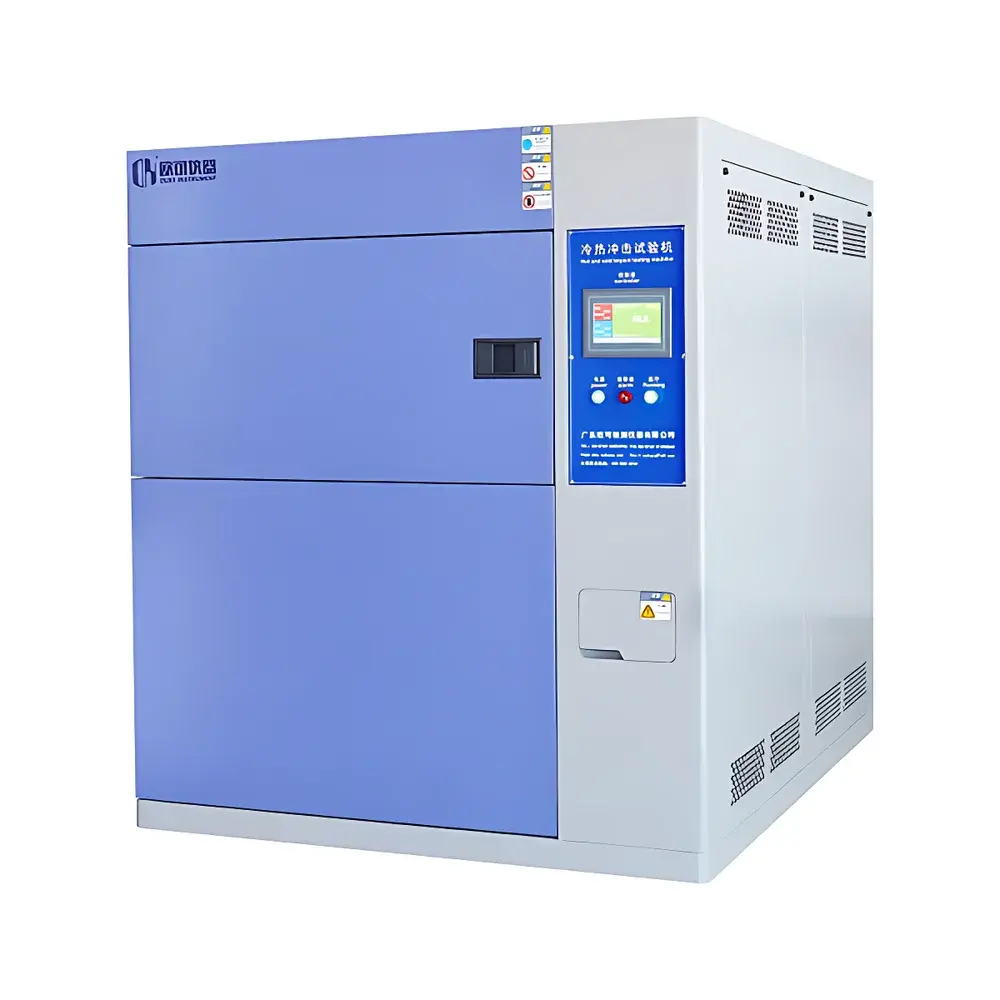
OK-TS-49.1 Thermal Shock Test Chamber
| Brand | OK Instruments |
|---|---|
| Origin | Guangdong, China |
| Manufacturer Type | Direct Manufacturer |
| Product Origin | Domestic (China) |
| Model | OK-TS-49.1 |
| High Temperature Range | 200 °C |
| Low Temperature Range | −40 °C |
| Thermal Shock Range | −40 °C to 200 °C |
| Temperature Stability | ±2 °C |
| Heating Rate | ≤10 s (to reach target temp from ambient) |
| Cooling Rate | ≤10 s (to reach target temp from ambient) |
Overview
The OK-TS-49.1 Thermal Shock Test Chamber is a dual-compartment (hot/cold) rapid-transition environmental test system engineered for precise execution of thermal shock testing per MIL-STD-883 Method 1010.8, IEC 60068-2-14, GJB 150.5A, and JESD22-A106. It operates on the principle of mechanical basket transfer between independently controlled high-temperature and low-temperature chambers, enabling step-change temperature transitions—rather than linear ramping—to subject specimens to abrupt thermal gradients. This architecture induces transient mechanical stress via differential thermal expansion across material interfaces, making it suitable for evaluating solder joint integrity, encapsulant delamination, wire bond lift-off, and interfacial adhesion failure in electronic packages, PCB assemblies, automotive sensors, and aerospace components.
Key Features
- Dual-chamber configuration with independent refrigeration (two-stage cascade system) and electric heating circuits, ensuring stable setpoint maintenance at −40 °C and +200 °C respectively.
- Automated horizontal transfer basket with pneumatic actuation, achieving ≤10-second transition time between extreme temperature zones—compliant with Class 1 thermal shock requirements per IEC 60068-2-14.
- High-efficiency air circulation design with turbulence-controlled airflow paths to minimize temperature overshoot and ensure uniform chamber distribution (±1.5 °C within working volume).
- Robust stainless-steel interior construction (SUS304), insulated with high-density polyurethane foam (≥150 mm thickness), minimizing thermal leakage and enhancing energy efficiency.
- Integrated safety interlocks including over-temperature cutoff, compressor high-pressure protection, door-open alarm, and emergency stop circuit meeting IEC 61000-6-2/6-4 EMC standards.
Sample Compatibility & Compliance
The OK-TS-49.1 accommodates standard test specimens up to 300 mm × 300 mm × 250 mm (W×D×H) with maximum payload of 15 kg. Its chamber geometry and transfer mechanism support both bare die, QFN, BGA, and board-level assemblies without requiring fixture redesign. The system supports full traceability for GLP/GMP-regulated environments: all temperature setpoints, dwell durations, transfer timestamps, and chamber sensor readings are logged with millisecond resolution. Calibration certificates are provided per ISO/IEC 17025-accredited procedures, and optional validation packages (IQ/OQ/PQ) align with FDA 21 CFR Part 11 data integrity requirements.
Software & Data Management
Equipped with OK-ControlSuite™ v3.2—a Windows-based control platform compliant with IEC 62443-3-3 industrial cybersecurity guidelines—the chamber enables programmable multi-step profiles with up to 99 segments per cycle. Real-time monitoring includes dual-channel PT100 sensor feedback (hot chamber and cold chamber), basket position status, and compressor operational parameters. All test logs are exported in CSV and PDF formats with embedded digital signatures; audit trails record user login/logout events, parameter modifications, and manual overrides. Optional Ethernet/IP and Modbus TCP interfaces allow integration into centralized MES or LIMS infrastructure.
Applications
- Qualification testing of semiconductor devices under JEDEC JESD22-A106 (Thermal Shock) and A104 (Temperature Cycling).
- Reliability screening of automotive ECUs per AEC-Q200 Rev D, focusing on solder fatigue resistance under repeated thermal transients.
- Evaluation of coating adhesion and substrate bonding strength in optical components and MEMS packaging.
- Failure analysis correlation studies linking thermal shock-induced microcracks to subsequent functional degradation in power modules.
- Process validation of conformal coating cure cycles and rework thermal profiles in high-reliability electronics manufacturing.
FAQ
What is the difference between thermal shock testing and temperature cycling?
Thermal shock involves instantaneous transfer between two stabilized temperature extremes (e.g., −40 °C ↔ +200 °C), inducing high-rate strain via thermal gradient mismatch. Temperature cycling uses gradual, programmed ramps (e.g., 5–15 °C/min) across the same range and emphasizes cumulative fatigue over hundreds or thousands of cycles.
Does the OK-TS-49.1 meet MIL-STD-883H requirements?
Yes—it satisfies Method 1010.8 for thermal shock when configured with appropriate dwell times (≥10 min per zone) and transition timing (≤10 s), as verified during factory performance qualification.
Can this chamber perform humidity-controlled thermal shock?
No. The OK-TS-49.1 is a dry-thermal shock system. For combined temperature/humidity shock, OK Instruments recommends the OK-THS-72 series, which integrates vapor injection and desiccant drying modules.
Is third-party calibration included with purchase?
A NIST-traceable initial calibration report is supplied. Annual recalibration services—including on-site verification and uncertainty budget documentation—are available under OK’s ISO/IEC 17025-certified service program.
What maintenance intervals are recommended?
Compressor oil and filter replacement every 2,000 operating hours; refrigerant leak check semiannually; basket rail lubrication and sensor verification quarterly. Full preventive maintenance is supported by OK’s global service network.



