
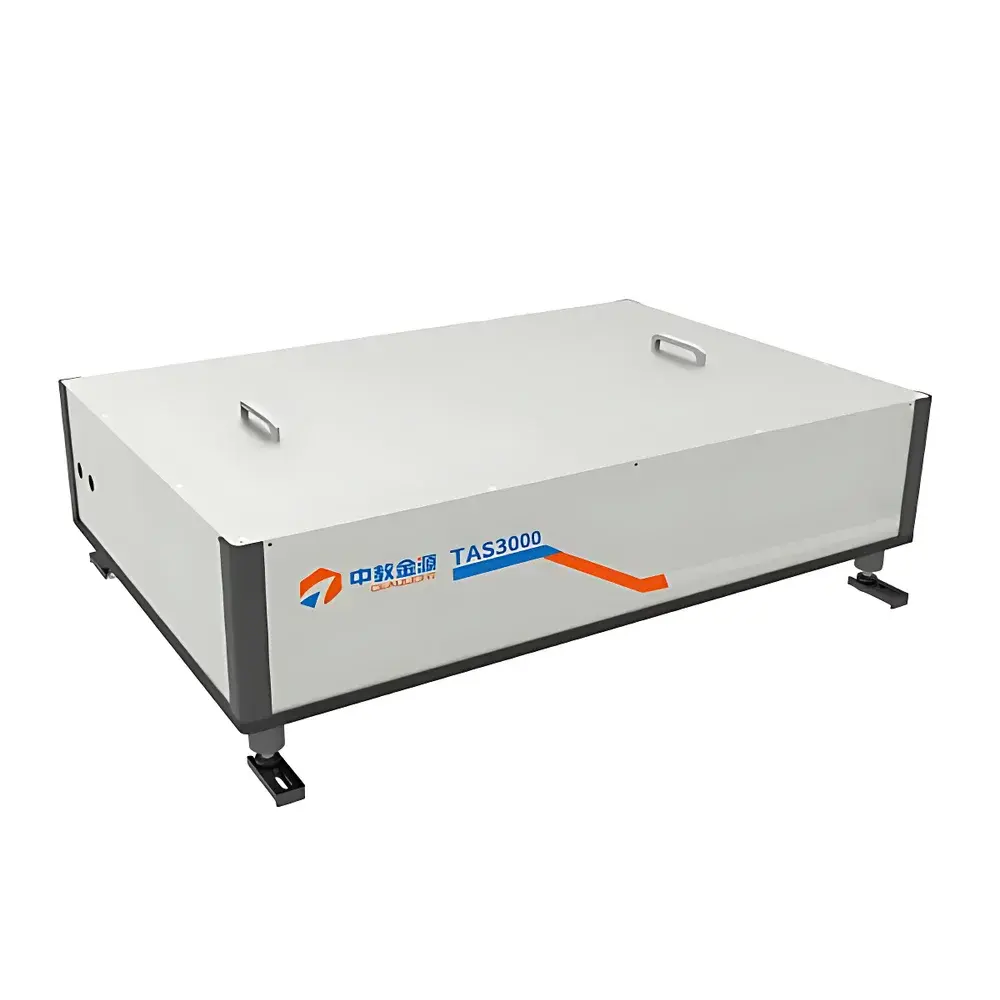
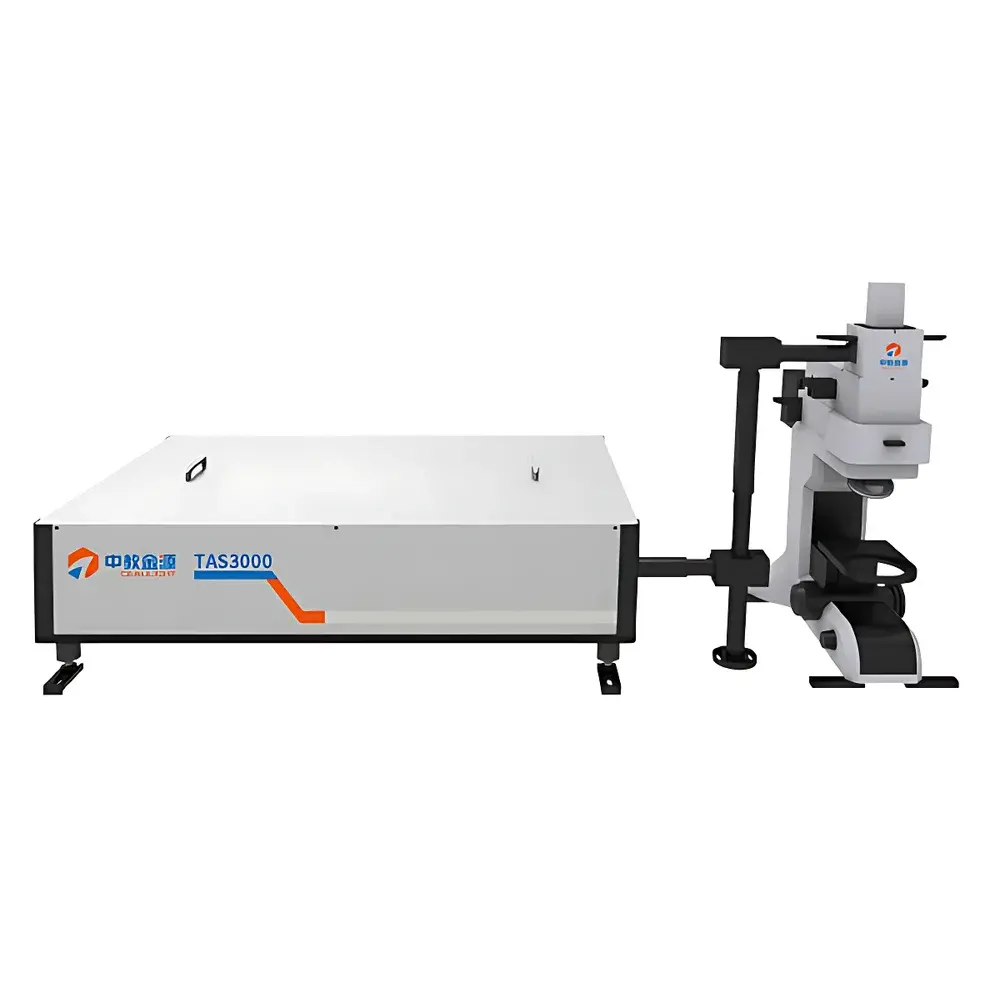
CEL-TAS3000 Femtosecond Transient Absorption Spectroscopy System
| Brand | CEAULIGHT |
|---|---|
| Origin | Beijing, China |
| Manufacturer Type | OEM Manufacturer |
| Country of Origin | China |
| Model | CEL-TAS3000 |
| Pricing | Upon Request |
| Sensitivity | < 0.1 mOD |
| Time Resolution | ≤1.4 × laser pulse width |
| Delay Line Time Accuracy | 1 fs (2 ns time window) |
| Probe Spectral Range | 350–1100 nm |
| Time Window Options | 2 ns / 4 ns |
| Detector | 2048-pixel high-speed CMOS spectral array |
| Spectral Resolution | 2.5 nm (50 µm slit) |
| Acquisition Rate | 2.5 kHz |
| Pump Laser Compatibility | Integrated frequency-doubling optics |
| Sample Compatibility | Solid films, liquids, thin-film substrates |
| Upgradability | Microscopic pump-probe configuration via standardized optical interface |
Overview
The CEL-TAS3000 Femtosecond Transient Absorption Spectroscopy System is a turnkey, modular pump-probe platform engineered for ultrafast photophysical and photochemical characterization across femtosecond to nanosecond timescales. Based on the collinear or non-collinear transient absorption (TA) technique, the system measures differential optical density (ΔOD) induced by ultrafast photoexcitation, enabling quantitative analysis of excited-state lifetimes, energy transfer pathways, charge carrier dynamics, and intermediate species formation. Its core architecture integrates a stabilized delay line with sub-femtosecond timing precision, a broadband white-light continuum probe source, and a high-frame-rate CMOS spectrometer—ensuring robust signal-to-noise performance at <0.1 mOD sensitivity. Designed for long-term operational stability in academic and industrial R&D laboratories, the CEL-TAS3000 adheres to fundamental principles of ultrafast spectroscopy: precise temporal gating, spectrally resolved detection, and reproducible pump-probe overlap geometry.
Key Features
- Sub-fs delay line accuracy (±1 fs) over a standard 2 ns time window, extendable to 4 ns via hardware reconfiguration
- Broadband probe coverage from 350 nm to 1100 nm with 2.5 nm spectral resolution (50 µm input slit)
- Real-time acquisition at 2.5 kHz frame rate using a 2048-pixel back-illuminated CMOS linear array detector
- Integrated harmonic generation optics (e.g., BBO-based SHG) enabling direct 350 nm or 400 nm pump excitation without external OPA
- Modular mechanical design with standardized optomechanical interfaces for seamless integration of microscope objectives and translation stages
- Thermally stable monolithic baseplate and kinematic mounting for minimal drift during extended acquisition sessions (>8 h)
- Compatible with cryogenic sample environments (optional liquid nitrogen or closed-cycle cryostat integration)
Sample Compatibility & Compliance
The CEL-TAS3000 supports diverse sample formats including spin-coated thin films (e.g., perovskites, organic photovoltaics), solution-phase cuvettes (1 cm pathlength), solid-state single crystals, and vacuum-deposited layers on quartz or sapphire substrates. All sample holders comply with ISO 7010 mechanical mounting standards and feature adjustable XYZ positioning with ±5 µm repeatability. The system’s optical layout conforms to ANSI Z80.10 safety guidelines for Class 4 ultrafast laser systems, and its electronic control architecture meets IEC 61000-6-3 EMC emission limits. While not pre-certified for GLP/GMP environments, the instrument’s deterministic timing engine and audit-ready data logging structure support validation under FDA 21 CFR Part 11 when deployed with compliant third-party software and networked storage infrastructure.
Software & Data Management
Acquisition and analysis are managed through TASControl v3.x—a native Windows application built on LabVIEW Real-Time and .NET Core frameworks. The software provides synchronized hardware control (delay stage, spectrometer triggering, shutter sequencing), real-time ΔOD visualization, and batch processing pipelines for global fitting (e.g., multi-exponential decay models), singular value decomposition (SVD), and target analysis. Raw datasets are saved in HDF5 format with embedded metadata (wavelength calibration, delay timestamps, pump fluence, sample ID), ensuring FAIR (Findable, Accessible, Interoperable, Reusable) compliance. Export modules support ASCII, MATLAB .mat, and Origin-compatible OPJ formats. Remote monitoring and script-based automation are enabled via TCP/IP API and Python SDK (PyTAS), facilitating integration into automated materials screening workflows.
Applications
- Charge carrier recombination kinetics in metal-halide perovskite thin films (e.g., MAPbI₃, CsPbBr₃) under varied pump fluences and ambient conditions
- Exciton dissociation and polaron formation dynamics in bulk heterojunction organic photovoltaic blends (e.g., PBDB-T:IEICO)
- Triplet state population buildup and intersystem crossing rates in transition-metal complexes and porphyrin derivatives
- Photoinduced electron transfer in dye-sensitized solar cell architectures and photocatalytic systems (e.g., TiO₂, g-C₃N₄)
- Ultrafast vibrational relaxation and solvation dynamics in aqueous and non-aqueous molecular solutions (e.g., LAC, CIS nanoparticles)
- Time-resolved band-edge shifts and hot-carrier cooling in colloidal quantum dots and 2D transition metal dichalcogenides
FAQ
What laser sources are compatible with the CEL-TAS3000?
The system is optimized for Ti:sapphire oscillators (70–100 MHz, <100 fs pulses) and amplified systems (1 kHz–1 MHz, <35 fs). Integrated SHG enables direct 350/400 nm pumping; optional OPA modules extend coverage to UV (260 nm) and IR (up to 16 µm).
Can the CEL-TAS3000 perform micro-scale transient absorption?
Yes—standardized kinematic mounts and a dedicated microscope coupling port allow straightforward integration of 10×–100× objective lenses, enabling spatially resolved TA mapping with ~1 µm lateral resolution.
Is temperature-controlled sample measurement supported?
The base system includes a room-temperature sample stage with XYZ adjustment; low-temperature operation down to 77 K is achievable via add-on cryostat modules with optical access windows and thermal shielding.
How is data traceability ensured for regulated research?
All acquisitions embed UTC timestamps, hardware serial numbers, calibration coefficients, and user-defined experimental notes. When paired with validated third-party LIMS or ELN platforms, full audit trails meet GLP documentation requirements.
What maintenance is required for long-term stability?
No routine optical alignment is needed due to monolithic mechanical design. Annual verification of delay line encoder linearity and spectrometer wavelength calibration is recommended; both procedures are software-guided and require <30 minutes.



