
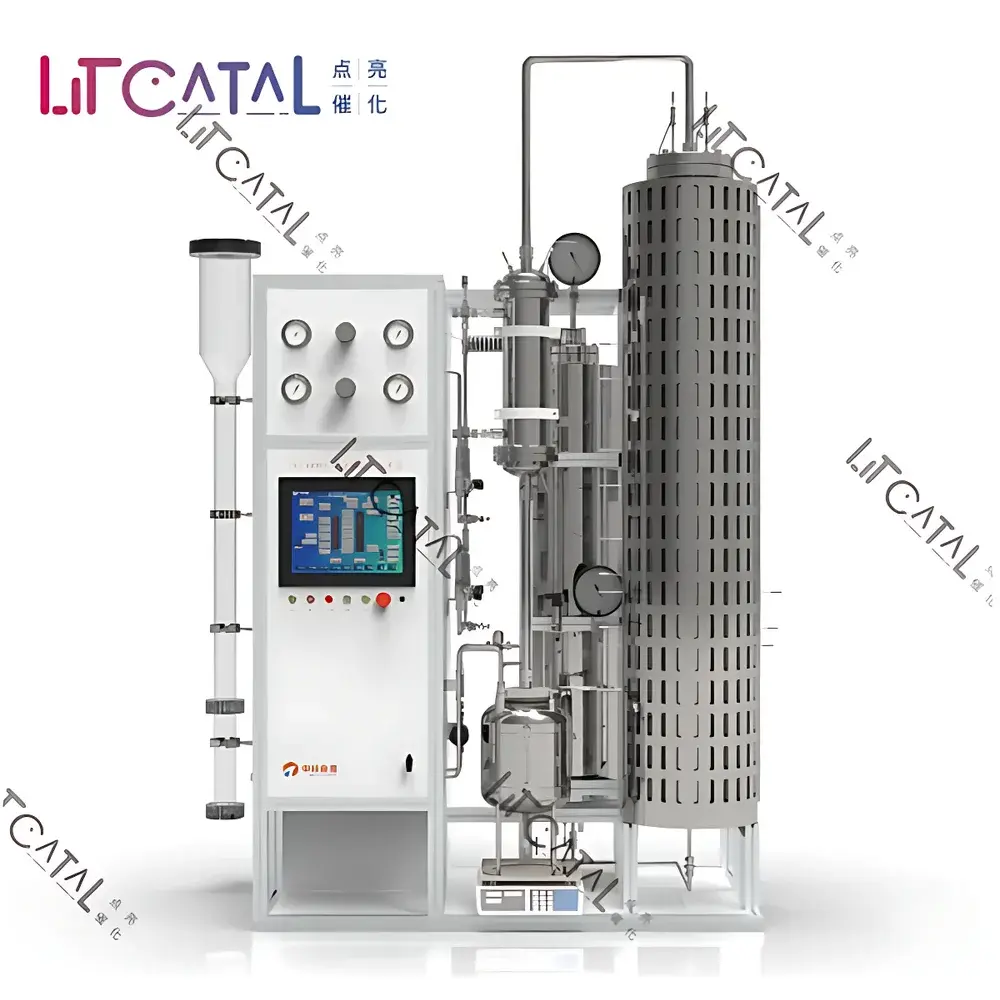
CEL-CPPCF Fluidized-Bed Heat-Exchange Reaction System (Custom-Engineered)
| Brand | CEL (Zhongjiao Jinyuan) |
|---|---|
| Origin | Beijing, China |
| Manufacturer Type | Direct Manufacturer |
| Country of Origin | China |
| Model | CEL-CPPCF Fluidized-Bed Heat-Exchange Reaction System (Custom-Engineered) |
| Pricing | Available Upon Request |
| Dimensions | 1690 mm × 800 mm × 2543 mm |
| Reactor Material | 310S Stainless Steel |
| Tubing Material | 316L Stainless Steel |
| Vaporizer Temp. Range | 0–800 °C |
| Steam Preheater Temp. Range | 0–950 °C |
| Reactor Temp. Range | 0–950 °C |
| Tubing Trace Heating Range | 0–200 °C |
| Operating Pressure | Atmospheric |
| Max. Liquid Flow Rate (Fully Vaporized) | ≤100 mL/min |
| Catalyst Bed Volume | <1500 mL |
| Gas Flow Capacity | 0–100 SLPM (scalable to multiple gas streams) |
| Mass Measurement | 0–30 kg (0.1 g resolution) |
| Safety Systems | Proportional pressure relief valve, rupture disc, independent overtemperature alarms at all critical zones, interlocked shutdown logic |
Overview
The CEL-CPPCF Fluidized-Bed Heat-Exchange Reaction System is a custom-engineered, modular laboratory-scale platform designed for rigorous investigation of heterogeneous catalytic processes under dynamically controlled fluidization conditions. It operates on the fundamental principle of fluidization—where upward-flowing gas or liquid suspends solid catalyst particles in a turbulent, homogenized state—enabling high interfacial area, uniform temperature distribution, and enhanced heat and mass transfer between phases. This system supports gas–solid, liquid–solid, and gas–liquid–solid reaction regimes, with fully automated control of reactor temperature (including programmable ramp/soak profiles), gas-phase mass flow (via thermal mass flow controllers), and liquid-phase delivery (via precision syringe or HPLC-grade pumps with integrated vaporization). The integrated heat-exchange architecture ensures thermal stability during exothermic or endothermic reactions, while maintaining isothermal or near-isothermal operation across the catalyst bed. Designed for reproducible bench-scale process development, it serves as a bridge between kinetic screening and pilot-scale validation.
Key Features
- Modular fluidized-bed reactor core constructed from high-temperature 310S stainless steel, rated for continuous operation up to 950 °C
- Dual-stage vaporization system: pre-heating zone (0–950 °C) coupled with precision vaporizer (0–800 °C) enabling complete and stable phase transition of organic/inorganic liquids
- Independent trace heating (0–200 °C) applied to all liquid and vapor transport lines to prevent condensation and ensure consistent feed composition
- Real-time gravimetric monitoring via industrial-grade 30 kg load cell (0.1 g resolution) for continuous recording of condensate or product accumulation mass
- Integrated safety architecture: redundant overtemperature detection at all thermal zones, hardware-interlocked emergency shutdown, ASME-compliant rupture disc, and proportional pressure-relief valve compatible with H₂ service
- Full software-defined automation using deterministic real-time control engine; all setpoints, alarms, and interlocks are configurable without code modification
- Industrial-grade touch-panel HMI (15″ ruggedized IPC) with intuitive workflow editor for experiment sequencing, parameter logging, and deviation tracking
Sample Compatibility & Compliance
The CEL-CPPCF system accommodates a broad range of solid catalysts—including supported metals, metal oxides, zeolites, MOFs, and structured monoliths—with bed volumes up to 1500 mL. It accepts gaseous feeds (e.g., H₂, CO, NH₃, CH₄, O₂, N₂, synthetic air), volatile organic liquids (e.g., alcohols, hydrocarbons, amines), and aqueous solutions (with appropriate corrosion-resistant wetted materials). All wetted surfaces comply with ASTM A269/A270 for sanitary-grade 316L stainless steel tubing. The system architecture meets mechanical integrity requirements per PED 2014/68/EU (for atmospheric-rated configuration) and incorporates design practices aligned with ISO 13849-1 for Category 3 PLd safety-related control functions. Data acquisition and audit trails conform to ALCOA+ principles, supporting GLP and GMP-aligned workflows where electronic records are subject to review.
Software & Data Management
Control and data acquisition are managed through CEL’s proprietary ChemReact Suite v4.x—a Windows-based application built on .NET Framework with OPC UA server integration. It provides synchronized logging of >128 analog/digital channels at user-selectable intervals (100 ms–5 s), automatic generation of timestamped CSV and PDF reports (including calibration logs, run summaries, and alarm histories), and native export compatibility with MATLAB, Python (Pandas), and commercial chromatography data systems (CDS). The software enforces role-based access control (RBAC), full electronic signature capability per FDA 21 CFR Part 11 Annex 11, and immutable audit trails for all configuration changes and manual overrides. Optional API modules enable bidirectional communication with LIMS and MES platforms.
Applications
- Kinetic modeling of Fischer–Tropsch synthesis, methanol-to-hydrocarbons (MTH), and ammonia decomposition
- Thermal stability and coking resistance evaluation of reforming catalysts under realistic steam/hydrocarbon ratios
- In situ catalyst activation studies (e.g., reduction of NiO, sulfidation of MoO₃) with concurrent mass spectrometry or GC–MS coupling
- Transient response analysis (SSITKA, step-change experiments) for surface intermediate identification
- Process intensification studies involving reactive distillation analogs or hybrid adsorption–reaction cycles
- Development and validation of multiphase CFD models via benchmarked experimental datasets
FAQ
Can the system be configured for pressurized operation?
Yes—while the standard configuration operates at atmospheric pressure, engineered variants with ASME-coded pressure vessels (up to 30 bar) and high-pressure mass flow controllers are available upon request.
Is GC or GC–MS interfacing supported out-of-the-box?
The system includes standardized heated transfer lines (with Swagelok VCR fittings) and pressure-regulated sampling ports compatible with most commercial GC inlets; optional integration kits include flow-splitting manifolds and cryo-trap interfaces.
What level of customization is possible beyond the listed specifications?
CEL offers full mechanical, electrical, and software co-design services—from reactor geometry optimization and material substitutions (e.g., Inconel 600, quartz-lined zones) to bespoke control logic development and third-party instrument synchronization protocols.
Does the system support catalyst regeneration cycles?
Yes—the control architecture includes dedicated regeneration sequences (e.g., oxidative burn-off, reductive reactivation) with multi-zone temperature profiling, oxygen concentration monitoring, and exotherm suppression logic.
Are validation documents (IQ/OQ/PQ) provided?
Comprehensive qualification packages—including factory acceptance test (FAT) reports, sensor calibration certificates (NIST-traceable), and protocol templates for site-specific installation and operational qualification—are supplied with each system.



