
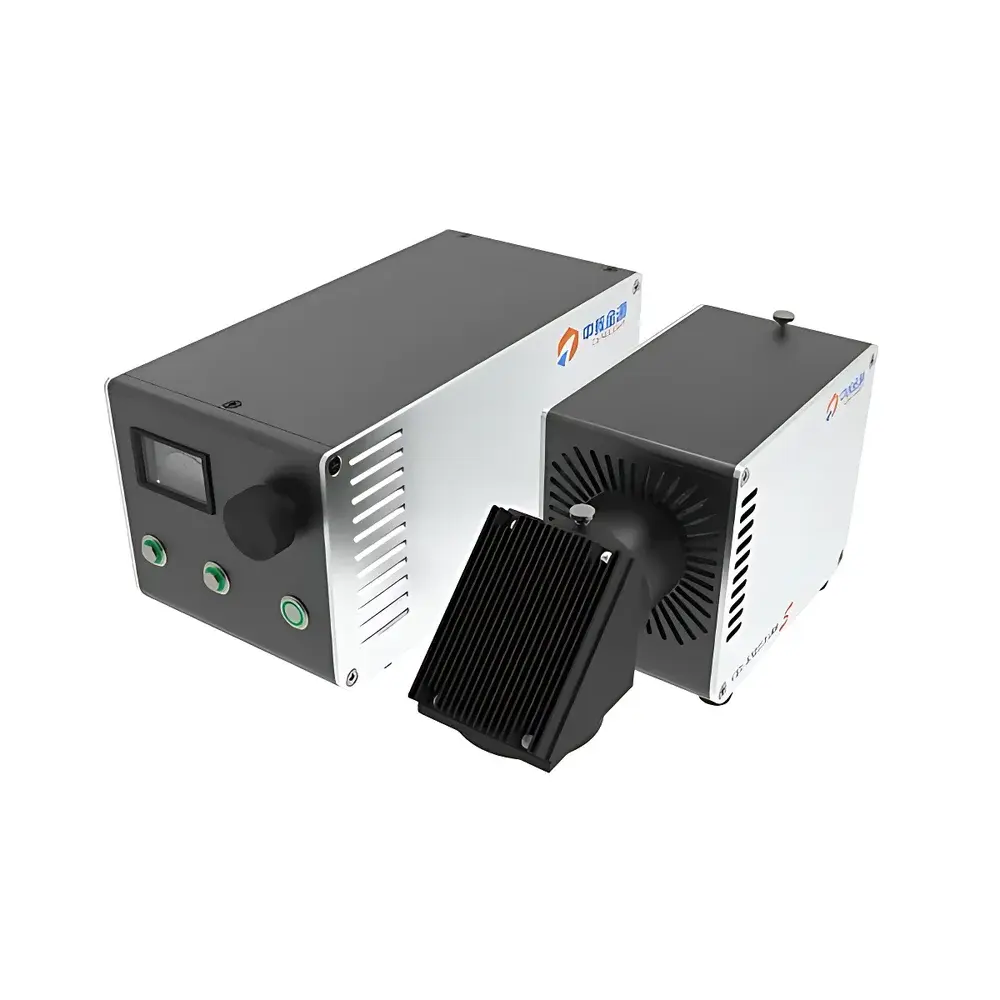
CEL-HXF300-S Xenon Light Source for Photocatalytic Research
| Brand | CEA-Light (Zhongjiaojinyuan) |
|---|---|
| Model | CEL-HXF300-S |
| Light Source Type | Short-Arc Xenon Lamp |
| Illumination Mode | External Irradiation |
| Input Power | 300 W (adjustable 180–320 W) |
| Rated Operating Current | 21 A (14–21 A) |
| Total Luminous Flux | 5000 lm |
| UV Output Power (300–400 nm) | 2.6 W |
| Visible Output (400–780 nm) | Dominant component of total radiant flux |
| IR Output Power (780–2500 nm) | 28.8 W |
| Color Temperature | 5600 K |
| Spectral Range | 300–2500 nm |
| Effective Beam Diameter | ≥60 mm |
| Beam Divergence (Full Angle) | ~5° |
| Lamp Window Diameter | 25.4 mm |
| Lamp Lifetime | ≥1000 h (at 20–30 °C, RH <45%) |
| Optical Collection | Ellipsoidal Reflective Cavity |
| Cooling Method | Forced-air Convection with Optimized Thermal Pathway |
| Safety Protection | Integrated Overtemperature Cut-off |
| Filter Compatibility | Standard 25.4 mm and 50.8 mm Mounting Threads |
| Modular Lamp Housing Design | Tool-free Lamp Replacement |
Overview
The CEL-HXF300-S is a high-stability, air-cooled short-arc xenon light source engineered specifically for controlled photocatalytic experimentation in academic and industrial research laboratories. It operates on the principle of thermal blackbody radiation from a high-pressure DC-excited xenon plasma arc, delivering a broad, continuous spectrum spanning 300–2500 nm—closely approximating natural solar irradiance above atmospheric absorption bands. Unlike pulsed or LED-based alternatives, this source provides steady-state, spectrally stable output essential for kinetic studies in heterogeneous photocatalysis, including hydrogen evolution via water splitting, CO₂ photoreduction, and oxidative degradation of organic pollutants under simulated sunlight. Its ellipsoidal reflective cavity ensures high collection efficiency (>75% radiometric coupling), while the collimated beam geometry (divergence ≤5°) enables uniform irradiance across sample areas ≥60 mm in diameter—critical for reproducible quantum yield determination and reactor scalability assessment.
Key Features
- Modular lamp housing architecture enabling tool-free xenon lamp replacement—minimizing system downtime and operator exposure to high-voltage components.
- Optimized forced-air convection pathway with thermally isolated lamp chamber and directional airflow routing, maintaining junction temperature below 85 °C during continuous operation at rated power.
- Dual-stage thermal monitoring: real-time thermistor feedback at lamp base and housing surface, triggering automatic shutdown if ambient or internal temperature exceeds safe thresholds (20–30 °C recommended operating range; RH <45%).
- Standardized optical interface accommodating 25.4 mm and 50.8 mm filter mounts—compatible with bandpass, longpass, and UV-blocking filters (e.g., UG11, KG5, Schott BG38) for spectral tailoring per experimental protocol.
- Rotatable output arm with precision angular indexing (±0.5° resolution), allowing alignment flexibility for top-irradiated slurry reactors, flow-through cells, or custom optical benches.
- DC power supply with soft-start ramping (0–10 s) and current regulation stability ±0.5% over 8-hour operation—ensuring minimal spectral drift (<1.2% UV irradiance variation per hour).
Sample Compatibility & Compliance
The CEL-HXF300-S is designed for integration into ISO/IEC 17025-compliant analytical workflows and aligns with ASTM E2739–22 (Standard Practice for Solar Simulator Classification) for Class AAA-equivalent spatial uniformity when used with optional homogenizing optics. It supports standard photocatalytic test configurations: aqueous suspension reactors (e.g., 100 mL Pyrex vessels), gas-phase fixed-bed reactors, and thin-film irradiation cells. All electrical components meet IEC 61000-6-3 (EMI emission limits) and IEC 61000-6-2 (immunity to electrostatic discharge and RF fields). The lamp enclosure conforms to IP20 ingress protection and UL/CSA Class 1 laser product safety requirements for non-coherent optical radiation (IEC 62471:2006, Risk Group 3).
Software & Data Management
While the CEL-HXF300-S operates as a standalone analog-controlled instrument, it features a 0–5 V analog input for external intensity modulation and a TTL-compatible status output for synchronization with data acquisition systems (e.g., potentiostats, gas chromatographs, or CCD spectrometers). Optional RS-485 interface module (CEL-COMM-485) enables remote parameter logging—including real-time power draw, elapsed lamp hours, and thermal sensor readings—into LabVIEW, Python (PySerial), or MATLAB environments. Audit trails generated via external SCADA platforms satisfy GLP documentation requirements for traceability in regulated photoreactor validation studies.
Applications
- Quantitative photocatalytic H₂ evolution kinetics using Pt/TiO₂ or NiFe-LDH catalysts under AM1.5G-simulated irradiance.
- Time-resolved transient absorption spectroscopy (TAS) pump-probe experiments requiring stable, broadband excitation pulses.
- Accelerated photoaging evaluation of polymer coatings per ISO 4892-2, using UV-filtered output to isolate 300–400 nm stress bands.
- In situ DRIFTS monitoring of surface adsorbate dynamics during CO₂ reduction on Cu/TaON under visible-light irradiation.
- Bio-photonic stimulation assays for algal growth inhibition or bacterial inactivation studies requiring calibrated spectral irradiance (W·m⁻²·nm⁻¹).
- Calibration reference source for spectroradiometers and actinometers traceable to NIST SRM 2241 (xenon arc standard).
FAQ
What is the recommended lamp replacement interval under continuous operation?
Lamp lifetime is rated ≥1000 hours at nominal 300 W input and ambient conditions of 20–30 °C and RH 15% drop at 365 nm indicates end-of-life).
Can the CEL-HXF300-S be used with liquid light guides or fiber optic couplers?
No—it is optimized for free-space collimated beam delivery. Coupling into fibers requires additional focusing optics and introduces significant throughput loss and spectral distortion; we advise using dedicated fiber-coupled solar simulators for such applications.
Is spectral calibration data provided with each unit?
Yes—each shipment includes a NIST-traceable spectral irradiance certificate (300–2500 nm, 1 nm resolution) measured at the working plane (60 mm diameter) using an Ocean Insight QE Pro spectrometer calibrated against a tungsten halogen standard.
Does the system comply with FDA 21 CFR Part 11 for electronic records?
The base unit does not include embedded audit trail functionality; however, when integrated with validated third-party DAQ software (e.g., Keysight PathWave, Thermo Fisher SampleManager), full Part 11 compliance—including electronic signatures and change control—is achievable through documented configuration management.





