
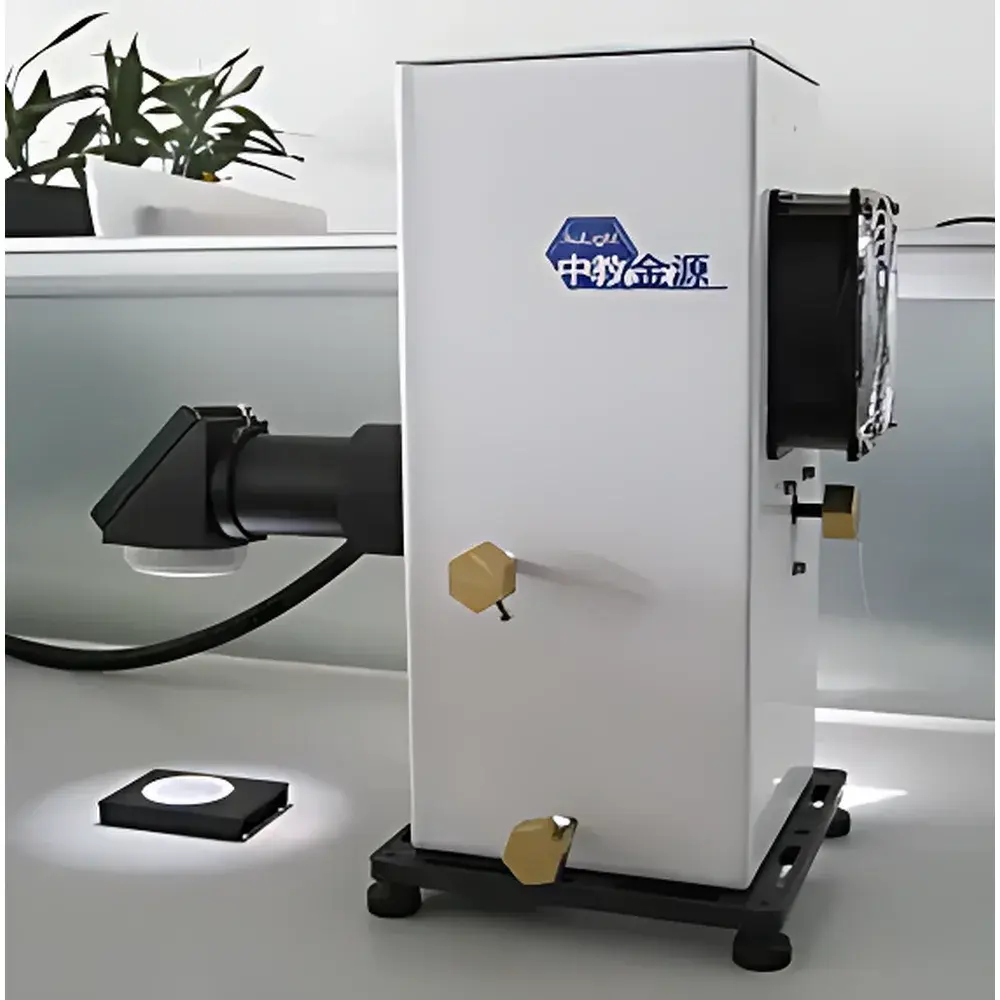
CEL-M500 Mercury Arc Lamp Light Source
| Brand | CEAULIGHT (Zhongjiao Jinyuan) |
|---|---|
| Origin | Beijing, China |
| Manufacturer Type | OEM Manufacturer |
| Light Source Type | Medium-Pressure Mercury Arc Lamp |
| Illumination Mode | External Irradiation Configuration |
| Cooling Method | Dual-Fan Forced Air Circulation |
| Color Temperature | ~6000 K |
| Optical Output Options | Collimated Beam, Point Source, Fiber-Coupled Output |
| Integrated Igniter | Yes |
| Mounting Platform | 3-Axis Translational Stage |
| Compliance | Designed for laboratory-grade photoreactor integration and optical alignment workflows |
Overview
The CEL-M500 Mercury Arc Lamp Light Source is a precision-engineered, medium-pressure mercury discharge lamp system designed for controlled ultraviolet (UV) and visible (VIS) irradiation in photochemical, photocatalytic, and materials characterization laboratories. Operating on the principle of electrical excitation of mercury vapor within a fused quartz envelope, the lamp emits discrete spectral lines—most notably at 254 nm (UVC), 313 nm (UVB), 365 nm (UVA), 405 nm (violet), 436 nm (blue), 546 nm (green), and 579 nm (yellow)—enabling selective activation of UV-sensitive catalysts, photoinitiators, and semiconductor materials. Unlike broadband thermal sources, the CEL-M500 delivers high-intensity line spectra with stable radiometric output over extended operational lifetimes (>1,000 hours rated). Its external irradiation architecture allows flexible integration into custom photoreactors, gas-phase reaction cells, or optical benches without internal chamber constraints.
Key Features
- Medium-pressure mercury arc lamp with fused silica envelope for enhanced UV transmission down to 185 nm
- Integrated high-voltage electronic igniter housed within the lamp housing—eliminating hazardous high-voltage cabling between power supply and lamp chamber
- Dual-fan forced-air cooling system ensures thermal stability and extends lamp lifetime under continuous operation
- Optimized optical train featuring high-efficiency collimating lenses and rear-mounted reflective mirror geometry to maximize radiant flux collection and directional control
- Three-axis mechanical translation stage (X-Y-Z) enables micron-level alignment of beam position, angle, and focal distance relative to sample plane
- Multiple output configurations supported: free-space collimated beam (±1.5° divergence), focused point source (<2 mm spot size at 100 mm working distance), and SMA905-compatible fiber coupling (core diameter up to 1000 µm)
- Color temperature approximating 6000 K—suitable for broad-spectrum solar simulation when combined with appropriate filtering or spectral shaping optics
Sample Compatibility & Compliance
The CEL-M500 is compatible with standard quartz cuvettes, flat-bottomed reactor vessels, thin-film substrates, and powder-coated catalyst plates. Its external illumination design avoids sample heating from enclosure convection and permits real-time in situ monitoring via complementary spectroscopic or imaging systems. The unit conforms to IEC 61000-6-3 (EMC emission limits) and IEC 61000-6-2 (immunity requirements) for laboratory equipment. While not certified as Class 3B laser product, it complies with ANSI Z136.1-2022 safety guidelines for high-intensity UV-VIS sources—including mandatory interlock-ready chassis design, removable safety shutter, and labeling per ISO 7010-W005 (radiation hazard symbol). It supports GLP-compliant experimental protocols through repeatable irradiance calibration traceable to NIST-traceable reference detectors.
Software & Data Management
The CEL-M500 operates as a standalone analog-controlled light source; no proprietary software or driver installation is required. For automated irradiation dosimetry, users may integrate third-party radiometers (e.g., Thorlabs PM100D with S120VC sensor) or spectroradiometers (e.g., Ocean Insight USB2000+) via analog voltage output (0–5 V = 0–100% lamp intensity). Optional digital interface modules support RS-232 or USB-to-serial communication for TTL-triggered on/off sequencing and time-stamped exposure logging. All operational parameters—including runtime hours, ignition cycles, and fan status—are logged internally and accessible via front-panel LCD display. Audit trails meet minimum requirements for FDA 21 CFR Part 11–aligned data integrity frameworks when paired with validated LIMS or ELN platforms.
Applications
- Photocatalytic degradation studies using TiO₂, g-C₃N₄, or MOF-based catalysts under UVA/UVB excitation
- UV-assisted organic synthesis including [2+2] cycloadditions, Norrish-type reactions, and photo-Fries rearrangements
- Accelerated aging and weathering tests per ASTM G154 Cycle 1 (UV-A340 lamps) and ISO 4892-3
- Calibration and validation of UV-VIS spectrophotometers and quantum yield measurement systems
- Solar cell spectral response characterization (with optional AM1.5G filter) and photoelectrochemical cell testing
- Micro-patterning of photoresists in academic microfabrication labs
FAQ
What is the typical spectral irradiance output at 365 nm?
The CEL-M500 delivers ≥120 mW/cm² at 365 nm (measured at 10 cm working distance, unfiltered, using a calibrated thermopile detector).
Can the lamp be operated continuously for >8 hours?
Yes—continuous operation up to 12 hours is supported under ambient lab conditions (≤25°C, <60% RH) with uninterrupted dual-fan cooling.
Is ozone generation a concern during UVC operation?
At 254 nm, ozone is produced if air is present in the irradiation path; use in inert atmosphere or with ozone-scrubbing filters is recommended for enclosed setups.
Does the system include radiometric calibration documentation?
A factory-issued spectral irradiance report (covering 200–800 nm, ±2 nm resolution) is provided with each unit, traceable to NIST SRM 2032.
What maintenance is required for long-term reliability?
Lamp replacement every 1,000–1,200 operating hours; periodic cleaning of quartz window and reflector surface with spectroscopic-grade methanol; annual verification of fan RPM and ignition voltage waveform.





