
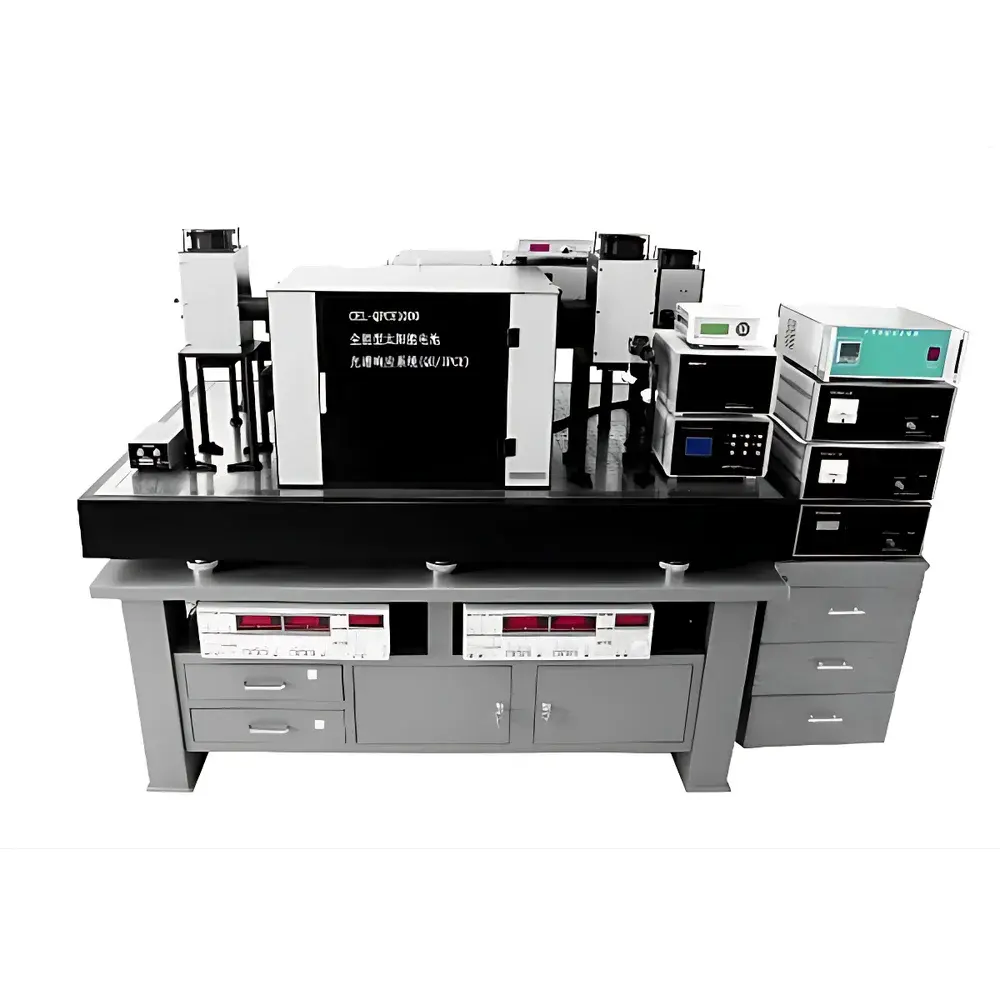
CEL-QPCE1000 All-in-One Solar Cell Quantum Efficiency & IPCE Measurement System
| Brand | CEA-Light (Zhongjiaojinyuan) |
|---|---|
| Origin | Beijing, China |
| Manufacturer Type | OEM/ODM Manufacturer |
| Origin Category | Domestic (PRC) |
| Model | CEL-QPCE1000 All-in-One Solar Cell Quantum Efficiency & IPCE Measurement System |
| Light Source Type | Multi-lamp Modular Source (Xenon, Tungsten-Halogen, Deuterium) |
| Illumination Mode | External Illumination Configuration |
| Spectral Range | 200–2500 nm (optional extended range) |
| Wavelength Step Resolution | ≥1 nm, continuously adjustable |
| Scan Repeatability | <0.3% (J<sub>sc</sub>) |
| Operating Modes | AC (chopper-synchronized) and DC |
| Chopping Frequency | 5–1000 Hz |
| Temperature Control Stage | 5–40 °C (±0.5 °C stability) |
| Bias Light Options | Dual independent bias channels, configurable for multi-junction devices |
| Monochromator Options | Single or dual monochromator configuration with stray-light suppression |
| Optical Monitoring | Real-time reference beam feedback for source drift correction |
| Software Compliance | Supports audit trail, parameter logging, and data integrity per GLP/GMP-aligned workflows |
Overview
The CEL-QPCE1000 All-in-One Solar Cell Quantum Efficiency & IPCE Measurement System is an integrated, research-grade optical instrumentation platform engineered for precise spectral responsivity characterization of photovoltaic (PV) materials and devices. Based on the fundamental principle of monochromatic photoresponse measurement—where incident photon flux at discrete wavelengths is quantified via calibrated silicon photodiode traceable to NIST standards—the system determines external quantum efficiency (EQE), internal quantum efficiency (IQE), incident photon-to-electron conversion efficiency (IPCE), spectral reflectance, spectral transmittance, and wavelength-resolved short-circuit current density (Jsc(λ)). Its architecture supports both single-junction and complex multi-junction architectures—including Si, GaAs, InGaP, InP, Ge, CdTe, CIGS, DSSCs, OPVs, and perovskite-based cells—enabling rigorous device physics analysis, interface loss quantification, and optical stack optimization under controlled illumination and thermal conditions.
Key Features
- Modular light source assembly integrating xenon arc, tungsten-halogen, and deuterium lamps—ensuring continuous, stable spectral coverage from deep UV (200 nm) to near-infrared (2500 nm)
- High-fidelity Czerny-Turner monochromator with aberration-corrected optics and automated filter wheel for higher-order spectrum suppression and minimized stray light (<10−5 relative intensity)
- Dual-mode signal acquisition: synchronized lock-in amplifier for AC mode (5–1000 Hz chopping) and low-noise transimpedance amplifier for DC mode—optimized for sub-picoamp photocurrent resolution
- Patented sample stage with vacuum-assisted fixation, gold-plated contact probes, and electromagnetic shielding—minimizing contact resistance variability and EMI-induced noise
- Real-time optical monitoring path with reference photodetector—enabling dynamic normalization to compensate for lamp intensity drift during long-duration scans
- Thermostatically regulated sample holder (5–40 °C, ±0.5 °C) with optional cryogenic or high-temperature extensions for temperature-dependent EQE studies
- Configurable bias illumination subsystem with two independently controllable channels—essential for accurate IQE derivation and multi-junction cell characterization
- Automated shutter control for primary monochromatic beam and auxiliary bias light—enabling dark-current subtraction, background correction, and sequential illumination protocols
Sample Compatibility & Compliance
The CEL-QPCE1000 accommodates standard PV test coupons (up to 5 × 5 cm), mini-modules, and custom substrates with edge-contact or busbar configurations. It complies with key international measurement standards including IEC 60904-8 (spectral response of PV devices), ASTM E1021 (test methods for spectral responsivity), and ISO 18583 (characterization of thin-film solar cells). The system’s calibration traceability follows SI units through NIST-traceable reference detectors and certified spectral irradiance standards. All hardware control logic and software data handling adhere to ALCOA+ principles (Attributable, Legible, Contemporaneous, Original, Accurate, Complete, Consistent, Enduring, Available), supporting GLP-compliant lab environments and FDA 21 CFR Part 11 readiness when deployed with electronic signature modules.
Software & Data Management
The proprietary QPCE-Studio software provides a unified interface for instrument orchestration, real-time signal visualization, and standardized data reduction. It automates wavelength scanning, bias light sequencing, dark-current acquisition, and spectral normalization routines. Built-in algorithms perform automatic background subtraction, linear/nonlinear error compensation (including T-error correction for non-uniform spectral responsivity), and IQE derivation using measured reflectance/transmittance inputs. Output includes export-ready CSV, TXT, and HDF5 datasets; publication-quality SVG/PNG plots; comparative overlay of multiple samples; and batch-report generation with metadata embedding (operator ID, timestamp, environmental conditions, calibration certificate IDs). Audit trails record all parameter changes, user actions, and system events—ensuring full reproducibility and regulatory traceability.
Applications
- Quantitative evaluation of charge carrier generation, recombination, and collection losses across the solar spectrum
- Optical modeling validation—e.g., verifying anti-reflection coating performance, texturing efficacy, and parasitic absorption in transport layers
- Multi-junction tandem cell current-matching analysis and subcell spectral yield decomposition
- Stability assessment under thermal cycling via temperature-resolved IPCE mapping
- Material screening for emerging PV absorbers (e.g., perovskites, organic semiconductors, quantum dots)
- Quality assurance and process development in R&D and pilot-line fabrication environments
FAQ
What spectral range does the standard CEL-QPCE1000 cover, and can it be extended?
The base configuration spans 200–2500 nm; optional upgrades include UV-enhanced optics (down to 190 nm) and extended NIR gratings (up to 3000 nm), subject to detector and lamp compatibility.
Is the system compatible with both rigid and flexible solar cell substrates?
Yes—the vacuum sample stage and modular probe design accommodate glass, silicon wafers, metal foils, and polymer-supported thin films without mechanical stress or alignment drift.
How is system calibration maintained over time?
Calibration is performed using NIST-traceable reference detectors and certified spectral irradiance standards; the software supports periodic recalibration workflows with full documentation export.
Can the CEL-QPCE1000 measure devices under operating bias conditions?
Yes—integrated potentiostatic control (optional add-on) enables J-V curve superposition with spectral response, supporting voltage-dependent EQE analysis.
Does the software support automated compliance reporting for ISO/IEC 17025 labs?
QPCE-Studio generates structured metadata logs and PDF reports aligned with ISO/IEC 17025 clause 7.8 requirements, including uncertainty budgets, calibration status, and environmental monitoring records.




