
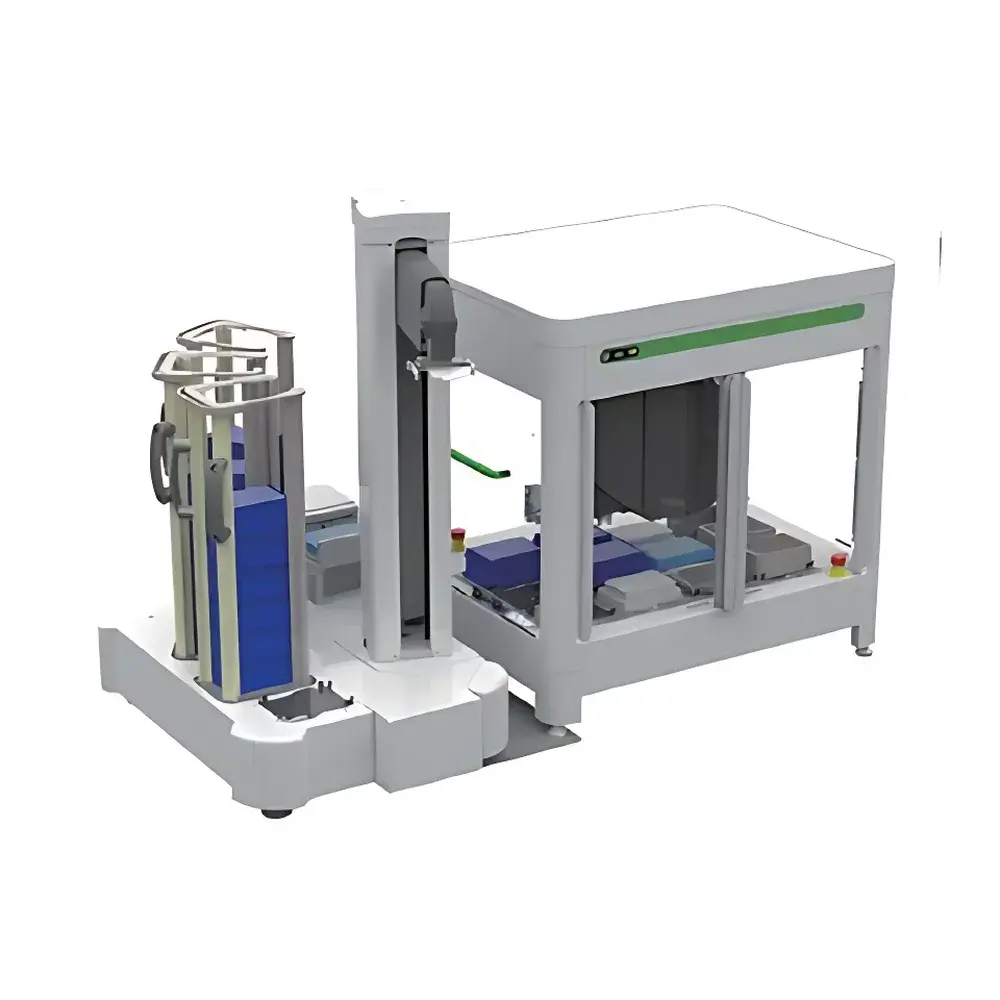
Revvity Zephyr G3 NGS iQ Integrated Library Preparation Workstation
| Brand | Revvity |
|---|---|
| Origin | USA |
| Manufacturer Type | Original Equipment Manufacturer (OEM) |
| Product Origin | Imported |
| Model | Zephyr G3 NGS iQ |
| Automation Level | Fully Automated |
| Channel Configuration | Multi-channel |
| Extraction Method | Membrane-based Solid Phase Extraction (SPE) |
| Flow Rate Control | Programmable per protocol step |
| Eluent Solvent Flexibility | Customizable per assay |
| Sample Throughput | 1–96 samples per run |
| Sample Input Volume | 1–200 µL |
| Wetted Materials | Chemically resistant polymers (e.g., PEEK, ETFE, fluorinated elastomers) compliant with organic solvents and enzymatic reagents |
Overview
The Revvity Zephyr G3 NGS iQ Integrated Library Preparation Workstation is a compact, benchtop-scale automation platform engineered specifically for next-generation sequencing (NGS) library construction. Unlike generic liquid handlers, the Zephyr G3 NGS iQ implements a purpose-built architecture integrating robotic liquid handling, on-deck thermal cycling, consumable storage, and coordinated workflow orchestration—all within a single footprint (~75 cm × 65 cm). Its core operation leverages precise positive-displacement pipetting combined with membrane-based solid-phase extraction (SPE) to perform bead-based or column-free cleanup steps critical for adapter ligation, size selection, and purification of fragmented DNA/RNA prior to amplification. The integrated thermal cycler supports real-time PCR, endpoint amplification, and enzyme incubation (e.g., A-tailing, end-repair, ligase reactions), eliminating manual plate transfers and minimizing contamination risk. Designed for reproducible, walk-away library prep—from sheared nucleic acid input to index-enriched, QC-ready libraries—the system complies with fundamental principles of Good Laboratory Practice (GLP) and supports audit-ready process documentation when paired with validated software configurations.
Key Features
- Fully automated, walk-away NGS library preparation for up to 96 samples per run, including fragmentation QC integration via optional microfluidic electrophoresis modules.
- Multi-channel liquid handler with sub-microliter dispensing accuracy (CV < 3% at 1 µL) and low-retention tips compatible with viscous enzymatic master mixes and magnetic beads.
- On-deck thermal cycler supporting ramp rates up to 4.0 °C/s, uniformity ±0.25 °C across 96-well format, and programmable hold steps for enzymatic incubations without external transfer.
- Integrated SPE module utilizing hydrophilic-hydrophobic membrane cartridges; enables high-recovery, low-background cleanup without centrifugation or vacuum manifolds.
- Modular consumable deck accommodating standard SBS-format plates (96- and 384-well), tube racks, filter plates, and custom carrier inserts—configured via drag-and-drop deck mapping in iQ Software.
- Chemically inert fluid path constructed from PEEK, ETFE, and fluorosilicone components, validated for compatibility with ethanol, isopropanol, 80% formamide, and common restriction enzyme buffers.
Sample Compatibility & Compliance
The Zephyr G3 NGS iQ accommodates diverse nucleic acid inputs including FFPE-derived DNA, cfDNA, total RNA, and single-cell lysates. It supports library prep kits from Illumina (TruSight, Nextera XT), Thermo Fisher (Ion AmpliSeq), and Pacific Biosciences (SMRTbell), with pre-validated protocols available through Revvity’s Application Library. All hardware and firmware comply with IEC 61000-6-2 (EMC immunity) and IEC 61010-1 (safety for laboratory equipment). When deployed under 21 CFR Part 11-compliant iQ Software configuration—including electronic signatures, audit trails, and role-based access control—the system meets requirements for regulated environments conducting clinical sequencing or IVD development.
Software & Data Management
The iQ Software Suite provides a cloud-enabled, browser-based interface (HTTPS/TLS 1.2+) for remote method design, run monitoring, and instrument diagnostics. Protocols are structured as modular “workflow blocks” (e.g., “Fragment + End-Repair”, “Adapter Ligation + SPRI Cleanup”) enabling rapid recombination without scripting. Each run generates a timestamped, immutable JSON log containing pipetting coordinates, temperature profiles, error codes, and completion status—exportable for LIMS integration. Raw log files and processed metadata adhere to MIAME and MINSEQE standards. Local data residency options and on-premise deployment mode are available for institutions requiring HIPAA or GDPR-aligned infrastructure.
Applications
- High-throughput targeted panel sequencing for oncology biomarker discovery and validation.
- Automated dual-indexed library prep for population-scale whole-exome sequencing studies.
- Low-input and degraded sample workflows, including forensic STR analysis and ancient DNA processing.
- Process standardization across multi-site clinical trial laboratories performing companion diagnostic assay development.
- Integration into ISO 15189-accredited molecular pathology labs seeking traceable, repeatable NGS prep SOPs.
FAQ
Does the Zephyr G3 NGS iQ support dual indexing for Illumina platforms?
Yes—pre-validated protocols include both single- and dual-indexing schemes compliant with Illumina’s IDT for Illumina and TruSight Oncology kits.
Can users import custom Python or JavaScript scripts into iQ Software?
No—iQ Software operates on a declarative workflow engine; customization occurs via parameterized protocol templates, not code injection.
Is the thermal cycler validated for quantitative PCR applications?
The integrated cycler is qualified for endpoint PCR and enzymatic incubation; for qPCR, Revvity recommends coupling with a dedicated real-time detection module (sold separately).
What maintenance intervals are recommended for the SPE membrane cartridges?
Cartridges are single-use per protocol run; no cleaning or reuse is supported. Shelf life is 24 months unopened under ambient storage.
How does the system ensure cross-contamination control between runs?
It employs positive-pressure HEPA-filtered laminar airflow above the deck, tip-waste decontamination via 10% bleach aspiration, and UV-C irradiation (254 nm) during idle cycles—each logged in the audit trail.



