English Product Name
| Brand | CMECO2 (Zhongjiao Jinyuan) |
|---|---|
| Origin | Beijing, China |
| Manufacturer Type | OEM Manufacturer |
| Country of Origin | China |
| Model | CMECO2-HPX Series |
| Pressure Range | Low-Pressure Mode < 0.6 MPa |
| Thermal Reactor Temp. | 0–800 °C |
| Photothermal Reactor Temp. | 0–800 °C |
| Vaporization Zone Temp. | 0–300 °C |
| Tubing Trace Heating Temp. | 0–200 °C |
| Liquid Flow Rate | 0.1–5 mL/min |
| Catalyst Bed Volume | < 5 mL |
| Frame Dimensions | 1130 × 550 × 1340 mm |
| Construction Material | ASTM A240 316L Stainless Steel & High-Strength Anodized Aluminum Extrusions |
| Control Interface | Industrial Touchscreen PC with Real-Time SCADA Software |
Overview
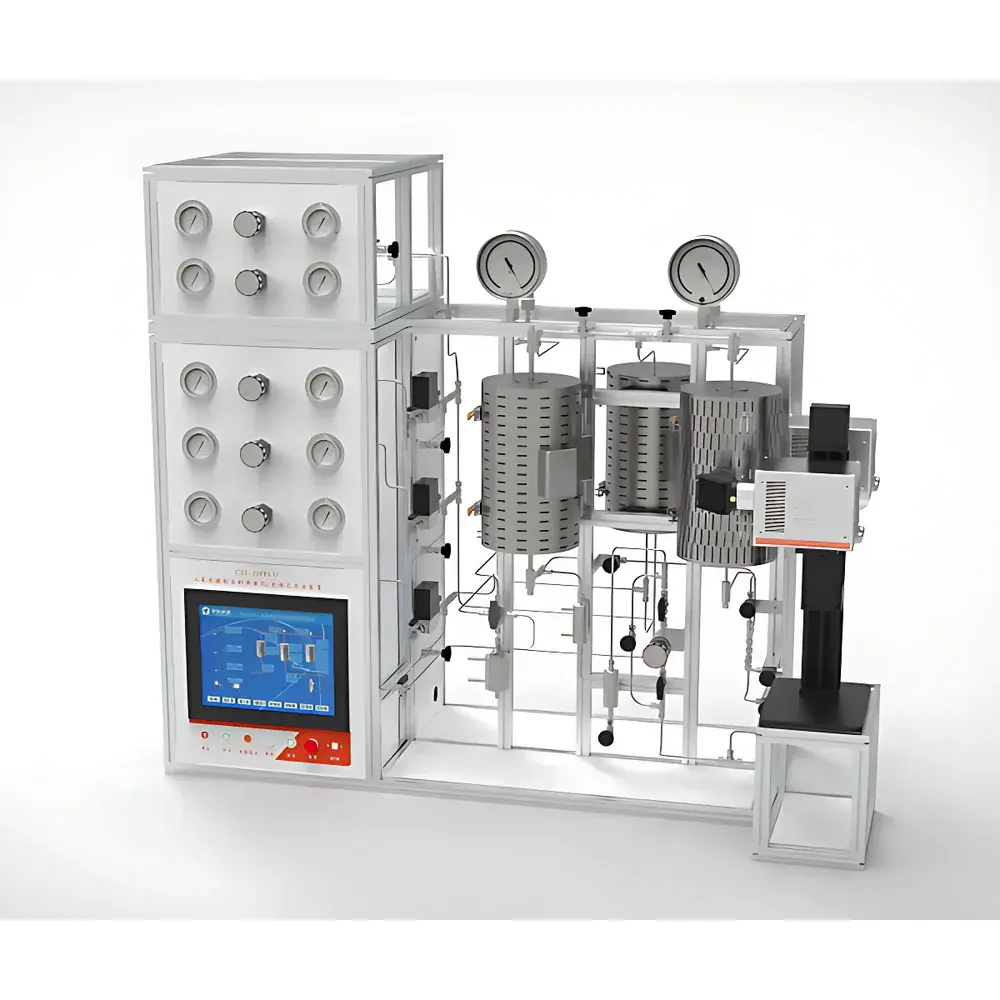
The CMECO2-HPX Series is an integrated fixed-bed catalytic reactor platform engineered for systematic evaluation and screening of heterogeneous catalysts in CO₂ hydrogenation, methanation, reverse water-gas shift (RWGS), and CO₂-to-methanol or CO₂-to-C₂₊ hydrocarbon conversion processes. It operates on dual-mode activation principles: conventional thermal catalysis (via resistive furnace heating) and photothermal catalysis (with optional integrated LED or Xe-lamp irradiation modules coupled to temperature-controlled quartz reactors). The system enables precise decoupling of thermal and photon-driven contributions under rigorously controlled gas-phase composition, partial pressure, residence time, and surface temperature—critical for mechanistic studies compliant with ISO 18397:2021 (catalyst testing guidelines) and ASTM D3222 (gas-phase reaction kinetics standards). Designed for laboratory-scale kinetic mapping and catalyst lifetime assessment, it supports continuous-flow operation with real-time process monitoring and automated data acquisition.
Key Features
- Modular dual-pressure architecture: Independent low-pressure (<0.6 MPa) and high-pressure (<10 MPa) fluidic paths, each equipped with proportional pressure relief valves, Class 0.25 accuracy digital pressure transducers, and ASME B31.3-compliant 316L stainless steel tubing.
- Multi-zone temperature control: Three independently regulated thermal zones—vaporizer (0–300 °C), preheater/trace heating (0–200 °C), and reactor furnace (0–800 °C)—all featuring PID + auto-tuning algorithms and hardware interlocked overtemperature cutoff.
- Calibrated liquid dosing: Syringe pump-based liquid delivery (0.1–5 mL/min) with programmable ramp profiles; vaporization module includes thermostatic water-bath control for ppm-level organic vapor generation (e.g., toluene, ethanol, water) without reliance on expensive certified standard gases.
- Automated safety protocol: Real-time monitoring of 12+ critical parameters (T, P, flow, valve position); automatic shutdown triggered by deviation beyond user-defined thresholds per IEC 61511 SIL-2 functional safety requirements.
- SCADA-integrated control: Windows-based HMI software with drag-and-drop experiment sequencing, event logging with ISO/IEC 17025-compliant audit trail, and export-ready CSV/Excel reporting aligned with GLP documentation standards.
Sample Compatibility & Compliance
The CMECO2-HPX accommodates solid catalysts in powder, pellet, or monolithic forms (bed volume ≤5 mL), with compatibility across gaseous reagents (CO₂, H₂, CO, CH₄, N₂, Ar), liquid co-reactants (H₂O, MeOH, EtOH), and vapor-phase organics. All wetted parts conform to USP Class VI biocompatibility and FDA 21 CFR Part 11 electronic record requirements when paired with validated software configuration. Pressure vessels are CE-marked per PED 2014/68/EU and designed to EN 13445-3. Gas handling components meet ISO 8573-1 Class 2 purity specifications for compressed air and inert carrier gases.
Software & Data Management
The embedded control suite provides full lifecycle experiment management—from method creation (including multi-step TPR/TPD-like temperature ramps) to post-run analysis. Data streams from thermocouples, mass flow controllers, pressure sensors, and optional external GC/FID/TCD signals are time-synchronized at 10 Hz sampling rate. Raw datasets are stored with metadata (operator ID, timestamp, calibration certificate IDs, version-controlled firmware logs). Reporting modules generate ASTM E29-compliant precision statements and support LIMS integration via OPC UA or RESTful API. Audit trails include user login/logout events, parameter changes, and alarm acknowledgments—fully traceable for FDA 21 CFR Part 11 compliance.
Applications
- Kinetic modeling of CO₂ hydrogenation pathways over Cu/ZnO/Al₂O₃, Ni-based, or MOF-derived catalysts.
- Stability testing under cyclic thermal stress (e.g., 100 h at 300 °C, 3 MPa) with periodic online GC analysis.
- Photothermal synergy quantification using wavelength-resolved irradiance control and simultaneous surface temperature mapping.
- Water-gas shift equilibrium studies across 200–500 °C at varying H₂O/CO ratios.
- Co-feeding experiments evaluating sulfur tolerance or halogen poisoning mechanisms.
FAQ
Can the system be configured for in situ spectroscopic coupling (e.g., DRIFTS, Raman)?
Yes—quartz reactor tubes with CaF₂ or sapphire windows (optional) enable integration with external spectrometers; flange interfaces comply with ISO-KF40 vacuum standards.
Is remote monitoring supported?
The system supports secure VNC and MQTT-based telemetry; full remote operation requires on-site network configuration and firewall exception approval.
What validation documentation is provided?
Each unit ships with Factory Acceptance Test (FAT) report, pressure vessel test certificates, calibration certificates for all sensors (NIST-traceable), and IQ/OQ protocols for GxP environments.
Are custom catalyst holders available?
Yes—custom-designed quartz or Inconel holders (including microchannel, membrane-supported, or graded-density beds) can be fabricated upon technical specification submission.
Does the software support automated method transfer to industrial-scale reactors?
While not a direct scale-up tool, the kinetic dataset generated adheres to Hougen-Watson formalism and can be imported into Aspen Custom Modeler or gPROMS for reactor simulation and scale-up correlation.