
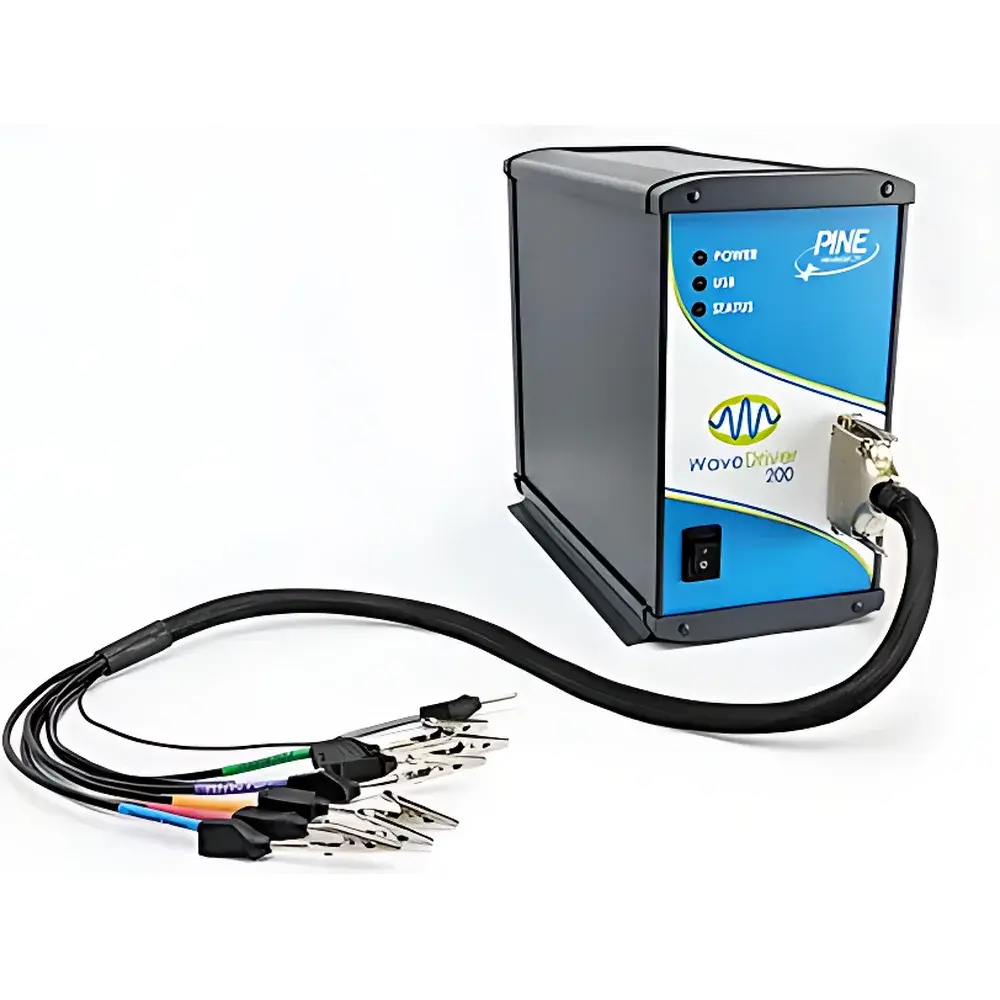
PINE WaveDriver200 Potentiostat/Galvanostat/ZRA with Integrated EIS and RRDE Capability
| Origin | USA |
|---|---|
| Manufacturer Type | Authorized Distributor |
| Origin Category | Imported |
| Model | WaveDriver200 |
| Pricing | Available Upon Request |
Overview
The PINE WaveDriver200 is a high-performance, modular potentiostat/galvanostat/zero-resistance ammeter (ZRA) engineered for precision electrochemical research in academic, industrial, and regulatory environments. Built on a robust analog front-end architecture and optimized digital signal processing, it operates on the principles of controlled-potential (potentiostatic), controlled-current (galvanostatic), and zero-resistance current measurement modes—enabling quantitative analysis of interfacial charge transfer kinetics, mass transport, and surface redox processes. Its native support for Electrochemical Impedance Spectroscopy (EIS) across a 10 μHz–1 MHz frequency range, combined with dedicated Rotating Ring-Disk Electrode (RRDE) methodology, makes it particularly suited for mechanistic studies in energy conversion and storage systems—including fuel cell catalyst characterization, Li-ion battery interface evolution, corrosion inhibition efficiency quantification, and electrocatalytic O₂ reduction reaction (ORR) pathway discrimination.
Key Features
- True four-electrode capability with independent potentiostatic control of disk and ring electrodes—enabling simultaneous, synchronized CV, LSV, CA, and CP waveforms in all six RRDE operational modes (Collection, Shielding, Window, Diametric, Galvanostatic, and Galvanostatic Shielding)
- Ultra-low noise performance: <10 mVRMS ripple, input leakage current <10 pA, and 16-bit ADC resolution supporting up to 10 million data points per experiment
- High-speed analog response: 10 V/μs slew rate, >15 MHz bandwidth (−3 dB), and ±17 V compliance voltage for demanding transient measurements
- Multi-range precision: Voltage resolution down to 78 μV/bit (±2.5 V range); current resolution down to 3.13 pA (±100 nA range); accuracy of ±0.2% (set value) and ±0.05% (measured value) for both potential and current
- Comprehensive IR compensation: Dual-mode (current interrupt + positive feedback) plus EIS-based solution resistance correction for accurate kinetic deconvolution in resistive electrolytes
Sample Compatibility & Compliance
The WaveDriver200 supports standard two-, three-, and four-electrode configurations with full floating (ground-isolated) operation—critical for measurements on insulating substrates, coated metals, or battery half-cells. It is compatible with rotating electrode systems (RDE, RRDE, RCE), spectroelectrochemical cells (with fiber-optic coupling), microfluidic electrochemical flow cells, and custom-designed in situ/operando cells. From a regulatory standpoint, its hardware design and firmware architecture align with GLP-compliant data integrity requirements; experimental metadata—including timestamp, instrument ID, parameter set, and user signature—is embedded in raw binary files. While not pre-certified for FDA 21 CFR Part 11, the system supports audit-trail-ready software workflows when paired with PINE’s AfterMath™ v3.x or third-party compliant platforms (e.g., MATLAB® with Data Acquisition Toolbox).
Software & Data Management
Controlled via PINE’s AfterMath™ software (Windows-based), the WaveDriver200 enables fully programmable experiment sequencing, template-driven method building, and real-time visualization of time-domain and frequency-domain responses. EIS data are presented in Lissajous, Bode, Nyquist, and Mott-Schottky formats, with built-in Kramers–Kronig validation and circuit fitting using modified Levenberg–Marquardt, Simplex, and Powell algorithms. Users may define custom frequency sweeps (linear/logarithmic/arbitrary), select active data points dynamically during fitting, and export impedance parameters with uncertainty estimates. All raw datasets are stored in HDF5 format—ensuring long-term readability, metadata embedding, and compatibility with Python (h5py), MATLAB, and open-source electrochemical analysis libraries (e.g., PyEIS, ECpy).
Applications
- Fuel cell catalyst evaluation: ORR electron transfer number (n) and peroxide yield (%H₂O₂) determination via RRDE collection efficiency calibration
- Lithium-ion battery SEI/CEI formation kinetics: In situ EIS monitoring during constant-current cycling and open-circuit relaxation
- Corrosion science: Linear polarization resistance (LPR), electrochemical noise analysis (ENA), and rotating cylinder electrode (RCE) mass-transport-controlled dissolution studies
- Electrocatalyst stability testing: Chronoamperometric decay profiling under accelerated stress conditions (e.g., potential hold at 1.5 V vs. RHE)
- Sensor development: Amperometric detection limits and interference rejection assessment using dual-electrode differential measurements
- Photoelectrochemistry: Time-resolved photocurrent transients coupled with potentiostatic bias control in tandem with optical excitation sources
FAQ
Does the WaveDriver200 support true bipotentiostatic operation for RRDE?
Yes—it provides independent, synchronized control of disk and ring potentials with sub-millisecond timing alignment, enabling all six defined RRDE measurement modes without external hardware synchronization.
Can EIS data be acquired simultaneously with DC techniques like CV or CA?
No—EIS is a separate AC perturbation technique; however, multi-step experiments can sequence EIS before/after DC methods within a single protocol.
Is AfterMath™ software included with the instrument purchase?
Yes—full license for AfterMath™ v3.x is bundled, including EIS modeling, RRDE analysis modules, and automated report generation.
What is the maximum sampling rate for time-domain techniques?
Up to 1 MHz (10⁶ points/sec) for fast-scan CV, constrained by data storage and bus throughput; typical high-resolution CV uses 50–200 kS/s depending on scan rate and potential window.
How is electrode fouling mitigated during long-term chronoamperometry?
The system supports automated cleaning protocols (e.g., cyclic potential sweeps between measurements) and real-time current drift monitoring with user-defined alert thresholds.



