
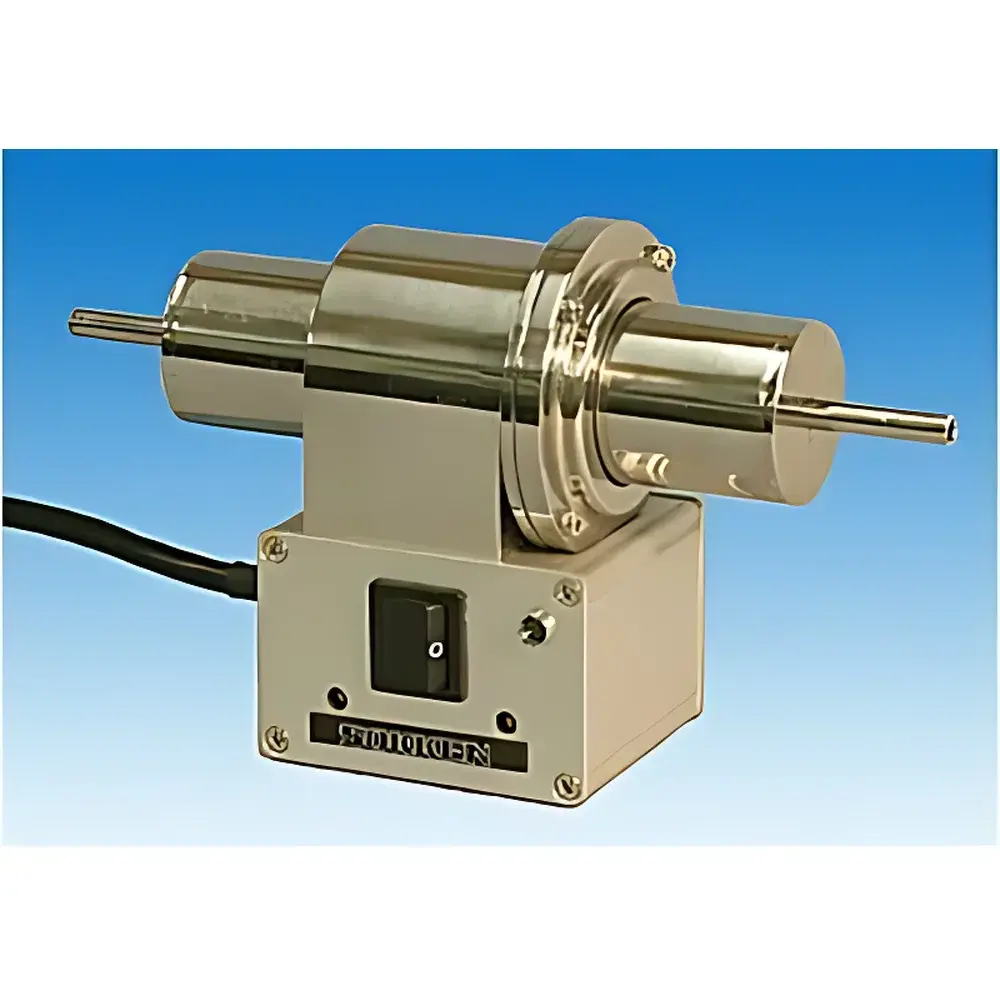
SOKKEN SMAC Aerosol Electrostatic Neutralizer
| Origin | Japan |
|---|---|
| Manufacturer Type | Distributor |
| Origin Category | Imported |
| Model | SMAC |
| Price | Upon Request |
Overview
The SOKKEN SMAC Aerosol Electrostatic Neutralizer is an engineered solution for charge equilibration of airborne aerosol particles in the nanometer to submicrometer size range (4 nm – 1 µm). It operates on the principle of surface micro-discharge (SMD) plasma generation—a non-radioactive, dielectric barrier discharge (DBD) technology originally developed by Japan’s National Institute of Advanced Industrial Science and Technology (AIST). Unlike traditional alpha-emitting 241Am neutralizers, the SMAC generates balanced bipolar ion populations (>1 × 10¹³ ions/m3 for both polarities) via localized electrostatic fields produced by four integrated SMD electrodes aligned parallel to the aerosol flow axis. This design ensures rapid, uniform particle charge relaxation—achieving Boltzmann equilibrium charge distribution under controlled laminar flow conditions—without reliance on radioactive materials. Its compact architecture (220 × 116 × 70 mm, 735 g), internal power supply, and low ozone emission (<50 ppb) make it suitable for integration into laboratory aerosol measurement systems, mobility spectrometers, CPC inlets, and ISO 14644-1 cleanroom monitoring setups.
Key Features
- Non-radioactive operation: Eliminates regulatory burden, licensing requirements, and disposal concerns associated with 241Am sources
- Bipolar ion generation: Dual-polarity output exceeds 1 × 10¹³ #/m3 per polarity, ensuring rapid neutralization kinetics across the full 4 nm–1 µm particle spectrum
- Low-ozone DBD design: Optimized dielectric barrier configuration minimizes ozone byproduct formation to <50 ppb at maximum flow
- Compact, self-contained unit: Integrated 100 VAC / 30 mA power supply; stainless steel (SUS304) housing with bakelite insulating electrodes
- Flow-compatible geometry: Cylindrical coaxial structure with central SMD array aligned parallel to aerosol stream direction, supporting laminar flow profiles from 0.3 to 2.0 slpm
- Stable thermal performance: Validated operational range of 5–40 °C ambient temperature, suitable for climate-controlled labs and portable field deployments
Sample Compatibility & Compliance
The SMAC neutralizer is compatible with monodisperse and polydisperse aerosols generated from liquid or solid precursors—including NaCl, ammonium sulfate, DEHS, and combustion-generated soot—provided particle concentration remains within instrument-specified limits for downstream detectors. It complies with IEC 61340-5-1 (Electrostatics – Protection of electronic devices from electrostatic phenomena) for charge control in sensitive instrumentation environments. While not a certified medical device, its design supports GLP-aligned aerosol characterization workflows where traceable, repeatable neutralization is required prior to differential mobility analysis (DMA), scanning mobility particle sizer (SMPS) measurements, or condensation particle counter (CPC) calibration per ISO 27891 and ASTM D6620. No radioactive material handling documentation or NRC/IAEA reporting is required.
Software & Data Management
The SMAC is a hardware-only neutralization module with no embedded firmware, display, or digital interface. It functions as a passive inline component requiring no software interaction or data logging capability. Integration into automated aerosol systems (e.g., SMPS, nano-DMA, or custom test benches) is achieved via mechanical mounting and electrical connection only. For auditability in regulated environments (e.g., pharmaceutical cleanroom qualification per ISO 14644 or EPA Method PS-1), users are advised to document installation date, flow calibration records, ozone verification reports (per ISO 16000-23), and periodic performance validation using reference neutralizers or charge distribution assays. The absence of digital controls inherently satisfies FDA 21 CFR Part 11 requirements for “non-computerized systems” in GMP contexts.
Applications
- Pre-conditioning inlet for Scanning Mobility Particle Sizers (SMPS) and Differential Mobility Analyzers (DMA)
- Charge neutralization upstream of Condensation Particle Counters (CPCs) operating below 10 nm detection thresholds
- Calibration and verification of aerosol charging models (e.g., Wiedensohler approximation, Kruis model)
- Replacement of 241Am sources in research laboratories subject to national nuclear regulatory restrictions
- Portable aerosol monitoring platforms requiring low-mass, low-power, radiation-free neutralization
- Environmental chamber studies involving nanoparticle exposure assessment and inhalation toxicology protocols
FAQ
Does the SMAC require recalibration during routine use?
No—its passive DBD architecture has no consumables or drift-prone components. Verification via ion density measurement or comparative neutralization efficiency testing is recommended annually or after physical impact.
Can the SMAC be used with corrosive or high-humidity aerosols?
Operation above 80% RH is not recommended due to potential surface conduction effects on SMD electrode performance. Corrosive gases (e.g., Cl2, SO2) may degrade bakelite insulation over extended exposure; stainless steel housing provides structural resistance but does not protect internal dielectrics.
Is ozone monitoring mandatory when operating the SMAC?
While ozone output is specified ≤50 ppb under nominal conditions, local occupational health regulations (e.g., OSHA PEL, ACGIH TLV) may require ambient ozone verification in confined or recirculated air systems.
What flow rate tolerance does the SMAC support without compromising neutralization efficiency?
Optimal performance is maintained between 0.3 and 2.0 slpm. Below 0.3 slpm, residence time increases but offers diminishing returns; above 2.0 slpm, laminar flow disruption may reduce ion–particle collision probability.
How does SMAC compare to soft X-ray neutralizers in terms of ion balance?
Unlike soft X-ray systems—which often exhibit inherent positive bias—the SMAC achieves symmetrical bipolar ion generation through geometrically balanced SMD electrode placement and pulsed DBD waveform control, yielding near-ideal Boltzmann charge distributions.
Related Products







