
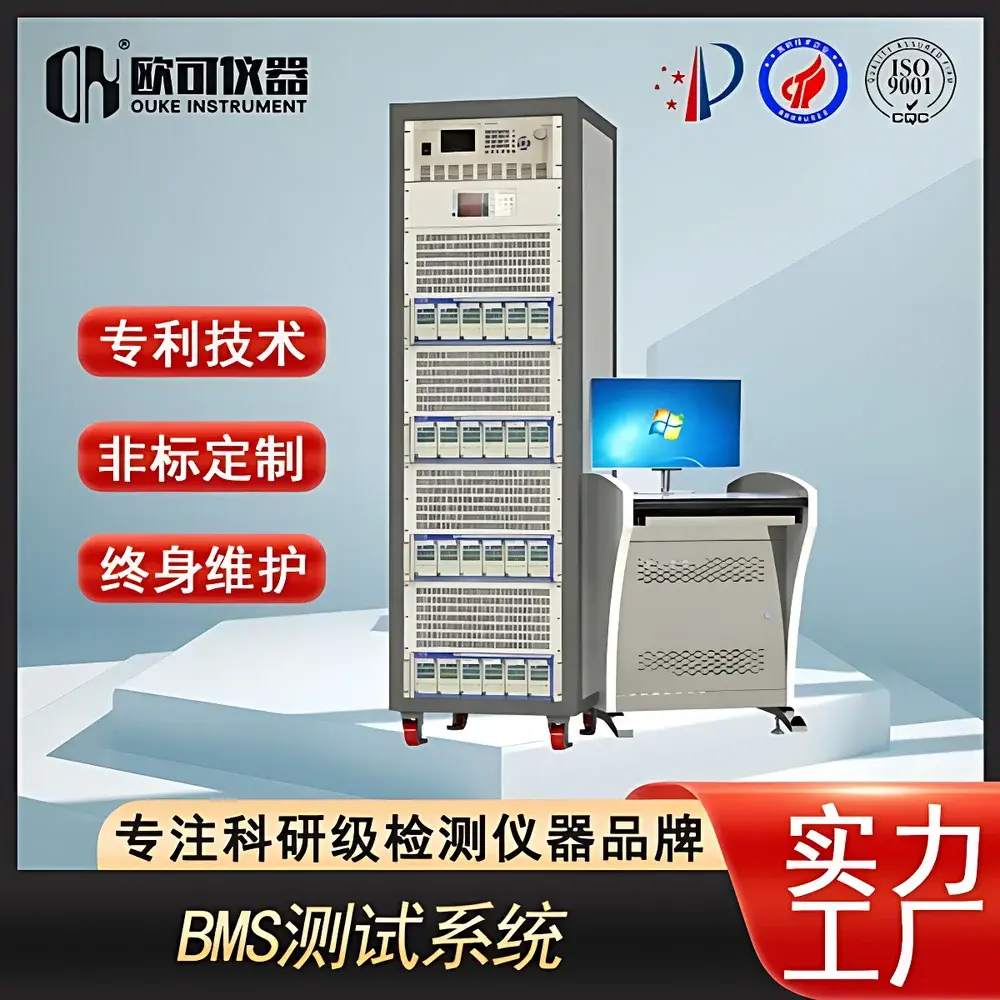
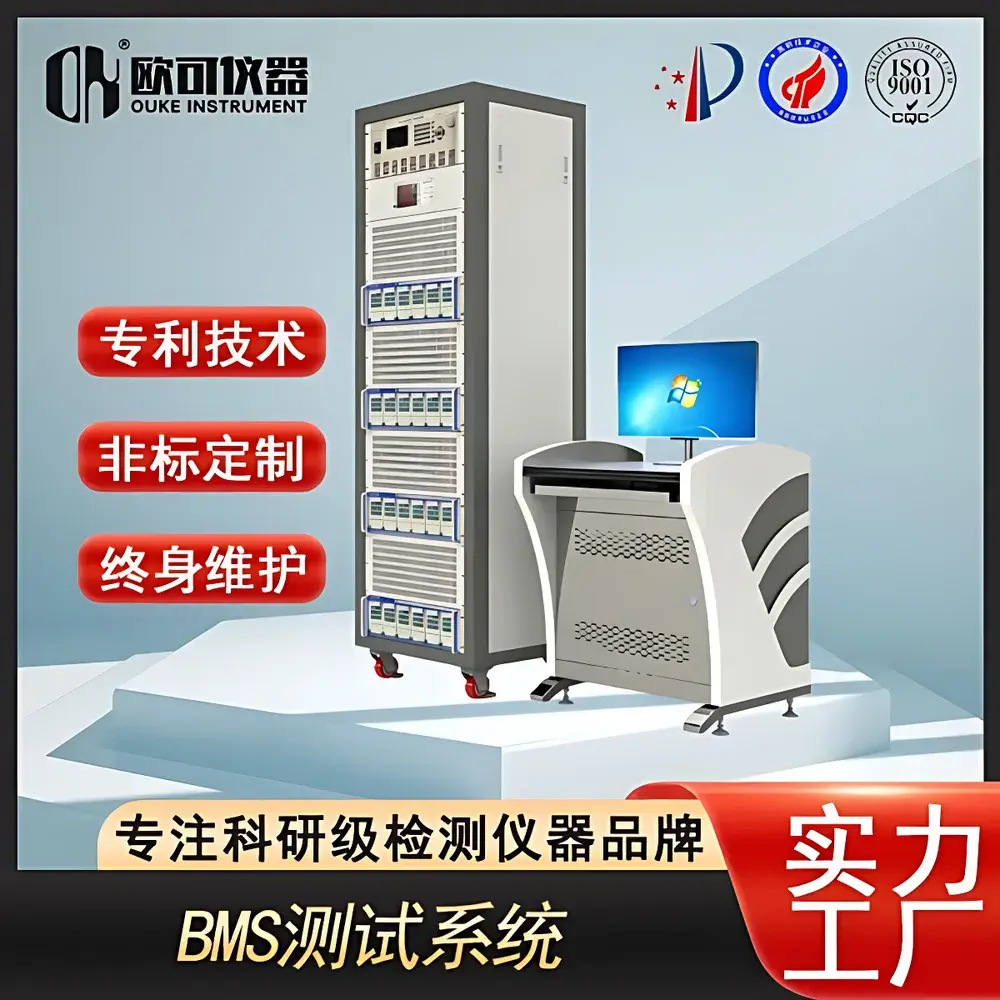
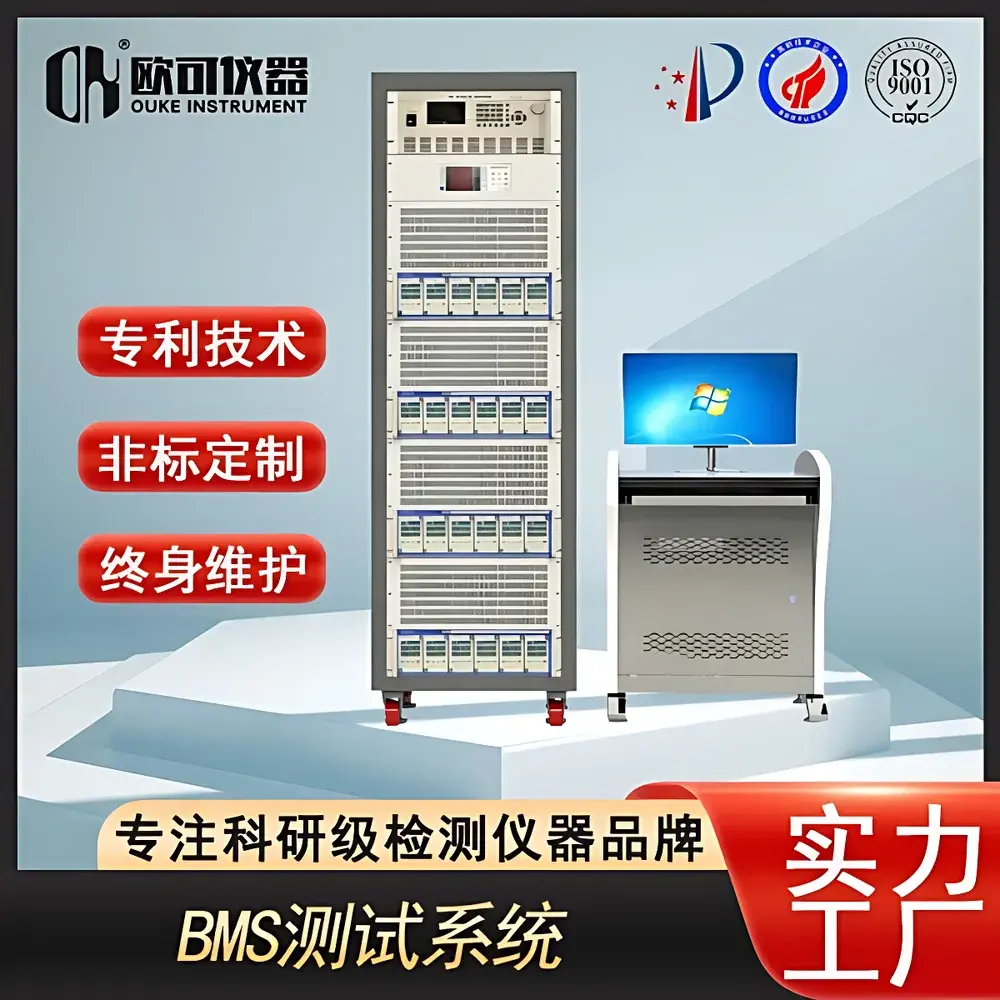
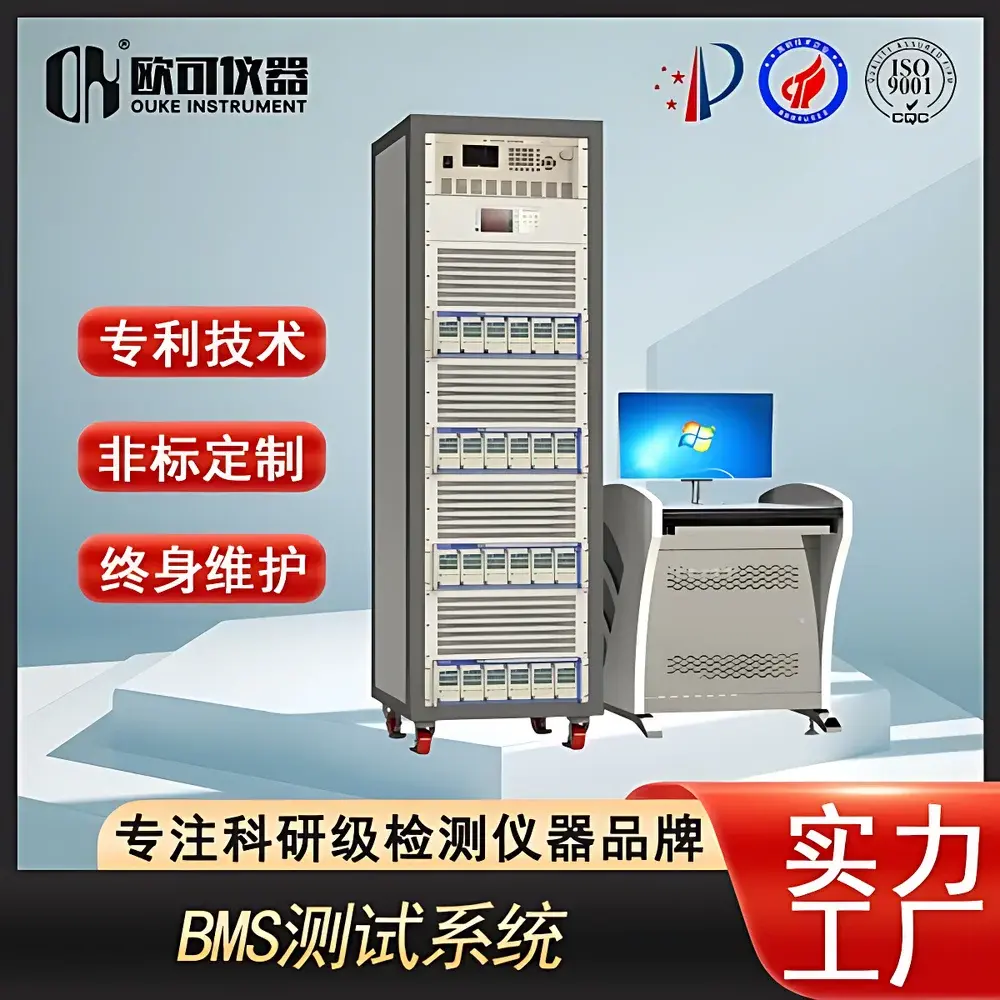
OK Instruments OK-BMS-1 Battery Management System (BMS) Test System
| Brand | OK Instruments |
|---|---|
| Origin | Guangdong, China |
| Manufacturer Type | Manufacturer |
| Origin Category | Domestic |
| Model | OK-BMS-1 |
| Price | USD 2,700 (est.) |
| Voltage Range | <1 mV |
| Voltage Measurement Accuracy | <1 mV |
| Max Output Power | ±40 W |
| Current Measurement Accuracy | ±2 µA |
| Max Output Current | ±5 A |
Overview
The OK Instruments OK-BMS-1 Battery Management System (BMS) Test System is a modular, hardware-in-the-loop (HIL)-capable validation platform engineered for rigorous functional, performance, and reliability verification of BMS hardware and firmware across lithium-ion battery applications. It operates on a hybrid physical-digital architecture—integrating high-fidelity electrochemical signal simulation with real-time control loop closure—to replace hazardous, time-intensive, and non-reproducible testing with actual battery packs. The system implements precision voltage, current, and temperature stimulus generation alongside synchronized acquisition and fault injection, enabling deterministic test execution under controlled boundary conditions. Its core measurement principle relies on calibrated analog signal synthesis (voltage/current sourcing), high-resolution delta-sigma ADC acquisition, and programmable relay-based fault switching—all traceable to NIST-traceable references and compliant with metrological best practices for industrial instrumentation. Designed explicitly for R&D labs, Tier-1 automotive suppliers, and battery pack OEMs, the OK-BMS-1 supports full lifecycle validation—from PCBA-level functional safety checks during design verification to end-of-line (EOL) automated pass/fail screening in high-volume production.
Key Features
- Modular, scalable architecture supporting 1–96 cell string configurations via hot-swappable channel modules
- High-precision voltage simulation: 0–5 V range per channel, <1 mV absolute accuracy, 1 mV resolution, channel-to-channel isolation >2000 VDC
- Ultra-low-current measurement capability: ±2 µA accuracy over ±5 A full-scale range, supporting leakage current and pre-charge diagnostics
- Programmable fault injection unit with sub-10 ms response time for overvoltage, undervoltage, open-circuit, short-circuit, reverse polarity, and insulation resistance faults
- Multi-protocol communication interface: native CAN 2.0B/CAN FD, LIN, RS-485/232, Ethernet; optional FlexRay and EtherCAT support for vehicle integration
- Temperature stimulus simulation: -40 °C to +125 °C range, ±0.1 °C accuracy, compatible with NTC, PTC, and K-type thermocouple models
- Integrated safety subsystem: dual-channel emergency stop (E-Stop), galvanic isolation, overcurrent protection, and real-time insulation monitoring per IEC 61000-4-5 and GB/T 17626 standards
Sample Compatibility & Compliance
The OK-BMS-1 accommodates a broad spectrum of BMS topologies—including centralized, distributed, and modular architectures—with support for single-board controllers (e.g., TI BQ796xx, Analog Devices LTC68xx) and multi-layer stack configurations. It validates compliance against key international and regional standards including GB/T 38661-2020 (Electric Vehicle BMS Functional Safety), GB/T 39751-2021 (Energy Storage BMS Requirements), QC/T 897-2011 (Automotive BMS Testing), and IEC 61508 (Functional Safety of Electrical/Electronic/Programmable Electronic Safety-Related Systems). All analog signal paths are calibrated to ISO/IEC 17025-accredited procedures, and data logging meets GLP/GMP audit trail requirements per FDA 21 CFR Part 11 when used with validated software configurations. Environmental robustness conforms to IP30 enclosure rating for indoor industrial use and EMC immunity per GB/T 17626 series (surge, ESD, fast transient burst).
Software & Data Management
The system ships with OK-BMS Control Suite—a Windows-based application built on Python and Qt, offering deterministic real-time test sequencing, parameter scripting, and synchronized multi-channel waveform capture at up to 1 kHz sampling rate. It supports custom test case development via Python API and integrates natively with MATLAB/Simulink for model-in-the-loop (MIL) and co-simulation workflows. Data is stored in structured HDF5 format with embedded metadata (timestamp, DUT ID, operator, calibration status), exportable to CSV, Excel, or PDF reports with configurable templates. Audit trails record all user actions, parameter changes, and test outcomes with SHA-256 hashing for integrity verification. Remote operation is enabled via secure HTTPS RESTful API with role-based access control (RBAC), facilitating integration into factory MES and PLM systems.
Applications
- Automotive BMS Validation: HIL testing of SOC/SOE estimation algorithms under dynamic drive cycles (e.g., WLTP, UDDS); verification of contactor control timing, pre-charge logic, and thermal runaway mitigation strategies
- Energy Storage System (ESS) Certification: Grid-tied and off-grid mode transition testing; cycle-life validation of balancing efficacy across 5000+ charge/discharge cycles; islanding detection and anti-islanding response latency measurement
- Industrial & Mobility Applications: Functional safety assessment (ASIL-B/C) for AGV, e-forklift, and UAV battery packs; EOL testing of protection thresholds (OVP/UVP/OCP/OTP) with statistical process control (SPC) charting
- Research & Development: Algorithm prototyping for adaptive Kalman filtering, impedance spectroscopy-based SoH estimation, and AI-driven fault classification using real-time streaming telemetry
FAQ
Does the OK-BMS-1 support real-time closed-loop control for HIL testing?
Yes—it features deterministic I/O latency (<10 ms) and supports real-time co-simulation with dSPACE SCALEXIO, NI Veristand, or Speedgoat platforms via CAN FD or Ethernet interfaces.
Can the system validate BMS communication protocols beyond CAN?
Standard configuration includes CAN, LIN, RS-485, and Ethernet. Optional modules add FlexRay, EtherCAT, and isoSPI support, with protocol decoding and conformance testing capabilities.
Is calibration documentation provided with each unit?
Each OK-BMS-1 ships with a factory calibration certificate traceable to national metrology institutes, including as-found/as-left data for all analog input/output channels and uncertainty budgets per ISO/IEC 17025.
How is data integrity ensured during long-duration tests?
The system employs cyclic redundancy checking (CRC32) on all acquired frames, automatic file segmentation every 2 GB, and timestamped checksum logging to prevent corruption or loss during multi-hour validation runs.
What environmental conditions must be maintained for optimal operation?
Operating ambient: 15–30 °C, 30–70% RH non-condensing; recommended installation in climate-controlled lab environments with dedicated grounding and filtered AC supply (220 V ±10%, 50 Hz).







