
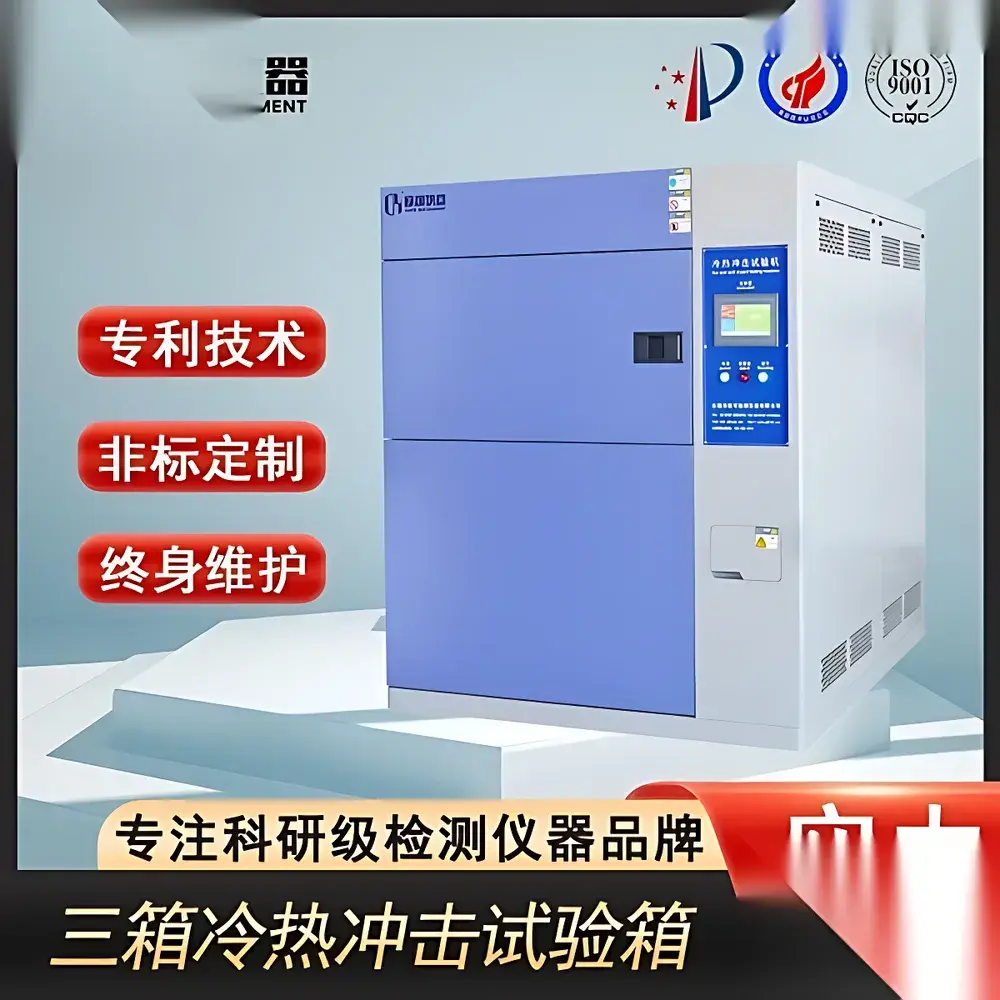
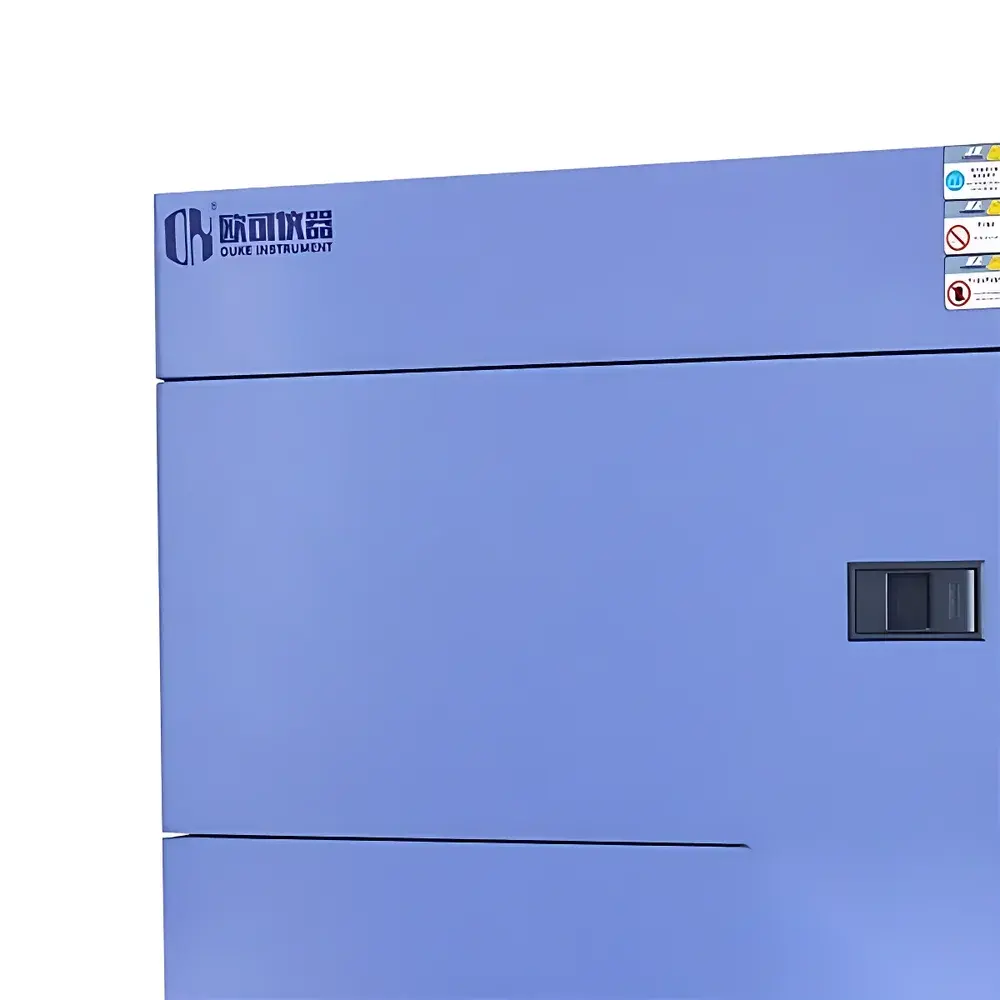
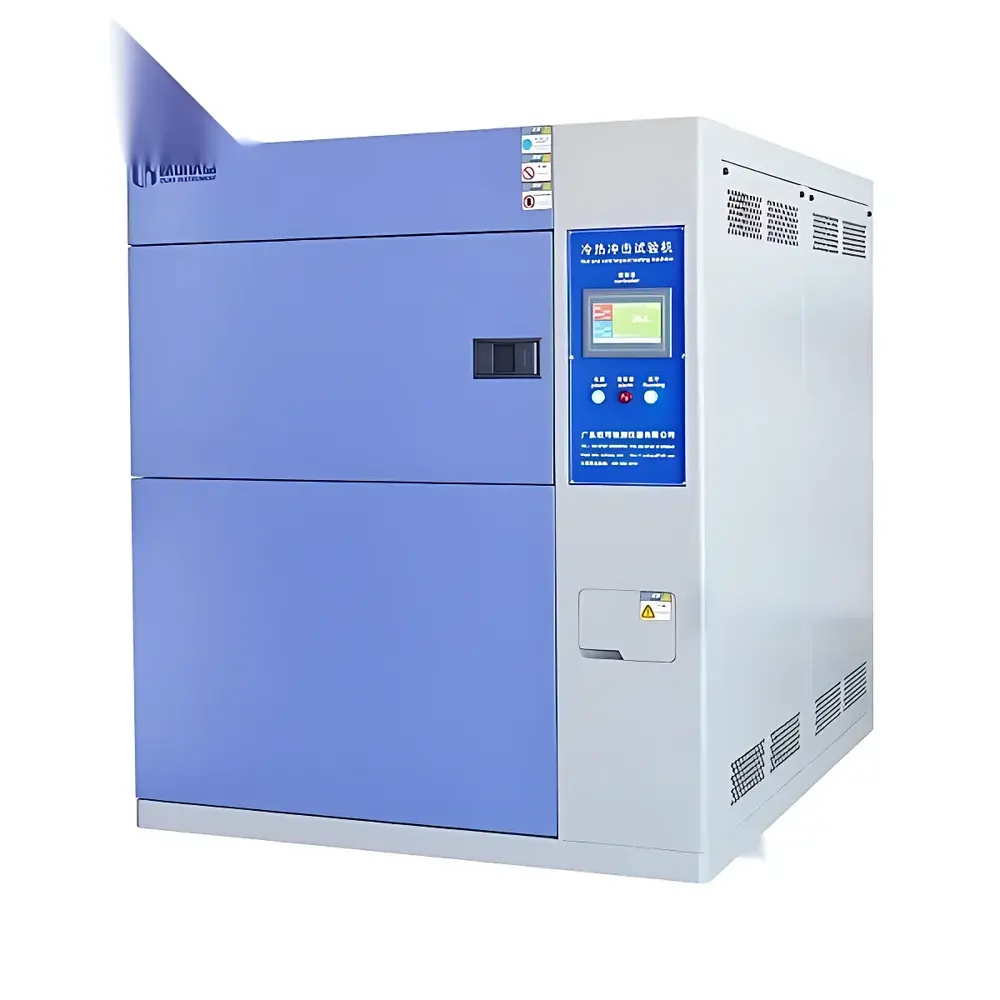
Thermal Shock Test Chamber OK-HH Series – Three-Zone Advanced Environmental Stress Screening System
| Key | Brand: Other Brands |
|---|---|
| Origin | Imported |
| Manufacturer Type | Authorized Distributor |
| Price | USD 12,500 (FOB) |
| Temperature Range (Hot Zone) | RT to +200 °C |
| Temperature Range (Cold Zone) | RT to −70 °C |
| Test Zone Range | +60 °C to +150 °C (Hot Shock), 0 °C to −65 °C (Cold Shock) |
| Switching Mechanism | Pneumatic Air-Damper–Actuated Static Specimen Method |
| Recovery Time | <5 min |
| Temperature Uniformity | ±2.0 °C |
| Control Accuracy | ±0.5 °C |
| Refrigeration | Dual-Stage Cascade System with R404A/R23 Refrigerants |
| Construction | Interior – Mirror-Finish SUS304 Stainless Steel |
| Insulation | High-Density Fire-Retardant PU Foam |
| Power Supply | AC 380 V ±5%, 50 Hz ±0.5 Hz, 3-Phase 5-Wire |
Overview
The OK-HH Series Thermal Shock Test Chamber is an engineered environmental stress screening (ESS) system designed for rapid, high-fidelity thermal cycling of electronic components, aerospace hardware, automotive modules, and advanced polymeric composites. It operates on the principle of abrupt thermal transition—subjecting specimens to extreme temperature differentials without physical movement—by isolating test samples in a stationary test chamber while pneumatically actuating insulated air dampers to connect it alternately to pre-conditioned hot and cold reservoirs. This three-zone architecture (hot soak zone, cold soak zone, and static test zone) eliminates mechanical handling-induced vibration or misalignment, ensuring metrological integrity during qualification per MIL-STD-810, IEC 60068-2-14 (Test N), and AEC-Q200. The system delivers controlled thermal shock profiles with defined dwell times, transition rates, and recovery stabilization—critical for detecting latent interfacial delamination, solder joint fatigue, seal failure, or coefficient-of-thermal-expansion (CTE) mismatch in multi-material assemblies.
Key Features
- Three-zone static-test architecture: Eliminates specimen motion—ensures repeatable positioning and avoids inertial artifacts during shock transitions.
- Dual-stage cascade refrigeration system: Comprising German-sourced semi-hermetic compressors, R404A (high-stage) and R23 (low-stage) refrigerants, and an evaporative condenser for stable sub-70 °C cold zone performance.
- Pneumatic damper switching: Achieves <5-minute thermal recovery between zones with minimal overshoot, verified via calibrated PT100 sensors at multiple spatial locations.
- High-precision PID control with adaptive tuning: Maintains ±0.5 °C setpoint accuracy and ±2.0 °C uniformity across the test volume under dynamic load conditions.
- Fire-retardant polyurethane insulation (≥150 mm thickness): Minimizes thermal bridging and ensures energy efficiency during extended dwell cycles.
- Modular stainless-steel construction: Interior mirror-finish SUS304 panels resist corrosion from condensate and cleaning agents; exterior options include SUS304 or electrostatically coated steel.
- Standardized interface provisions: One 50 mm diameter cable port (sealable), two adjustable SUS304 shelf levels, and rear-mounted 2.5 m power cord compliant with IEC 60309-2 industrial connectors.
Sample Compatibility & Compliance
The OK-HH Series accommodates specimens up to 70 × 60 × 60 cm (OK-HH-225 model), supporting PCB assemblies, sensor housings, battery packs, optical modules, and encapsulated semiconductor devices. Its design satisfies mandatory compliance requirements for qualification testing across defense, automotive, and medical electronics sectors—including MIL-STD-810H Method 503.5 (Temperature Shock), DO-160G Section 4.5, AEC-Q200 Rev D, and ISO 16750-4. All units are supplied with factory calibration certificates traceable to NIST standards and support GLP/GMP audit readiness through configurable data logging intervals, user access levels, and electronic signature capability (when integrated with optional compliant software).
Software & Data Management
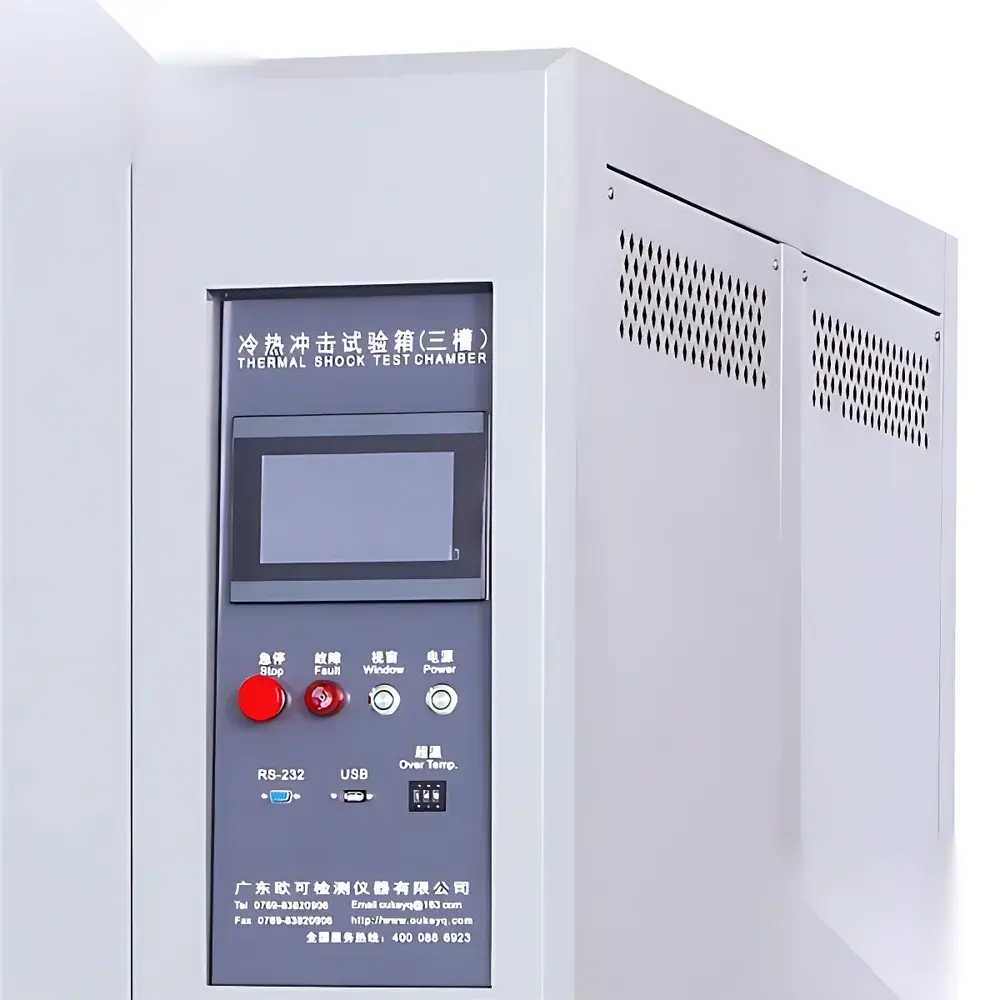
Equipped with a 10.1″ capacitive touchscreen HMI running embedded Linux, the chamber provides real-time monitoring of all thermal zones, compressor status, damper position feedback, and alarm history. Optional PC-based software (OK-DataLink v3.2) enables full test protocol definition—including multi-step shock sequences, dwell time ramping, pass/fail criteria based on chamber stability windows, and automated report generation in PDF/CSV formats. Data export complies with FDA 21 CFR Part 11 requirements when configured with audit trail, electronic signatures, and role-based permissions. Raw sensor data (10 Hz sampling) is stored internally for ≥30 days and can be retrieved via USB or Ethernet (TCP/IP Modbus TCP). All firmware updates are digitally signed and validated prior to installation.
Applications
- Failure mode identification in lead-free solder joints subjected to repeated thermal expansion mismatch.
- Validation of hermetic seals in MEMS pressure sensors under −65 °C to +150 °C cycling.
- Qualification of conformal coatings on automotive ECUs per ISO 16750-4 Annex C.
- Reliability screening of Li-ion battery modules prior to accelerated life testing.
- Material compatibility assessment of adhesive bonds in hybrid packaging (e.g., SiC MOSFETs on AlN substrates).
- Pre-screening of avionics enclosures for DO-160G Section 4.5 compliance before formal certification.
FAQ
What distinguishes the three-zone (OK-HH) configuration from two-zone thermal shock chambers?
The three-zone design maintains specimen immobility—critical for fragile or alignment-sensitive devices—whereas two-zone systems rely on mechanical basket transfer that introduces vibration, positional uncertainty, and potential thermal lag due to mass inertia.
Is external cooling water infrastructure required?
Yes. The dual-stage cascade system requires a dedicated closed-loop cooling tower delivering 10 m³/h of water at ≤32 °C inlet temperature. Water quality must meet ASTM D1141 Class II specifications to prevent heat exchanger fouling.
Can the chamber perform temperature ramping or only step transitions?
It is optimized for discrete shock transitions per IEC 60068-2-14. Continuous ramping is not supported; however, sequential shocks with programmable dwell times emulate pseudo-ramp behavior for specific qualification protocols.
How is calibration maintained over time?
The system includes self-diagnostic routines for sensor drift detection. Annual third-party calibration is recommended using accredited labs per ISO/IEC 17025, with documented as-found/as-left data and uncertainty budgets.
Are custom internal dimensions available beyond the four standard models?
Yes. Engineering consultation is provided for bespoke configurations—including extended depth for large-format battery trays or reinforced shelves for >50 kg loads—while preserving thermal performance and regulatory compliance.



