
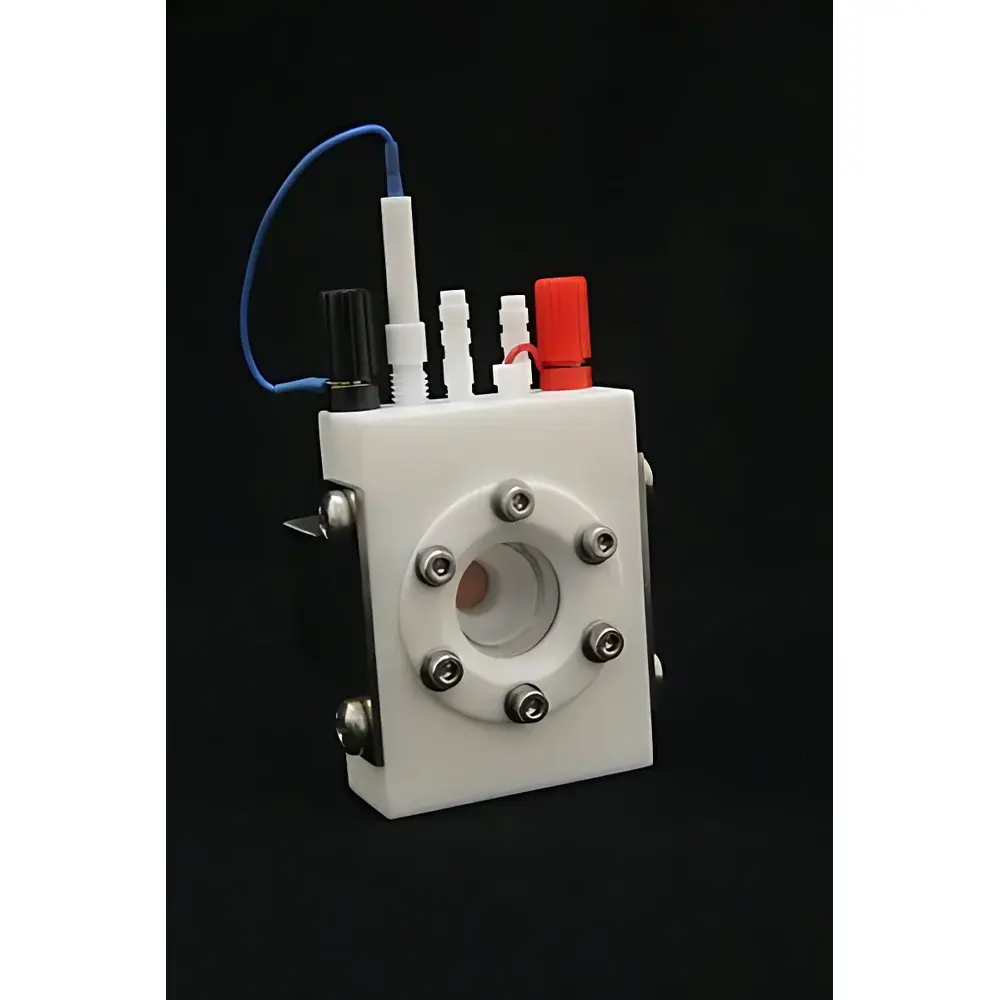
Zhongjiaojinyuan PECK51 Miniature Photoelectrochemical Cell
| Brand | Zhongjiaojinyuan |
|---|---|
| Origin | Beijing, China |
| Manufacturer Type | Direct Manufacturer |
| Country of Origin | China |
| Model | PECK51 |
| Component Category | Optical Component |
| Cell Volume | 5 mL |
| Working Electrode Area | ~1 cm² |
| Quartz Window Diameter | 20 mm |
| Counter Electrode | Platinum Wire |
| Reference Electrode | Ag/AgCl |
| Electrode Configuration | Three-Electrode System |
| Sealing Type | Hermetic Seal |
| Compatibility | Planar Solid Electrode Samples |
Overview
The Zhongjiaojinyuan PECK51 Miniature Photoelectrochemical Cell is a precision-engineered optical-electrochemical interface device designed for controlled in situ investigation of photoactive materials under illumination. It operates on the fundamental principle of photoelectrochemistry—where incident photons generate electron–hole pairs at a semiconductor or molecular photoanode/cathode surface, and the resulting photocurrent, photovoltage, or transient charge-transfer kinetics are quantified under potentiostatic or galvanostatic control. The cell integrates a high-transmission fused quartz optical window (20 mm diameter, UV–Vis transparent from ~190 nm to >2500 nm) with a rigorously defined three-electrode electrochemical configuration, enabling simultaneous optical excitation and electrochemical interrogation in a compact, sealed environment. Its 5 mL internal volume minimizes solution resistance and electrolyte consumption while maintaining sufficient headspace for gas evolution studies (e.g., O₂ or H₂ detection in water splitting). The design prioritizes experimental reproducibility, thermal stability, and compatibility with standard electrochemical workstations (e.g., Gamry, BioLogic, PalmSens) and optical setups including monochromators, LED arrays, and solar simulators.
Key Features
- Hermetically sealed cell body constructed from chemically inert PTFE and polyether ether ketone (PEEK), ensuring long-term compatibility with aqueous and non-aqueous electrolytes (pH 0–14, organic solvents including acetonitrile, DMF, and propylene carbonate).
- Interchangeable planar working electrode holder with precise mechanical alignment; active electrode area fixed at 1.00 ± 0.03 cm² via insulating gasket—eliminating edge effects and enabling quantitative comparison across samples.
- Integrated quartz optical window (20 mm Ø, thickness 3 mm, <0.1% absorption at 350–800 nm) aligned perpendicular to the working electrode surface for collimated normal-incidence illumination and minimal optical path distortion.
- Dedicated ports for counter electrode (Pt wire, 0.5 mm Ø) and reference electrode (Ag/AgCl in 3 M KCl, double-junction optional), both electrically shielded and mechanically stabilized to reduce noise and vibration-induced signal drift.
- Modular lid assembly with O-ring compression sealing (FKM elastomer, rated to 80 °C) and threaded inlet/outlet fittings for optional purging (N₂, Ar) or continuous flow operation.
Sample Compatibility & Compliance
The PECK51 supports rigid, flat, conductive substrates—including FTO-, ITO-, or metal-coated glass slides; sputtered or spin-coated thin films (TiO₂, BiVO₄, perovskites); and exfoliated 2D materials mounted on conductive backings. It is not intended for powder electrodes, rotating disk configurations, or liquid junctions requiring Luggin capillaries. The cell complies with standard laboratory safety protocols for low-voltage (<±15 V) electrochemical systems and meets ISO 8573-1 purity class 5 requirements when used with filtered purge gases. While not certified to IEC 61010-1 as a standalone instrument, its materials and construction align with GLP-compliant electrochemical testing practices. Documentation includes material traceability (quartz grade: IR-grade Suprasil®), dimensional drawings (GD&T controlled), and electrical leakage test reports (<1 nA at 10 V DC).
Software & Data Management
The PECK51 functions as a passive electro-optical interface and does not include embedded firmware or proprietary software. It is fully compatible with industry-standard electrochemical analysis platforms supporting three-electrode mode, including EC-Lab (BioLogic), Framework (Gamry), and NOVA (Metrohm Autolab). When coupled with time-resolved optical detection (e.g., lock-in amplified photocurrent detection or transient absorption spectroscopy), data synchronization is achieved via TTL trigger inputs/outputs on compatible potentiostats and digitizers. All experimental metadata—electrode geometry, optical path length, electrolyte composition, and illumination intensity (calibrated via NIST-traceable silicon photodiode)—must be manually logged to satisfy audit requirements under FDA 21 CFR Part 11 when used in regulated R&D environments.
Applications
- Quantitative photoconversion efficiency (ABPE, IPCE) mapping of semiconductor photoanodes in alkaline and neutral media.
- Stability assessment of dye-sensitized and perovskite-based photoelectrodes under chronoamperometric stress at constant illumination.
- In situ electrochemical impedance spectroscopy (EIS) under modulated light bias to resolve recombination resistance and Helmholtz layer capacitance.
- Transient photocurrent/photovoltage decay analysis for carrier lifetime estimation using pulsed LED excitation (10 ns–100 ms range).
- Photoelectrocatalytic CO₂ reduction product quantification via online GC-MS coupling through optional gas-tight outlet tubing.
FAQ
Can the PECK51 be used with corrosive electrolytes such as concentrated HF or molten salts?
No. The PTFE/PEEK body and FKM seals are incompatible with hydrofluoric acid, fuming nitric acid, or temperatures exceeding 80 °C. For aggressive media, custom quartz-glass variants with Kalrez® seals are available upon engineering review.
Is the working electrode area truly invariant across different sample thicknesses?
Yes—the gasket defines the exposed geometric area independent of film thickness up to 200 µm. Thicker substrates require custom gaskets to maintain planarity and seal integrity.
Does the cell support four-electrode (Kelvin probe) measurements?
No. It is configured exclusively for three-electrode potentiostatic control. Four-terminal sensing requires external current-sense leads and is not mechanically supported.
What is the maximum recommended illumination power density?
Up to 1.5 W/cm² (equivalent to ~15 suns) with active cooling. Uncooled operation is validated to 100 mW/cm² (1 sun AM1.5G) without thermal drift exceeding ±0.5 mV.
Are replacement quartz windows and electrode assemblies available as spare parts?
Yes. Quartz windows (20 mm Ø, 3 mm thick, polished both sides), Pt wire counter electrodes (0.5 mm Ø, 30 mm length), and Ag/AgCl reference electrode cartridges (with refillable KCl reservoir) are stocked and shipped with calibration certificates.




