
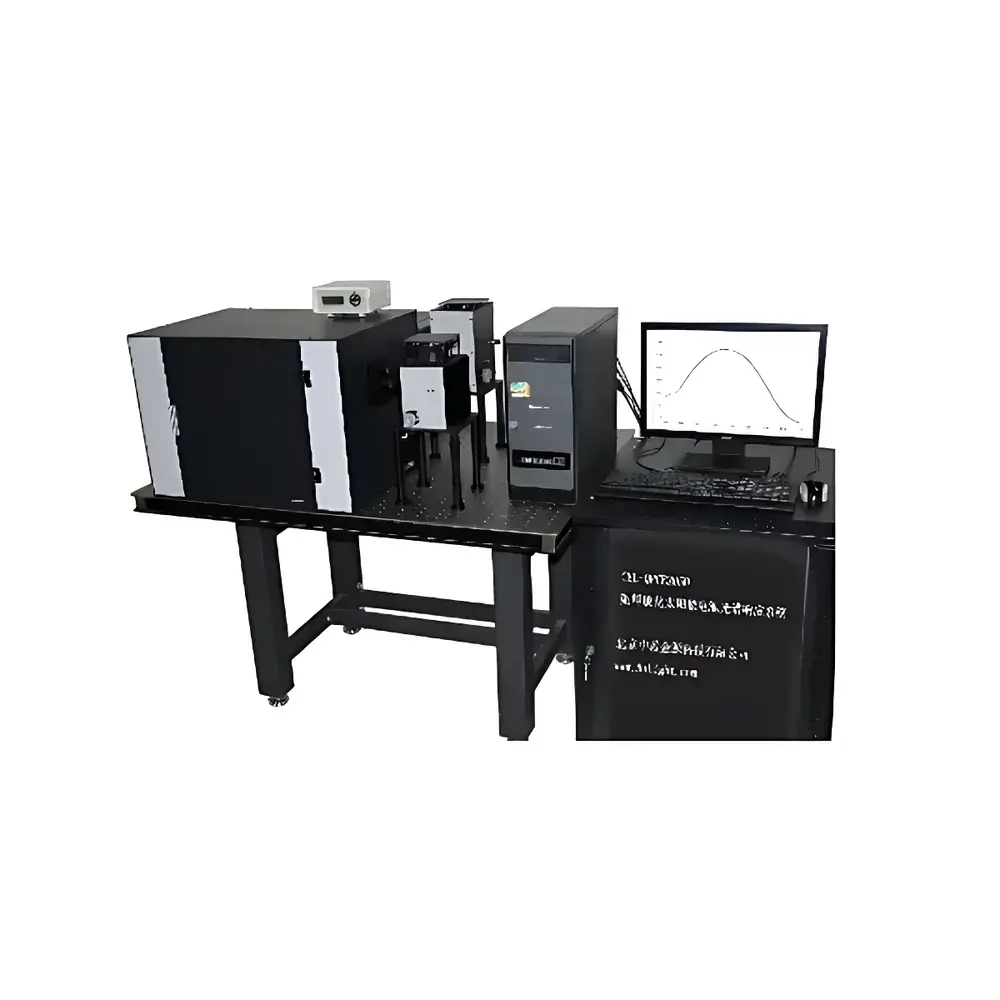
CEL-QPCE2050 Quantum Efficiency / Incident Photon-to-Current Efficiency (QE/IPCE) Measurement System for Dye-Sensitized and Perovskite Solar Cells
| Brand | CEAULIGHT (Zhongjiaojinyuan) |
|---|---|
| Origin | Beijing, China |
| Manufacturer Type | OEM Manufacturer |
| Product Category | Domestic |
| Model | CEL-QPCE2050 |
| Light Source Type | Tunable Monochromatic Light + Bias Illumination (Xenon-based White Light) |
| Illumination Mode | External Illumination |
| Spectral Range | 200–1100 nm |
| Wavelength Resolution | ≥1 nm (continuously adjustable) |
| Scan Mode | Fully Automated, Continuous Monochromatic Scanning |
| Repeatability | <0.3% (J<sub>sc</sub>) |
| Operating Mode | DC Measurement Only |
| Chopping Frequency | 5–1000 Hz |
| Temperature Control Stage (Optional) | 5–40 °C (±0.5 °C) |
| Bias Light Intensity | ~0.5 SUN (AM1.5G spectrum) |
| Monochromator Focal Length | 300 mm or 150 mm (configurable) |
| Detection System | Keithley Digital Multimeter (High-Accuracy DC Current/Voltage Acquisition) |
| Compliance | ASTM E1021-12, IEC 60904-8, GB/T 6495.8-2002 |
| Sample Compatibility | Dye-sensitized solar cells (DSSCs), perovskite solar cells (PSCs), other single-junction photovoltaic devices compatible with DC-based QE characterization |
Overview
The CEL-QPCE2050 is a fully automated, high-precision Quantum Efficiency (QE) and Incident Photon-to-Current Efficiency (IPCE) measurement system engineered specifically for dye-sensitized solar cells (DSSCs), perovskite solar cells (PSCs), and other single-junction photovoltaic devices requiring DC-biased spectral response characterization. Unlike AC-modulated systems—whose applicability is limited by the inherently slow carrier recombination kinetics and redox dynamics in liquid-electrolyte-based DSSCs—the CEL-QPCE2050 operates exclusively in DC mode, eliminating phase-dependent artifacts and enabling robust, low-noise current quantification under steady-state illumination conditions. Its optical architecture integrates a high-stability monochromator-coupled light source with a calibrated broadband bias lamp, ensuring simultaneous spectral selectivity and controlled background illumination aligned to the AM1.5G reference spectrum (~0.5 SUN). The system adheres to internationally recognized photovoltaic metrology standards—including ASTM E1021-12 (Standard Test Method for Spectral Responsivity Measurements of Photovoltaic Devices), IEC 60904-8 (Photovoltaic devices – Part 8: Measurement of spectral response of a photovoltaic (PV) device), and GB/T 6495.8-2002—making it suitable for R&D labs, certification facilities, and quality assurance departments operating under GLP/GMP-aligned workflows.
Key Features
- Fully automated optical path switching between calibrated reference detector and sample under test—no manual alignment or reconfiguration required during scan sequences.
- Dual-source illumination architecture: tunable monochromatic light (200–1100 nm, ≥1 nm step resolution) paired with a stabilized xenon-based white-light bias source delivering uniform 0.5 SUN irradiance (AM1.5G spectrum).
- All-reflective sample chamber design eliminates chromatic aberration and stray-light errors associated with transmissive optics; ensures consistent beam geometry across full spectral range.
- High-fidelity DC current acquisition using a Keithley digital multimeter with sub-picoamp sensitivity and >1 kS/s sampling rate—optimized for low-current photovoltaic devices with typical Jsc values from 1–30 mA/cm².
- Integrated temperature-controlled stage (optional) maintains sample thermal stability within ±0.5 °C over 5–40 °C range—critical for studying thermally sensitive perovskite and electrolyte-based architectures.
- Software-controlled error compensation routines including dark-current subtraction, background illumination correction, and spectral responsivity normalization against NIST-traceable silicon photodiode standards.
Sample Compatibility & Compliance
The CEL-QPCE2050 supports planar and mesoporous thin-film photovoltaic structures where active area definition is critical—including DSSCs with TiO₂ nanoparticle scaffolds, PSCs with mixed-halide perovskite absorbers, and organic photovoltaics validated for DC-mode QE analysis. Its external illumination configuration accommodates standard 1 cm² active-area test cells as well as custom substrates mounted on precision translation stages. All calibration procedures follow traceable protocols compliant with ISO/IEC 17025 requirements for testing laboratories. Data integrity safeguards include audit-trail logging, user-access controls, and timestamped metadata embedding—facilitating compliance with FDA 21 CFR Part 11 when deployed in regulated environments.
Software & Data Management
The proprietary QEScan software provides an intuitive GUI for method setup, real-time monitoring, and post-processing visualization. It enables batch execution of multi-sample campaigns with automatic file naming, metadata tagging (e.g., date, operator ID, environmental conditions), and export to CSV, MATLAB (.mat), or HDF5 formats. Raw photocurrent and incident photon flux data are stored alongside calculated QE, IPCE, and integrated Jsc values referenced to AM1.5G. Built-in spectral interpolation algorithms ensure smoothness and physical plausibility of output curves without oversmoothing. Exported reports include conformance statements referencing ASTM E1021-12 Annex A1 (uncertainty budgeting) and IEC 60904-8 Clause 7 (calibration verification).
Applications
- Quantitative evaluation of electron injection efficiency at dye/TiO₂ interfaces in DSSCs.
- Identification of parasitic absorption losses in perovskite charge-transport layers via wavelength-resolved photocurrent suppression analysis.
- Correlation of QE spectra with UV-Vis absorption and PL quantum yield measurements to decouple optical and electronic loss mechanisms.
- Stability assessment under prolonged bias illumination by tracking QE drift over time (e.g., 24–72 h continuous operation).
- Validation of anti-reflection coating performance through comparison of measured vs. theoretical IPCE enhancement across visible-NIR bands.
- Supporting interlaboratory round-robin studies in accordance with IEA-PVPS Task 12 guidelines for spectral responsivity harmonization.
FAQ
Why does the CEL-QPCE2050 use DC measurement instead of AC lock-in detection?
DC mode avoids modulation-induced artifacts arising from slow redox kinetics in DSSCs and ion diffusion limitations in quasi-solid electrolytes—conditions under which signal phase lag exceeds practical lock-in bandwidths.
Can the system measure devices with non-standard active areas?
Yes—users define effective area manually in software; beam homogeneity and spot size (<1 mm diameter at sample plane) ensure full-area illumination for samples ≥5 mm × 5 mm.
Is NIST-traceable calibration included with the system?
A factory-calibrated silicon reference photodiode (with NIST-traceable certificate) is supplied; users may optionally upgrade to secondary-standard GaAs or InGaAs detectors for extended NIR coverage.
How is stray light minimized in the monochromator?
Dual-grating configuration with order-sorting filters and optimized baffling reduces stray light to <1×10⁻⁵ relative to peak intensity—meeting IEC 60904-8 Class A spectral purity requirements.
Does the software support automated compliance reporting for ISO/IEC 17025 audits?
Yes—audit logs record all parameter changes, calibration events, and result exports with digital signatures; optional integration with LIMS via REST API is available.







