
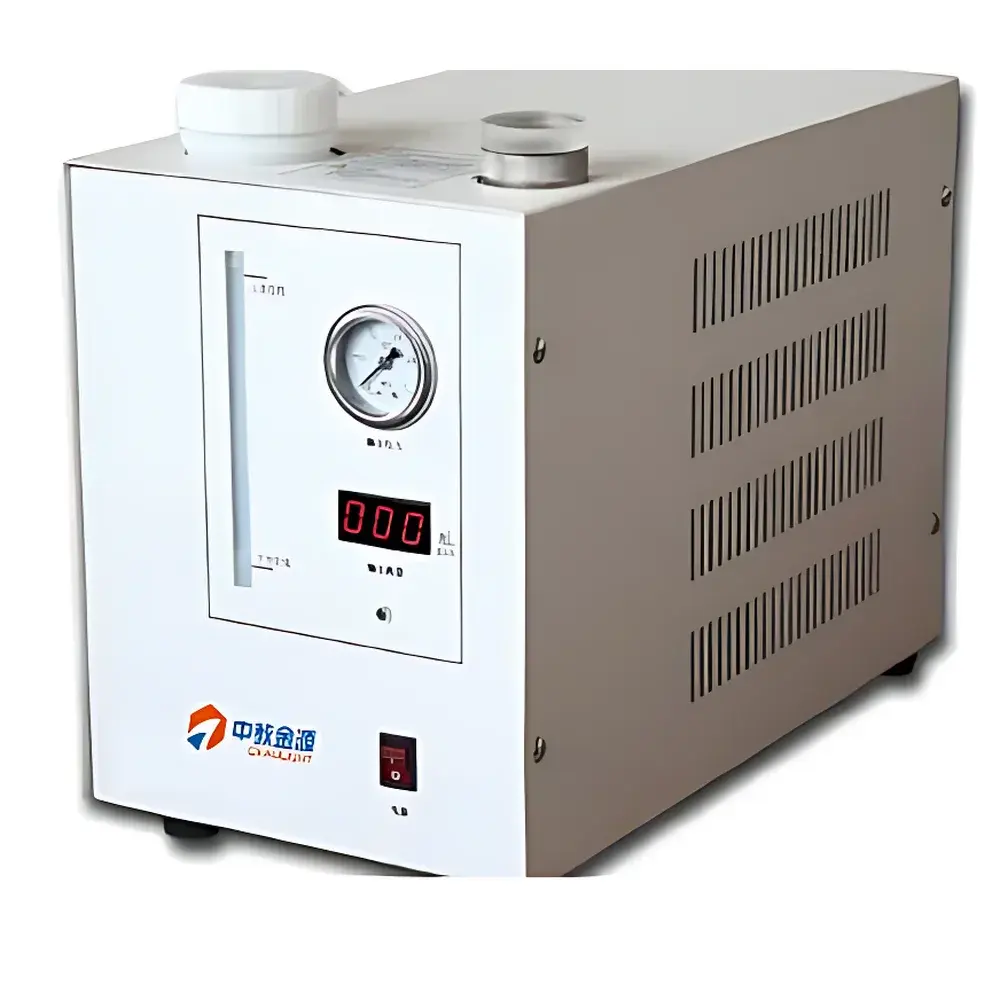
CEHL Hydrogen Generator by CECO
| Key | Brand: CECO |
|---|---|
| Origin | Beijing, China |
| Manufacturer Type | OEM Manufacturer |
| Country of Origin | China |
| Model | CEHL |
| Power Input | 220 V, 50 Hz |
| Max Power Consumption | 150 W / 180 W (model-dependent) |
| Operating Temperature | 0–40 °C |
| Relative Humidity | <85% RH |
| H₂ Purity | 99.999% (v/v, O₂-equivalent basis) |
| Flow Rate | CEHL-300: 0–300 mL/min |
| CEHL-500 | 0–500 mL/min |
| Output Pressure | 0.4 MPa (custom pressure available upon factory configuration) |
| Dimensions (L×W×H) | 370 × 180 × 360 mm |
| Weight | CEHL-300: ~12 kg |
| CEHL-500 | ~13 kg |
Overview
The CEHL Hydrogen Generator by CECO is a compact, on-demand electrolytic hydrogen source engineered for continuous or intermittent operation in analytical laboratories, gas chromatography (GC) carrier gas supply, and catalytic reaction environments. It employs a PEM-free alkaline water electrolysis system with a stainless-steel electrolytic cell, generating high-purity hydrogen (99.999% v/v, referenced to residual oxygen content) without requiring compressed gas cylinders. The generator operates at ambient temperature with low thermal load due to integrated heat dissipation and optimized electrode geometry—ensuring stable cell temperature during extended runtime. Its design conforms to standard laboratory safety protocols for non-pressurized gas generation systems, and the output pressure is regulated via an internal mechanical pressure control valve set at 0.4 MPa (factory-default), with optional pre-shipment calibration for alternative setpoints.
Key Features
- One-touch operation: Power-on initiation delivers immediate, stable hydrogen flow—no warm-up time or manual gas purging required.
- Digital LED flow display: Real-time volumetric flow rate monitoring (0–300 mL/min or 0–500 mL/min) enables precise method alignment with GC or reactor inlet specifications.
- Integrated electrolyte management: Unified reservoir-electrolysis-oxygen vent architecture eliminates external fluid handling; distilled water replenishment only is needed—no KOH or acid maintenance.
- No-backflow protection: A patented anti-siphon check mechanism prevents liquid carryover into downstream instrumentation, safeguarding sensitive detectors (e.g., TCD, FID) and GC columns from contamination or damage.
- Low-power, high-efficiency design: Rated at 150 W (CEHL-300) or 180 W (CEHL-500), the unit meets IEC 61000-3-2 harmonic emission standards and operates silently under typical lab ambient conditions (0–40 °C, <85% RH).
- Compact footprint: Dimensions of 370 × 180 × 360 mm (L×W×H) allow placement beneath fume hoods, on benchtops, or within modular lab cabinets without obstructing workflow.
Sample Compatibility & Compliance
The CEHL series is compatible with all standard GC systems requiring ultra-high-purity hydrogen carrier or fuel gas—including Agilent, Thermo Fisher, Shimadzu, and PerkinElmer platforms. Its 99.999% purity specification satisfies ASTM D7217–22 requirements for hydrogen used in trace-level hydrocarbon analysis and complies with ISO 8573-1:2010 Class 1 particulate/oil/water limits when paired with optional inline desiccant and particle filters. While not intrinsically rated for hazardous locations, the unit adheres to EN 61010-1:2010 safety standards for electrical equipment used in laboratory environments. No regulatory certification (e.g., UL, CE marking) is claimed unless explicitly validated per regional import requirements.
Software & Data Management
The CEHL Hydrogen Generator operates as a standalone hardware device with no embedded firmware, network interface, or software dependency. All operational parameters—including flow rate, pressure, and power status—are monitored via front-panel LED indicators. As such, it requires no driver installation, cloud connectivity, or cybersecurity configuration. This architecture ensures deterministic behavior, zero firmware update risk, and full compatibility with GLP/GMP environments where audit-trail simplicity and validation stability are prioritized over digital integration. For labs implementing 21 CFR Part 11 compliance, instrument logs may be manually recorded in paper-based or LIMS-linked procedural documentation.
Applications
- Carrier gas supply for capillary GC and GC-MS systems requiring consistent, low-moisture hydrogen flow.
- Fuel gas source for flame ionization detectors (FID) and photoionization detectors (PID), eliminating cylinder logistics and pressure fluctuations.
- Hydrogen feed for benchtop catalytic reactors, hydrotreatment studies, and electrochemical hydrogenation setups.
- Calibration gas generation in environmental air monitoring labs performing VOC speciation via GC-FID.
- Backup or primary hydrogen source in teaching laboratories where safety, cost-per-use, and ease of instruction outweigh high-throughput demands.
FAQ
What type of water must be used to refill the electrolyte reservoir?
Only deionized or distilled water (resistivity ≥ 1 MΩ·cm) is permitted. Tap water, tap-deionized blends, or water containing additives will cause scaling, electrode passivation, and premature cell degradation.
Can the output pressure be adjusted by the user after installation?
No. The 0.4 MPa pressure setting is fixed by internal mechanical regulation. Custom pressure configurations must be specified prior to factory shipment and cannot be field-modified.
Is routine maintenance required beyond water refills?
Yes. Electrolytic cell performance should be verified annually via flow/pressure stability testing. Optional replacement of the oxygen vent membrane is recommended every 24 months under continuous operation.
Does the CEHL series support remote monitoring or analog signal output?
No. It lacks analog voltage/current outputs, RS-232/USB interfaces, or Ethernet connectivity. Integration with building management systems or SCADA requires external flow/pressure transducers and third-party signal conditioning.
How does the anti-return liquid mechanism function?
A gravity-assisted dual-chamber siphon break combined with a hydrophobic PTFE membrane prevents condensed electrolyte from migrating upstream—even during abrupt shutdown or pressure transients—ensuring zero liquid ingress into connected instruments.



