
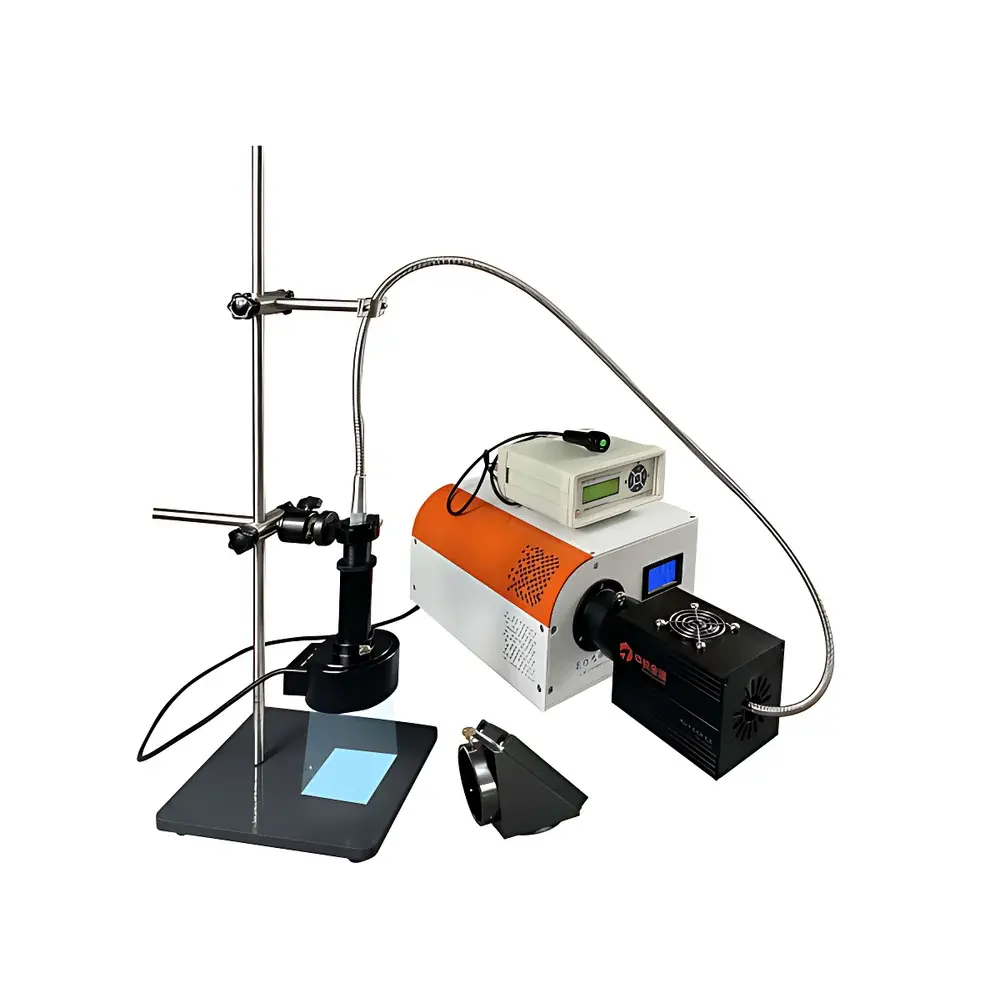
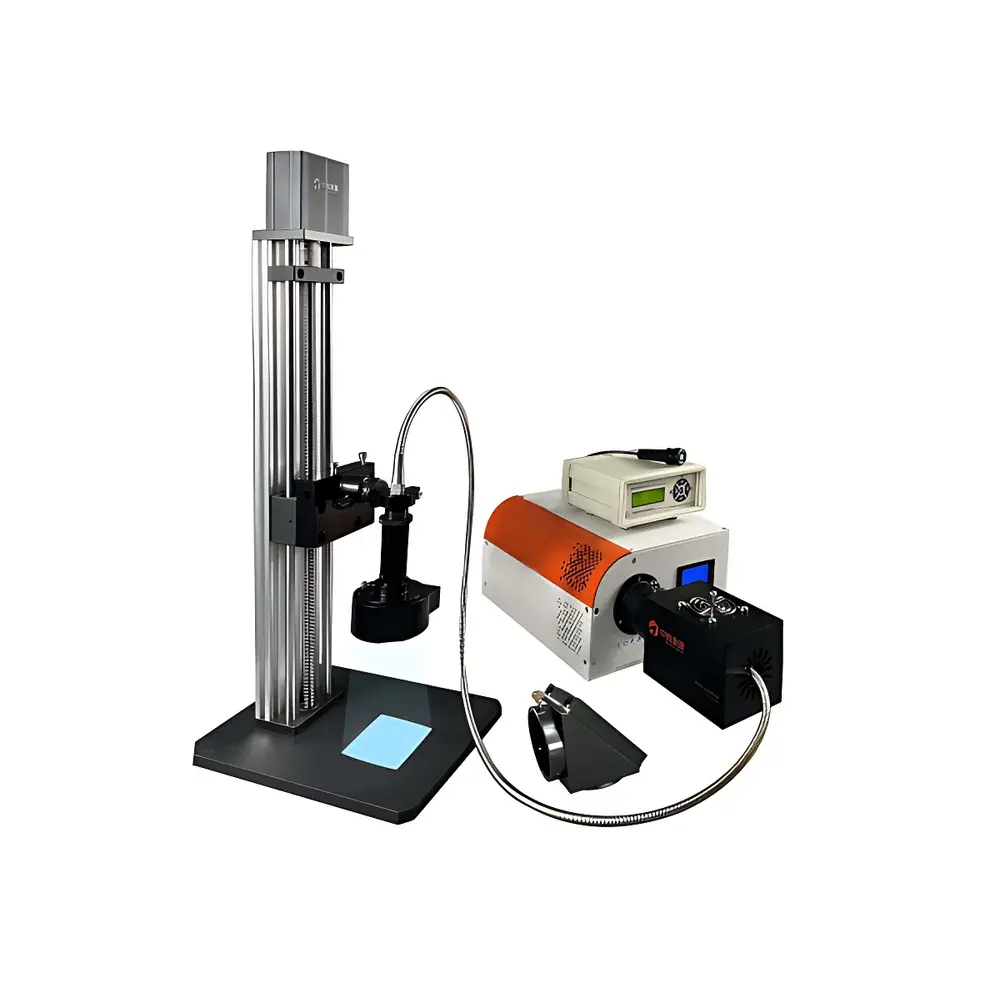
CEL-FES300 Multi-Functional Fiber-Coupled Xenon Light Source
| Brand | CEAULIGHT (Zhongjiao Jinyuan) |
|---|---|
| Origin | Beijing, China |
| Manufacturer Type | OEM Manufacturer |
| Product Category | Domestic |
| Model | CEL-FES300 |
| Light Source Type | 300 W Short-Arc Xenon Lamp |
| Illumination Mode | External Irradiation |
| Spectral Output Range | 300–2500 nm (Ozone-Free) |
| Fiber-Coupled Square Beam Size | 10×10 to 60×60 mm (Continuously Adjustable) |
| Beam Uniformity (≤40 mm) | <5% |
| UV Output (<390 nm) | 2.6 W |
| Visible Output (390–770 nm) | 18.6 W, 5000 lm, 5600 K |
| IR Output (>770 nm) | 28.8 W |
| Optical Power Density Range | 0–20 Sun (1 Sun = 1000 W/m²) |
| Electronic Shutter Accuracy | ±0.01 s |
| Lamp Lifetime | >1000 h (up to 6000 h under optimal conditions) |
| Input Power | 300 W (Ignition Voltage: 15 kV |
| Operating Voltage | 14 V DC |
| Operating Current | 21 A DC) |
| Total Radiant Output | ~50 W |
Overview
The CEL-FES300 Multi-Functional Fiber-Coupled Xenon Light Source is an engineered optical platform designed for high-precision photonic experimentation in catalytic, electrochemical, and photovoltaic research environments. Based on a stabilized 300 W short-arc xenon lamp, it delivers broadband spectral irradiance spanning 300–2500 nm—covering deep UV through near-infrared—with ozone-free operation enabled by fused silica optics and optimized lamp envelope design. Its core architecture integrates fiber-optic coupling with collimated square-beam delivery, enabling spatial decoupling of the light source from the sample chamber while preserving spectral fidelity and intensity stability. The system implements ASTM E927-20-compliant solar simulation capabilities—including built-in AM1.5G spectral filtering—and supports quantitative irradiance calibration traceable to NIST-traceable reference detectors (e.g., CEL-NP2000-2). Unlike conventional benchtop lamps, the CEL-FES300 employs closed-loop thermal management: real-time multi-point temperature sensing modulates fan speed dynamically to suppress thermal drift, achieving long-term radiometric stability of ±0.5% over 8-hour continuous operation.
Key Features
- Fiber-coupled output enables flexible experimental layout—light delivery is independent of lamp housing orientation or proximity constraints.
- Continuously adjustable square beam size (10×10 mm to 60×60 mm) via motorized focusing optics, with uniformity ≤4.96% across 40×40 mm field (measured per ISO 9050).
- High-stability electronic shutter with programmable on/off timing (resolution: 10 ms), repeatable cycle control, and TTL-compatible triggering for synchronized electrochemical or time-resolved measurements.
- Integrated AM1.5G filter module compliant with IEC 60904-9 and ASTM G173-03 standards for terrestrial solar spectrum replication.
- Dual-mode operation: direct irradiation (via articulated arm and rotatable head) and fiber-guided delivery—both configurable with >100 standardized bandpass, longpass, and reflective filters (e.g., QD365, UVIRCut420, AM1.5G, AREF).
- Real-time power density monitoring capability when paired with optional CEL-NP2000-2 calibrated photodiode sensor (±2% uncertainty, 200–1100 nm).
Sample Compatibility & Compliance
The CEL-FES300 accommodates diverse sample geometries and environmental requirements. Its external irradiation mode supports standard quartz cuvettes (10 mm path), gas-phase reactors (e.g., annular PEC cells), thin-film photoelectrodes, and large-area perovskite or organic PV devices. When used with optional LB70 optical dark box, it satisfies GLP-compliant dark-current measurement protocols for photocurrent quantum efficiency (IPCE) and incident photon-to-current conversion efficiency (APCE) testing. All optical components meet RoHS Directive 2011/65/EU material restrictions. Filter mounting interfaces conform to standard M62 thread specifications (per ISO 10110-1), ensuring mechanical interchangeability with third-party optical mounts. System firmware supports audit trails for shutter actuation logs and lamp runtime counters—facilitating 21 CFR Part 11–aligned data integrity in regulated R&D labs.
Software & Data Management
The CEL-FES300 operates via embedded microcontroller with RS232/USB interface for remote command execution (SCPI-compliant syntax). Optional PC software provides GUI-based scheduling of irradiation sequences—including ramped intensity profiles, timed shutter cycles, and multi-step filter wheel positioning. All operational parameters (lamp hours, thermal sensor readings, shutter timestamps) are logged in CSV format with UTC timestamps. Exported datasets include metadata headers compliant with FAIR principles (Findable, Accessible, Interoperable, Reusable), supporting integration into LIMS or ELN platforms such as LabArchives or Benchling. Firmware updates are delivered via signed binary packages verified using SHA-256 checksums to ensure integrity.
Applications
- Photoelectrochemical (PEC) water splitting: controlled illumination during linear sweep voltammetry (LSV) and chronoamperometry (CA) under simulated AM1.5G conditions.
- Photocatalytic degradation kinetics: quantified mineralization of VOCs (e.g., formaldehyde, NOx) and aqueous organics (methylene blue, phenol) under defined UV–vis fluence rates.
- Perovskite and dye-sensitized solar cell characterization: J–V curve acquisition, light-soaking stability assessment, and spectral response mapping.
- CO2 photoreduction studies requiring precise wavelength selection (e.g., QD365 + VisREF for selective excitation of Cu-based catalysts).
- Photochromic material evaluation: reversible isomerization kinetics under millisecond-gated UV pulses.
- Optical thin-film metrology: broadband reflectance/transmittance measurements using fiber-coupled integrating sphere configurations.
FAQ
What spectral range is delivered through the fiber output?
The fiber-coupled output spans 350–1100 nm, with AM1.5G spectral shaping applied internally. UV transmission below 350 nm is attenuated due to fused silica fiber limitations.
Can the system be integrated with commercial potentiostats for PEC testing?
Yes—TTL synchronization signals and analog intensity monitoring outputs enable hardware-level triggering with Gamry, BioLogic, or PalmSens instruments.
Is NIST-traceable calibration included with purchase?
No—calibration is performed using factory-characterized reference detectors. Users may commission third-party NIST-traceable recalibration annually per ISO/IEC 17025 requirements.
What maintenance is required to sustain rated lamp lifetime?
Lamp replacement is recommended after 1000 h of cumulative operation. Maintain ambient temperature <25°C and relative humidity <60%; avoid particulate-laden environments to prevent quartz envelope fouling.
Does the system support automated filter wheel control?
Yes—the optional M62 filter wheel driver accepts ASCII commands over RS232 and supports up to 12-position indexing with positional feedback.



