
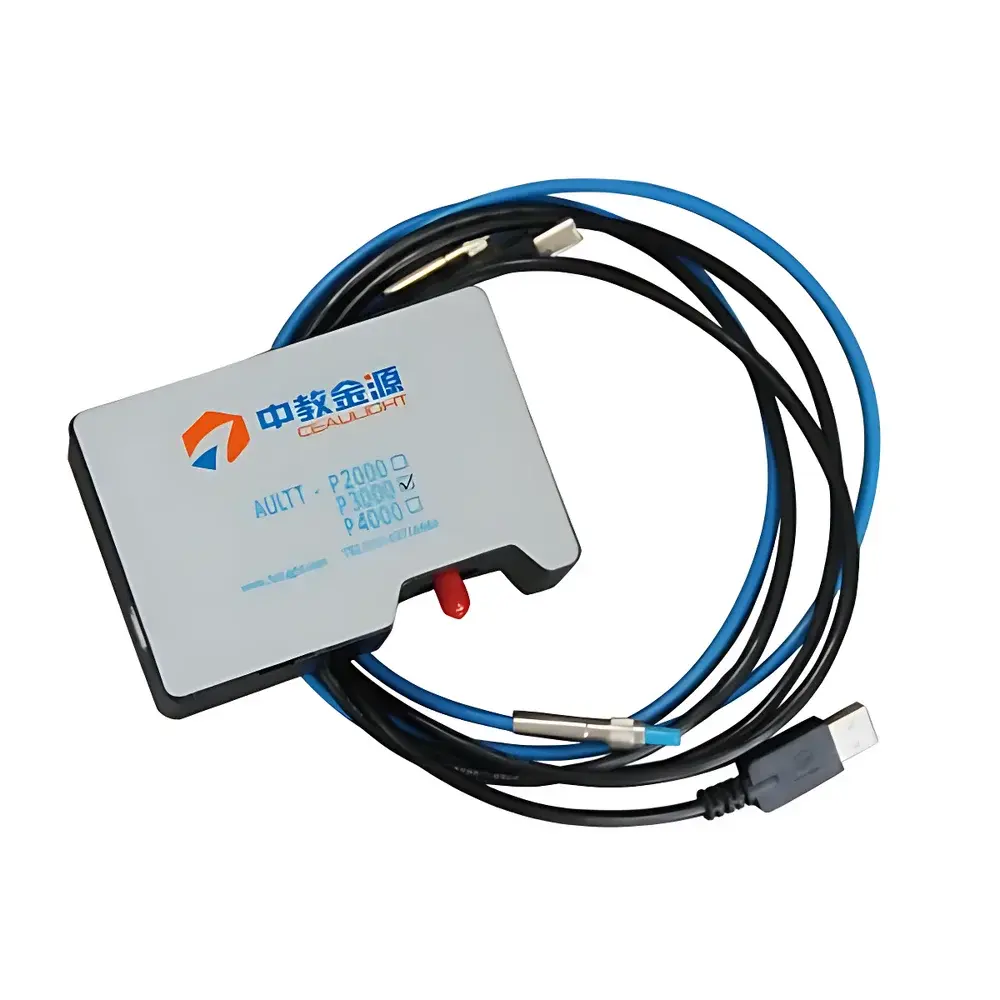
AULTT-P3000 Fiber-Optic Spectrometer
| Brand | AULTT |
|---|---|
| Model | P3000 |
| Detector | 3648-pixel linear silicon CCD |
| Wavelength Range | 200–800 nm (UV-Vis) |
| Optical Resolution (FWHM) | ≤ 0.03 nm |
| Wavelength Repeatability | < ±0.3 nm |
| Slit Width | 30 µm |
| Grating | 600 lines/mm, blazed at 250 nm |
| Interface | USB 2.0, bus-powered |
| Software Compatibility | Windows 7 and later |
| Data Export Formats | CSV, TXT, PDF, BMP |
| Spectral Acquisition Modes | Single-shot, continuous scan, spectral video |
| Calibration | Factory NIST-traceable wavelength & radiometric calibration |
| Compliance | CE, RoHS |
| Accessories Support | Modular fiber-optic coupling (SMA905), interchangeable light sources (deuterium, tungsten-halogen, LED), cuvette holders, integrating spheres, and filter kits |
Overview
The AULTT-P3000 Fiber-Optic Spectrometer is a compact, high-performance benchtop spectrometer engineered for precision UV-Vis spectral analysis in research laboratories, quality control environments, and optical education settings. Based on Czerny-Turner optical architecture with a fixed 600-line/mm holographic grating blazed at 250 nm, the instrument delivers high spectral fidelity across its calibrated range of 200–800 nm. Its core measurement principle relies on dispersion of incident light via diffraction grating, followed by spatially resolved detection using a 3648-element linear silicon CCD array. The system operates without external power—drawing full operational current via USB 2.0 bus power—enabling stable, low-noise acquisition under laboratory or field-deployable conditions. Designed for reproducibility and long-term stability, the AULTT-P3000 incorporates thermally stabilized optical alignment and sealed detector housing to minimize drift during extended acquisition sequences.
Key Features
- High-resolution spectral acquisition with ≤ 0.03 nm full-width-at-half-maximum (FWHM) resolution at optimal slit and grating configuration
- Wavelength repeatability better than ±0.3 nm over repeated scans, verified per ISO 17025 traceable procedures
- Integrated USB 2.0 interface supporting plug-and-play operation and multi-device synchronization (up to 8 units concurrently addressable)
- Factory-calibrated wavelength and intensity response, traceable to NIST standards; optional recalibration service available
- Intelligent auto-exposure algorithm dynamically adjusts integration time (1 ms – 10 s range) to prevent saturation and optimize signal-to-noise ratio
- Spectral video mode enables time-resolved monitoring of dynamic optical processes (e.g., photoreaction kinetics, LED thermal drift, plasma emission evolution)
- Modular mechanical design compliant with standard SMA905 fiber-optic interfaces, enabling seamless integration with external light sources, sample holders, and accessories
Sample Compatibility & Compliance
The AULTT-P3000 supports diverse sample configurations via interchangeable optical pathways—including free-space beam coupling, liquid cuvettes (10 mm pathlength), reflective/transmissive solid samples, and fiber-coupled illumination systems. It meets essential regulatory and operational requirements for analytical instrumentation: CE marking confirms compliance with EU Electromagnetic Compatibility (2014/30/EU) and Low Voltage (2014/35/EU) directives; RoHS 2011/65/EU compliance ensures restricted substance control. While not certified for GMP or FDA 21 CFR Part 11 out-of-the-box, the software architecture supports audit trail logging, user access control, and electronic signature readiness—enabling validation pathways for GLP-compliant laboratories following internal SOPs aligned with ISO/IEC 17025.
Software & Data Management
The bundled SpectraView Pro software provides a unified platform for instrument control, real-time visualization, and post-acquisition analysis. It features automatic device enumeration, multi-spectrometer synchronization, and embedded spectral libraries including standard illuminants (D65, A, F2), elemental emission references (Hg, Ne, Ar), and common LED and fluorescent lamp spectra. Analytical modules support quantitative absorbance calculation (using reference/background subtraction), CIE 1931 chromaticity coordinate mapping (x, y, u’, v’), correlated color temperature (CCT), and dominant wavelength determination. Data export supports CSV (for Excel/Python analysis), plain-text (TXT), publication-ready PDF reports, and bitmap (BMP) snapshots. All spectral acquisitions are timestamped and metadata-tagged (integration time, grating position, slit width, calibration file ID), facilitating traceability in regulated environments.
Applications
- UV-Vis absorbance spectroscopy of aqueous and organic solutions (e.g., concentration determination per Beer-Lambert law)
- LED and OLED spectral characterization—including peak wavelength, FWHM, color rendering index (CRI), and R9 values
- Thin-film interference analysis and optical coating transmission/reflection profiling
- Educational optics labs: grating dispersion experiments, atomic emission line identification, fluorescence excitation-emission mapping
- Environmental monitoring: solar irradiance spectral decomposition, water quality parameter estimation (e.g., nitrate, chlorophyll-a)
- Material science: bandgap estimation of semiconductors via Tauc plot analysis from diffuse reflectance data
FAQ
Is the AULTT-P3000 compatible with operating systems beyond Windows 7?
Yes—the device driver and SDK support Windows 10 and Windows 11 (64-bit). Linux and macOS users may access raw spectral data via libusb-based custom development using provided register-level documentation.
Can I perform absolute irradiance measurements with this spectrometer?
Absolute radiometric calibration is available as an optional add-on service. Standard delivery includes relative intensity calibration; NIST-traceable irradiance calibration requires separate purchase and factory reconfiguration.
What is the minimum detectable optical density (OD) for absorbance measurements?
With optimized signal averaging and dark-current subtraction, the system achieves OD resolution of ~0.005 AU in the 350–750 nm range using a 10 mm quartz cuvette and tungsten-halogen reference source.
Does the software support scripting or API integration for automated workflows?
Yes—SpectraView Pro includes a documented COM interface and Python-compatible DLL library, enabling integration into LabVIEW, MATLAB, or custom Python automation scripts for high-throughput screening applications.
How often should wavelength calibration be verified in routine use?
We recommend quarterly verification using a mercury-argon emission lamp; annual full recalibration is advised for applications requiring metrological traceability per ISO/IEC 17025.





