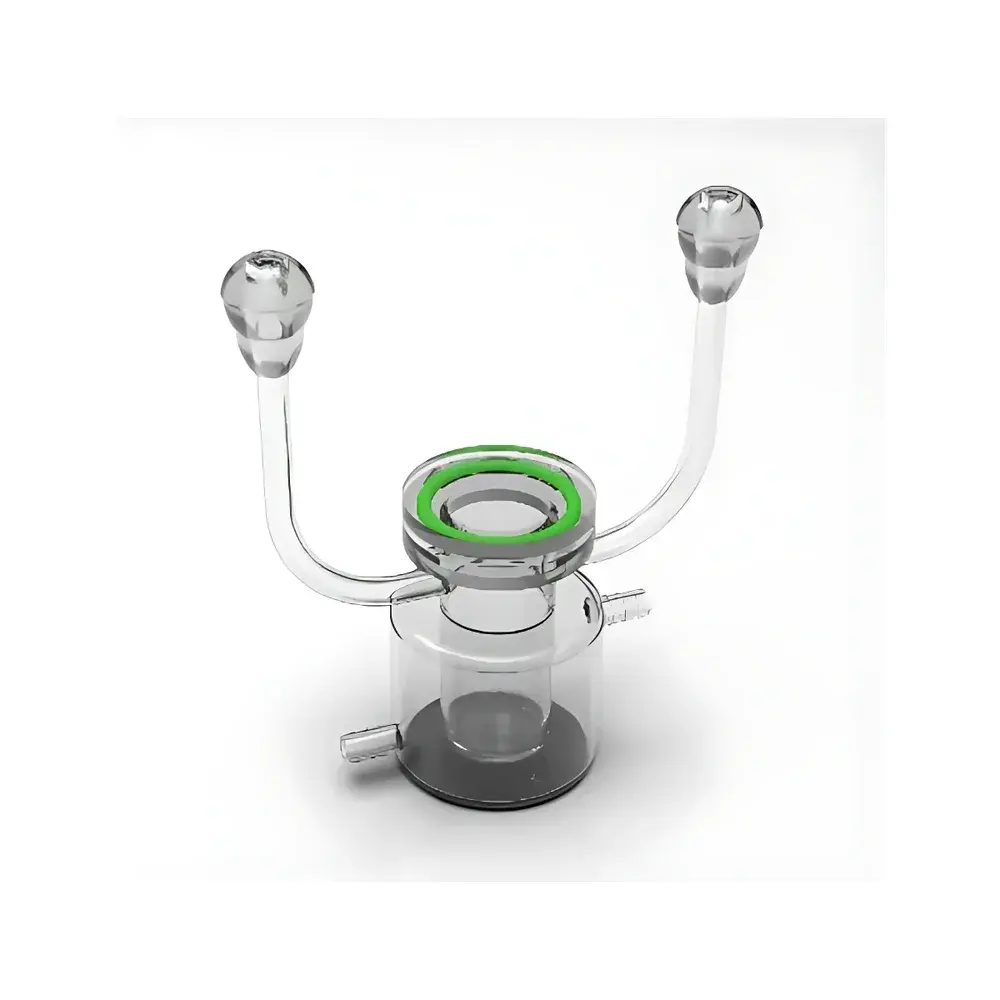
Online Reactor with Integrated Temperature Control (Standard Configuration)
| Brand | CME |
|---|---|
| Origin | Beijing, China |
| Manufacturer Type | OEM Manufacturer |
| Product Origin | Domestic (China) |
| Model | Online Reactor with Integrated Temperature Control (Standard Configuration) |
| Light Source Type | Customizable External Light Source (Xenon or Mercury Lamp Compatible) |
| Irradiation Mode | External Illumination |
| Reactor Volume | 50 mL |
| Working Solution Volume | 20–30 mL |
| Joint Standard | 28/30 Ground-Glass Spherical Joint (ISO 3722) |
| Sealing | Dual O-Ring Flange Seal (EPDM/FKM Optional) |
| Cooling Jacket Inlet/Outlet | 10 mm Barb Fitting |
| Temperature Control | Integrated Double-Wall Water Jacket with External Circulator Interface |
Overview
The Online Reactor with Integrated Temperature Control (Standard Configuration) is a purpose-engineered photoreactor system designed for quantitative photocatalytic activity evaluation under precisely regulated thermal conditions. It operates on the principle of controlled external irradiation—where light from a calibrated xenon or mercury arc lamp is directed onto the reaction mixture through optical-grade quartz windows—while maintaining isothermal stability via a dual-layer water jacket architecture. Unlike batch reactors with passive cooling or air-cooled housings, this design enables active heat exchange across the entire reactor wall surface, minimizing radial thermal gradients and ensuring reproducible kinetics in photochemical studies. The system is not a standalone light source but a modular reaction vessel optimized for integration into closed-loop gas-phase or liquid-phase photocatalytic testing platforms—commonly deployed in academic catalysis labs, materials science R&D centers, and industrial catalyst screening facilities.
Key Features
- Double-wall water-jacketed reactor body (50 mL nominal volume) with integrated inlet/outlet ports (10 mm barb fittings) for connection to external temperature circulators (e.g., Huber, Julabo, or LAUDA units)
- Standardized 28/30 spherical ground-glass joint per ISO 3722, enabling interchangeability with common laboratory condensers, gas inlets, sampling valves, and vacuum manifolds
- Dual O-ring flange sealing system using chemically resistant elastomers (EPDM standard; FKM available upon request), ensuring leak-tight operation up to 0.5 bar gauge pressure
- Optically transparent quartz observation window (optional upgrade to synthetic fused silica for UV-C transmission down to 190 nm)
- Modular mounting interface compatible with standard optical breadboards and XYZ translation stages for precise alignment with collimated light sources
- No internal electrical components or embedded sensors—designed exclusively for external instrumentation control to meet IEC 61000-6-4 EMC requirements in shared lab environments
Sample Compatibility & Compliance
The reactor accommodates homogeneous aqueous suspensions, colloidal dispersions, and immobilized photocatalyst coatings on internal surfaces. Its 20–30 mL working volume range supports stoichiometrically balanced gas–liquid reactions (e.g., CO₂ reduction, H₂ evolution, NOₓ degradation) while permitting headspace sampling via septum-piercing syringes or continuous online GC analysis. All wetted parts conform to USP Class VI biocompatibility standards. The mechanical design complies with ASME B31.3 Process Piping guidelines for low-pressure laboratory service. When operated within specified thermal limits (−10 °C to +80 °C with external circulator), the system meets GLP documentation requirements for method validation in catalytic performance reporting (per ASTM E2500-14 and ISO/IEC 17025:2017 Annex A.3).
Software & Data Management
This reactor does not include embedded firmware or proprietary software. It is intended for use with third-party data acquisition systems (e.g., LabVIEW, MATLAB Data Acquisition Toolbox, or Delta Tau PMAC) that log temperature setpoints, coolant flow rates, irradiance (via calibrated photodiode or spectroradiometer), and analytical outputs (e.g., GC-FID peak areas, dissolved O₂ decay curves). Full audit trails—including timestamped parameter changes and operator ID tagging—are achievable when paired with 21 CFR Part 11–compliant electronic lab notebooks (ELNs) such as LabArchives or Benchling. Calibration records for associated light sources and temperature sensors must be maintained separately per ISO/IEC 17025 Clause 6.6.
Applications
- Quantitative quantum yield determination of TiO₂, g-C₃N₄, MOFs, and perovskite-based photocatalysts
- Time-resolved in situ monitoring of radical intermediates (e.g., •OH, O₂•⁻) via spin-trapping ESR spectroscopy
- Accelerated aging studies of photoactive coatings under controlled irradiance and thermal stress
- Gas-phase photocatalytic oxidation of VOCs (e.g., formaldehyde, toluene) with real-time FTIR or PTR-MS coupling
- Photocorrosion resistance evaluation of semiconductor electrodes in three-electrode PEC cells
FAQ
Is this reactor compatible with ozone-generating mercury lamps?
Yes—provided quartz windows are specified with synthetic fused silica grade (transmission >85% at 254 nm) and O-rings are upgraded to FKM (Viton®) to resist ozone degradation.
Can the reactor be evacuated or pressurized?
It is rated for operation between −0.9 bar (vacuum) and +0.5 bar (gauge pressure) when sealed with dual O-rings and used with appropriate clamping hardware.
Does the system include a built-in temperature controller?
No—temperature regulation requires an external programmable circulator; the reactor provides only hydraulic interfaces and thermal mass optimization.
What light source alignment tolerances are recommended?
For uniform irradiance distribution, collimated beam divergence should be ≤±1.5°, with incident angle normal to the quartz window surface (0° ± 0.3°) per ASTM E2774-18 practice.
Is customization available for larger volumes or alternative joint standards?
Yes—custom configurations (e.g., 100 mL volume, DIN 29 or NS 29 joints, magnetic stirring integration) are supported under OEM engineering review and NDA.