
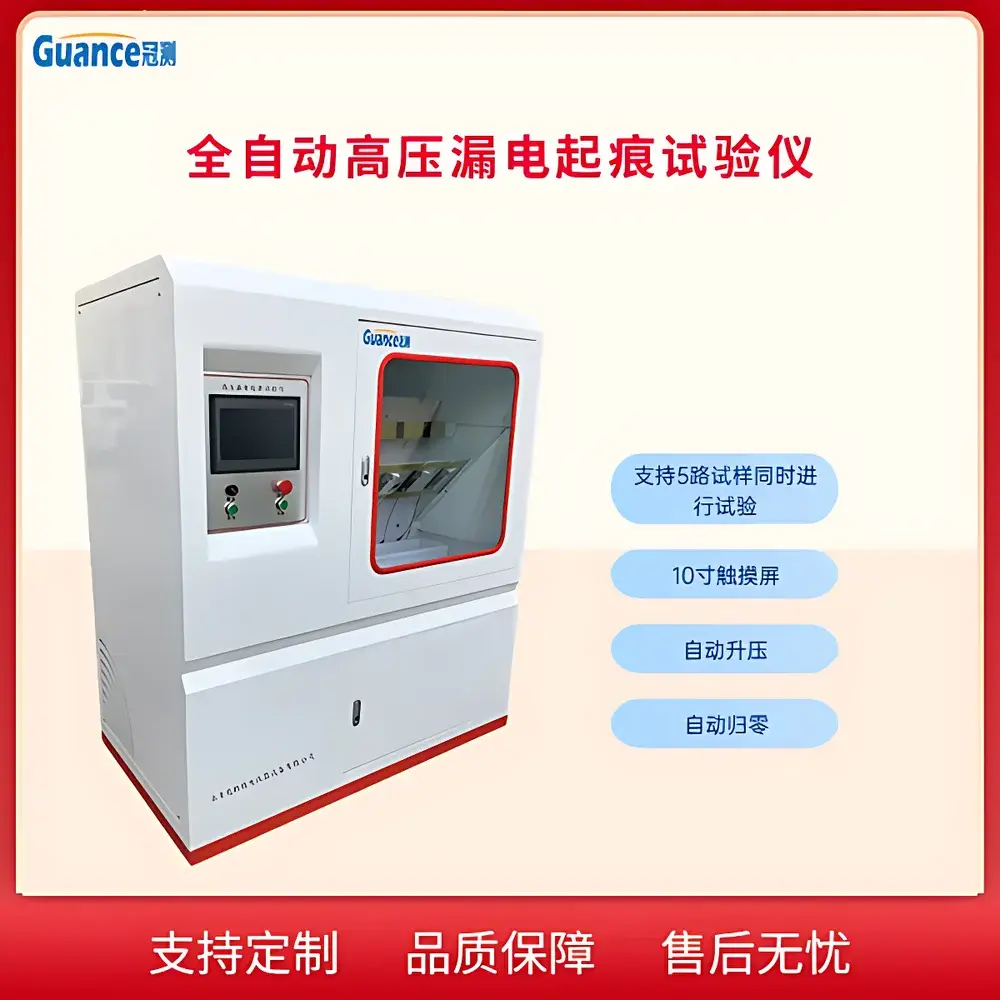
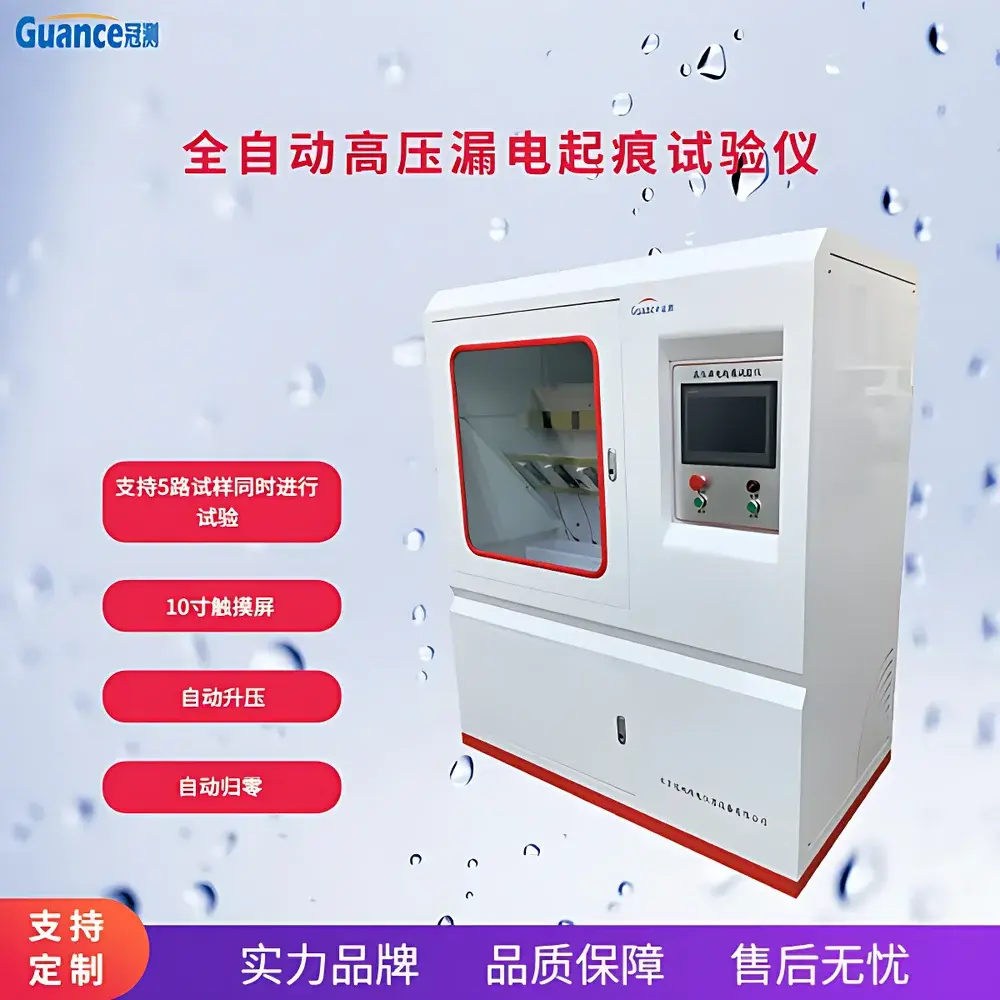
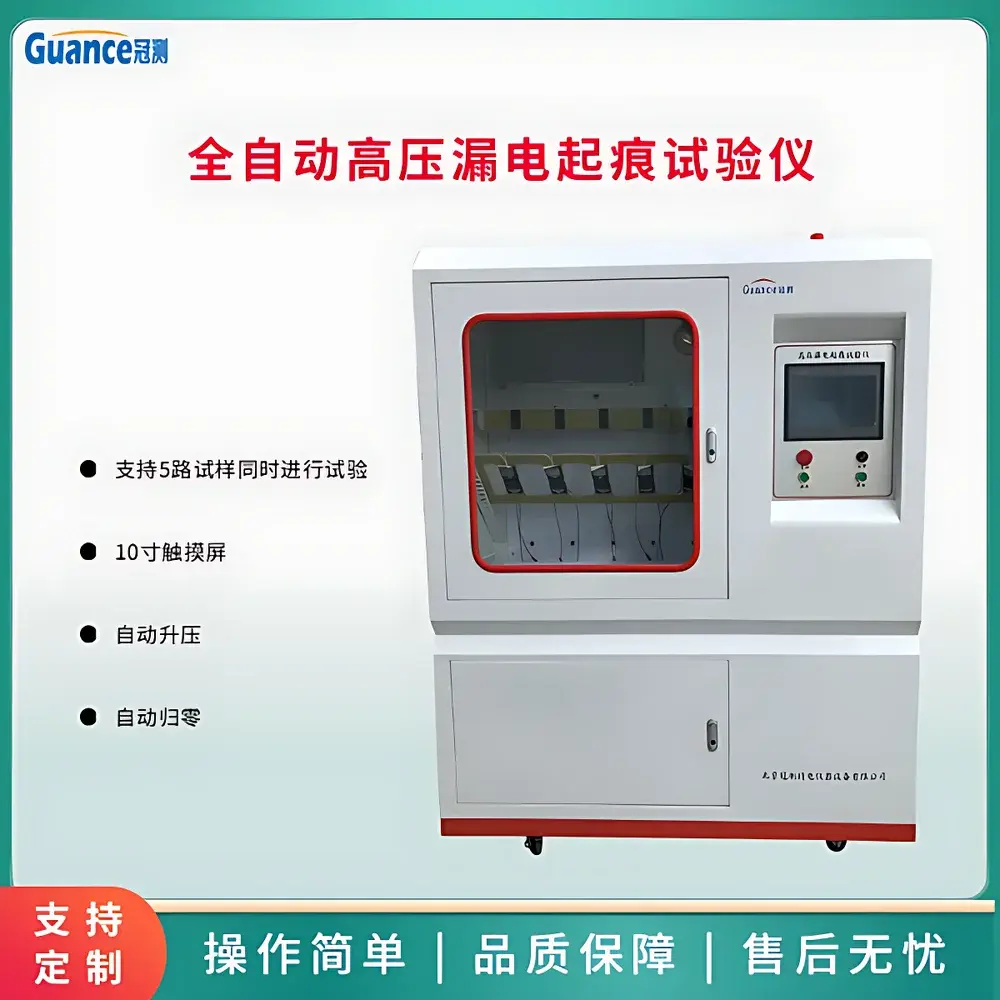
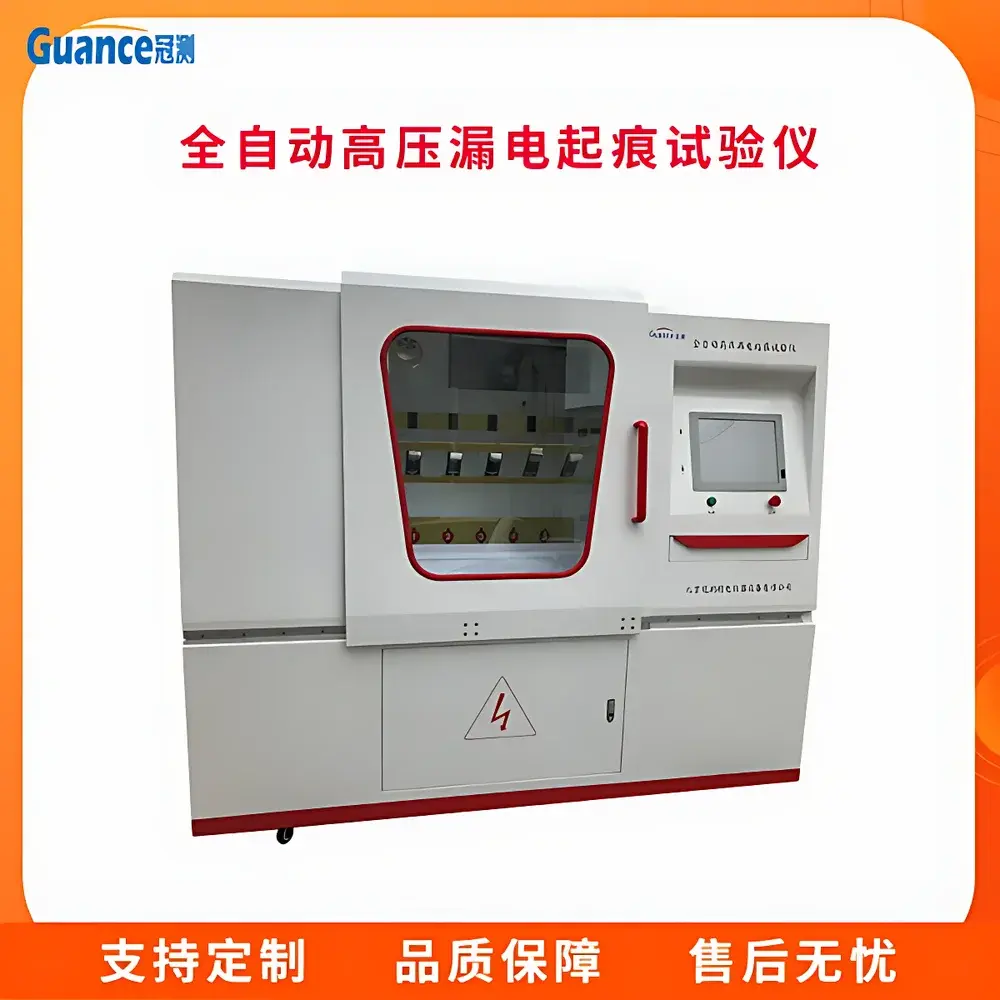
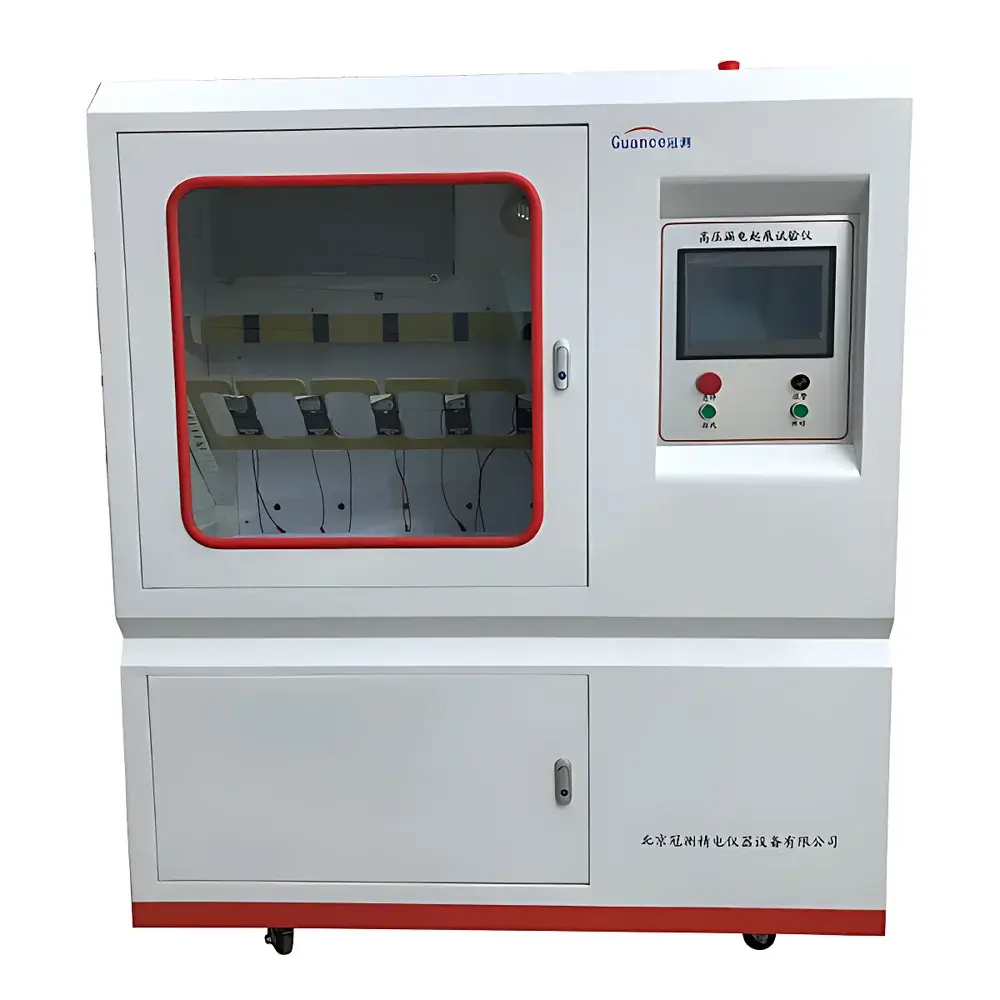
GuanCe NLD-AI Fully Automated High-Voltage Tracking Resistance Tester
| Brand | GuanCe Instruments |
|---|---|
| Origin | Beijing, China |
| Manufacturer Type | Authorized Distributor |
| Country of Origin | China |
| Model | NLD-AI |
| Instrument Type | Electronic Universal Testing Machine |
| Compliance | GB/T 6553–2003, IEC 60587:1984 |
| Voltage Modes | AC (48–62 Hz) and DC |
| Test Methods | Constant Voltage Method & Stepwise Voltage Method |
| Sample Channels | 5 independent parallel test circuits |
| Control System | Siemens PLC with optical isolation for voltage/current acquisition |
| Human Interface | 10-inch industrial touchscreen HMI |
| Leakage Current Alarm Range | 0–100 mA (user-configurable per channel) |
| Voltage Regulation | Autotransformer + oil-immersed high-voltage transformer |
| Safety Interlock | Door-open automatic HV cutoff |
| Drip Control | Precision peristaltic pump with real-time flow display and adjustable rate |
| Liquid Management | Separate fresh-contaminant reservoir and spent-solution collection |
| Ventilation | Dedicated exhaust system compliant with lab fume handling standards |
| Illumination | Integrated LED inspection lighting |
| Data Calibration | Onboard voltage and current calibration routines |
| Timing Resolution | Minute-level test duration logging |
| Post-Test Sequence | Automatic voltage ramp-down to zero |
Overview
The GuanCe NLD-AI Fully Automated High-Voltage Tracking Resistance Tester is an engineered solution for evaluating the comparative tracking index (CTI) and erosion resistance of solid electrical insulating materials under accelerated contamination conditions. It operates on the principle of controlled surface tracking—inducing progressive carbonized conductive paths across a dielectric surface via repeated electrolytic droplet application under sustained or stepped high voltage. Designed in strict accordance with GB/T 6553–2003 and IEC 60587:1984, the instrument replicates service stresses encountered in outdoor high-voltage equipment (e.g., polymer insulators, silicone rubber housings, and composite bushings) exposed to industrial pollution, coastal salt fog, or humid tropical environments. The test method employs a standardized inclined plane (typically 45°) specimen orientation, synthetic contaminant solution (e.g., ammonium chloride + sodium lauryl sulfate), and either constant-voltage or stepwise-voltage protocols to quantify time-to-failure, number of drops to tracking, or critical voltage thresholds.
Key Features
- Five-channel parallel testing architecture: Enables simultaneous evaluation of five specimens under identical environmental and electrical conditions—significantly improving statistical robustness and throughput for comparative material qualification.
- Siemens S7-series PLC control core: Integrates optically isolated analog input modules for high-fidelity acquisition of leakage current (0–100 mA full scale) and applied voltage (AC/DC), minimizing electromagnetic interference common in high-voltage laboratories.
- 10-inch industrial touchscreen HMI: Provides real-time visualization of per-channel parameters—including instantaneous leakage current, peak historical current, applied voltage, drip count, elapsed test time, and peristaltic pump flow rate—without requiring external PCs.
- Configurable per-channel alarm logic: Each test circuit features independent current threshold setting; exceeding the limit triggers immediate local HV disconnection while preserving continuity for remaining active channels.
- Calibration-traceable measurement subsystem: Onboard voltage and current calibration routines support periodic verification against certified reference standards—essential for ISO/IEC 17025-accredited labs and GLP-compliant reporting.
- Dedicated liquid handling system: Dual-reservoir design isolates fresh contaminant solution from post-test effluent, preventing cross-contamination and ensuring reproducible droplet composition per ASTM D2303 Annex A requirements.
- Oil-immersed high-voltage transformer stage: Coupled with autotransformer pre-regulation, this architecture maintains voltage stability (< ±1.5% regulation under load) and minimizes waveform distortion—critical for valid CTI determination per IEC 60587 Clause 7.3.
- Integrated safety interlocks: Mechanical door switch disables HV output within < 20 ms upon access panel opening; combined with automatic post-test voltage ramp-down to zero, it fulfills IEC 61010-1 Class II laboratory safety requirements.
Sample Compatibility & Compliance
The NLD-AI accommodates standard test specimens conforming to IEC 60587 dimensions (125 mm × 13 mm × 6 mm) and supports both rigid and semi-flexible polymeric insulation materials—including epoxy resins, thermoset composites, silicone elastomers, and filled polyolefins. Specimen mounting fixtures ensure consistent 45° inclination and precise electrode alignment per Clause 6.2. All operational parameters—including voltage ramp rate, dwell time, drop interval (30 ± 5 s), and solution conductivity (1.0 ± 0.05 mS/cm)—are programmable and auditable. The system supports full traceability for regulatory submissions under FDA 21 CFR Part 11 (when paired with validated software), and its mechanical and electrical design adheres to EN 61000-6-3 (EMC emission) and EN 61000-6-2 (immunity) standards.
Software & Data Management
While the NLD-AI operates autonomously via embedded PLC logic, optional PC-based data logging software (available separately) enables export of timestamped CSV files containing all acquired parameters per channel. Each record includes absolute UTC timestamps, user-defined sample IDs, operator credentials, calibration status flags, and pass/fail annotations per IEC 60587 acceptance criteria. Audit trails capture all configuration changes, alarm events, and manual interventions—supporting compliance with ISO/IEC 17025 clause 7.7 (result reporting) and internal quality management systems requiring ALCOA+ principles (Attributable, Legible, Contemporaneous, Original, Accurate, Complete, Consistent, Enduring, Available).
Applications
- Comparative CTI ranking of candidate insulating polymers for high-voltage switchgear enclosures
- Qualification testing of RTV silicone coatings applied to porcelain or glass insulators
- Failure mode analysis of composite insulator housing materials under accelerated pollution aging
- Development validation of flame-retardant additives impacting surface carbonization resistance
- Third-party certification testing per UL 746A, CSA C22.2 No. 0.3, and VDE 0303 Part 1
FAQ
What voltage ranges does the NLD-AI support?
The instrument delivers AC voltage from 0–6.0 kV RMS (48–62 Hz) and DC voltage from 0–6.0 kV, with programmable ramp rates and hold times per IEC 60587 test sequences.
Is the drip solution flow rate adjustable during active testing?
Yes—the peristaltic pump flow rate is continuously adjustable via the touchscreen interface and remains stable throughout the test cycle, with real-time feedback displayed for each channel.
How is data integrity ensured over extended calibration intervals?
Onboard voltage and current calibration routines allow field verification using NIST-traceable multimeters; calibration coefficients are stored in non-volatile memory with write-protection logic.
Does the system meet international EMC requirements?
Yes—the enclosure design, filtered power entry, and shielded signal cabling comply with EN 61000-6-2 (immunity) and EN 61000-6-3 (emission) for industrial environments.
Can test reports be generated directly from the instrument?
The embedded HMI displays real-time pass/fail status per channel; final summary reports require optional PC software or manual transcription of logged parameters into standardized templates per GB/T 6553 Annex B.



