
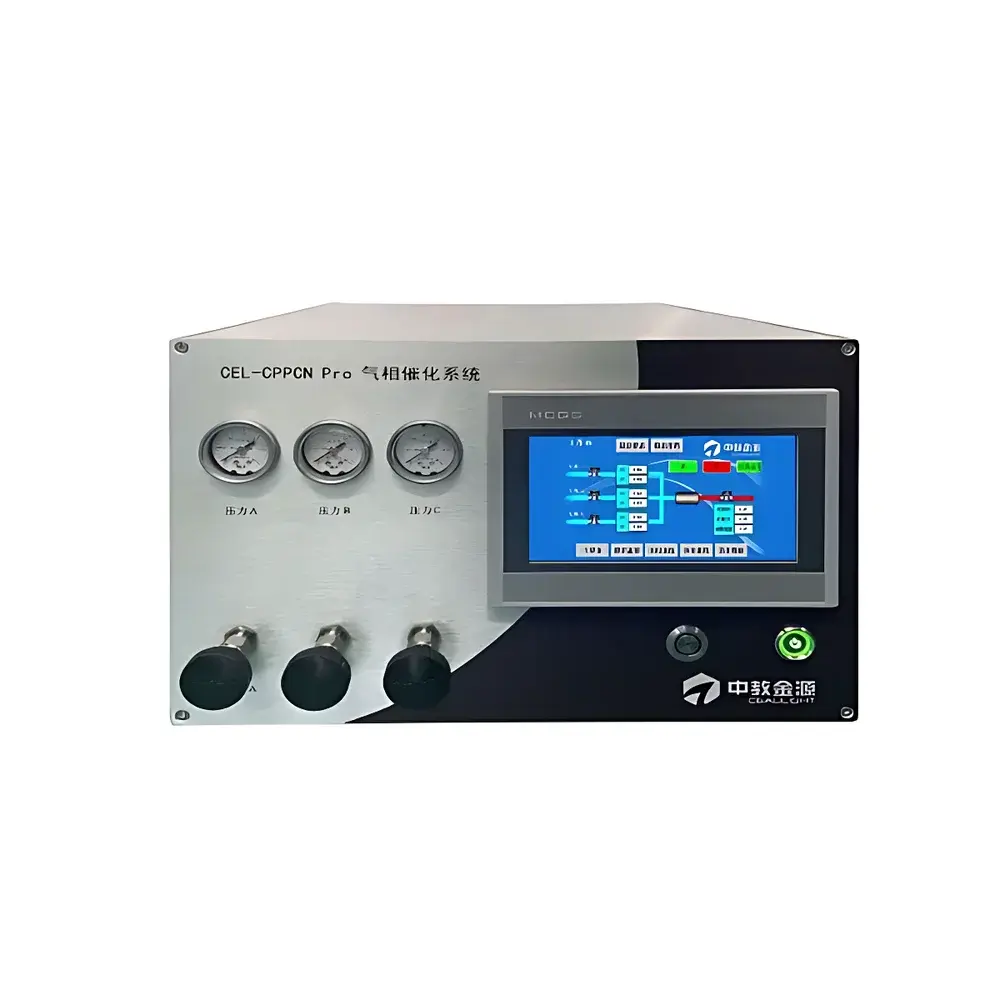
CEL-GPPCN Pro Gas-Phase Photocatalytic Reaction System
| Brand | CEL (China Education Goldsource) |
|---|---|
| Origin | Beijing, China |
| Manufacturer Type | Direct Manufacturer |
| Product Origin | Domestic (China) |
| Model | CEL-GPPCN Pro |
| Component Category | Gas-Phase Photocatalysis System |
| Touchscreen | 1.7-inch TFT LCD |
| Max Operating Pressure | 0.3 MPa |
| Gas Channels | 3 |
| Mass Flow Controllers | Two 100 mL/min + One 200 mL/min (N₂-calibrated) |
| Flow Control Range | 6–100% F.S. |
| Flow Accuracy | ±1.5% F.S. |
| Flow Repeatability | ±0.2% F.S. |
| Mixing Chamber | Microporous stainless steel design for homogeneous gas blending |
| Outlet Line Temperature Control | Ambient to 230 °C |
| Tubing & Valves | Anlok® fittings, SS316L |
| Dimensions (W×D×H) | 400 × 400 × 270 mm |
Overview
The CEL-GPPCN Pro Gas-Phase Photocatalytic Reaction System is an engineered platform for controlled, reproducible investigation of heterogeneous photocatalytic processes under continuous-flow gas-phase conditions. Designed around Couette-type laminar flow principles and precise stoichiometric gas delivery, the system enables quantitative evaluation of photocatalytic activity in gas–solid and gas–liquid–solid interfaces. Its architecture integrates calibrated mass flow control, thermostatically regulated outlet lines, and pressure-stable stainless-steel fluidics—ensuring compliance with fundamental requirements for kinetic studies, catalyst screening, and mechanistic validation per ISO 22197-1 (photocatalytic air purification) and ASTM E2915 (catalyst performance testing). The system operates without solvent interference, making it especially suitable for studying surface adsorption/desorption equilibria, radical-mediated oxidation pathways, and photon-driven charge-carrier dynamics in TiO₂, g-C₃N₄, MOFs, and other wide-bandgap semiconductors.
Key Features
- Triple-channel gas delivery with independently programmable mass flow controllers (MFCs), pre-calibrated for nitrogen—supporting binary or ternary gas mixtures (e.g., CO₂/N₂/H₂O, NO/O₂/N₂, CH₃CHO/air) with trace-level precision.
- Microporous stainless-steel mixing chamber enabling rapid, turbulence-free homogenization across full flow range (1–200 mL/min), minimizing residence time dispersion and ensuring plug-flow behavior.
- Electrically heated stainless-steel outlet tubing (SS316L), temperature-controlled from ambient to 230 °C with ±1 °C stability—critical for maintaining consistent vapor-phase composition during humidity-sensitive or condensation-prone reactions (e.g., H₂O-assisted CO₂ reduction).
- Integrated 1.7-inch resistive touchscreen interface with real-time display of flow rates, system pressure, and heater status—enabling standalone operation without external PC dependency.
- Full SS316L wetted path including Anlok® compression fittings, rated for sustained operation up to 0.3 MPa (43.5 psi), compliant with PED 2014/68/EU for pressure equipment safety.
- Modular reactor interface accommodating standardized flanged reactors (KF-16/KF-25), fixed-bed quartz reactors, annular photoreactors, and custom-designed catalytic cartridges for UV–Vis irradiation (300–780 nm).
Sample Compatibility & Compliance
The CEL-GPPCN Pro supports a broad spectrum of gas-phase photocatalytic substrates—including volatile organic compounds (VOCs) such as acetaldehyde, formaldehyde, and toluene; greenhouse gases (CO₂, CH₄); nitrogen oxides (NO, NO₂); sulfur-containing species (H₂S, SO₂); and small-molecule reagents (NH₃, H₂, O₂). All wetted components meet ASTM A269 and ASTM A270 standards for sanitary-grade stainless steel. The system’s pressure rating and leak-tight construction align with ISO 15848-1 for fugitive emission control. When operated with certified calibration gases and traceable MFC verification protocols, data generated satisfies GLP documentation requirements for academic publication and industrial R&D reporting.
Software & Data Management
While the embedded touchscreen provides local configuration and monitoring, optional RS-485/Modbus RTU communication allows integration into LabVIEW™, MATLAB®, or Python-based DAQ environments for automated long-term experiments. All flow setpoints, pressure readings, and temperature logs are timestamped and exportable as CSV files. Audit trails—including parameter changes, system start/stop events, and calibration history—are retained onboard for regulatory review. The firmware architecture supports firmware updates via USB and complies with basic cybersecurity hygiene practices for laboratory instrumentation (IEC 62443-1-1).
Applications
- Photocatalytic CO₂ reduction to CO, CH₄, or C₂H₄ under simulated solar illumination
- Gas-phase VOC abatement kinetics (e.g., acetaldehyde degradation efficiency vs. light intensity)
- Photo-assisted ammonia synthesis (N₂ fixation) using plasmonic or defect-engineered catalysts
- In situ DRIFTS-coupled studies of surface intermediates during sulfidation or nitridation
- Hybrid photo-thermal catalysis where controlled thermal input augments charge separation
- Accelerated aging tests of photocatalyst deactivation under humid, oxidizing atmospheres
FAQ
Can the system be used with corrosive gases such as Cl₂ or HF?
No—the standard configuration uses SS316L and fluoropolymer seals rated for inert and mildly acidic gases only. For halogenated or strongly reducing/corrosive streams, optional Hastelloy C-276 wetted parts and Kalrez® seals must be specified at order stage.
Is the system compatible with online GC or MS detection?
Yes—standard KF-16 vacuum flanges on the outlet line allow direct coupling to gas chromatographs (e.g., Agilent 7890B) or quadrupole mass spectrometers (e.g., Thermo ISQ LT) via heated transfer lines.
Does the system support dynamic light intensity modulation during reaction?
Not natively—the light source is external. However, the system includes TTL-trigger outputs synchronized to flow/pressure events, enabling third-party LED or Xe-lamp drivers to modulate irradiance in response to process variables.
What calibration documentation is provided?
Each unit ships with factory calibration certificates for all MFCs (traceable to NIM, China) and pressure transducers (ISO/IEC 17025 accredited lab), valid for 12 months under normal operating conditions.
Can reactor temperature be controlled independently from outlet line temperature?
Yes—optional reactor jacket modules (Peltier or oil-circulation) are available as add-ons, allowing independent thermal management of the catalytic zone versus transport lines.




