
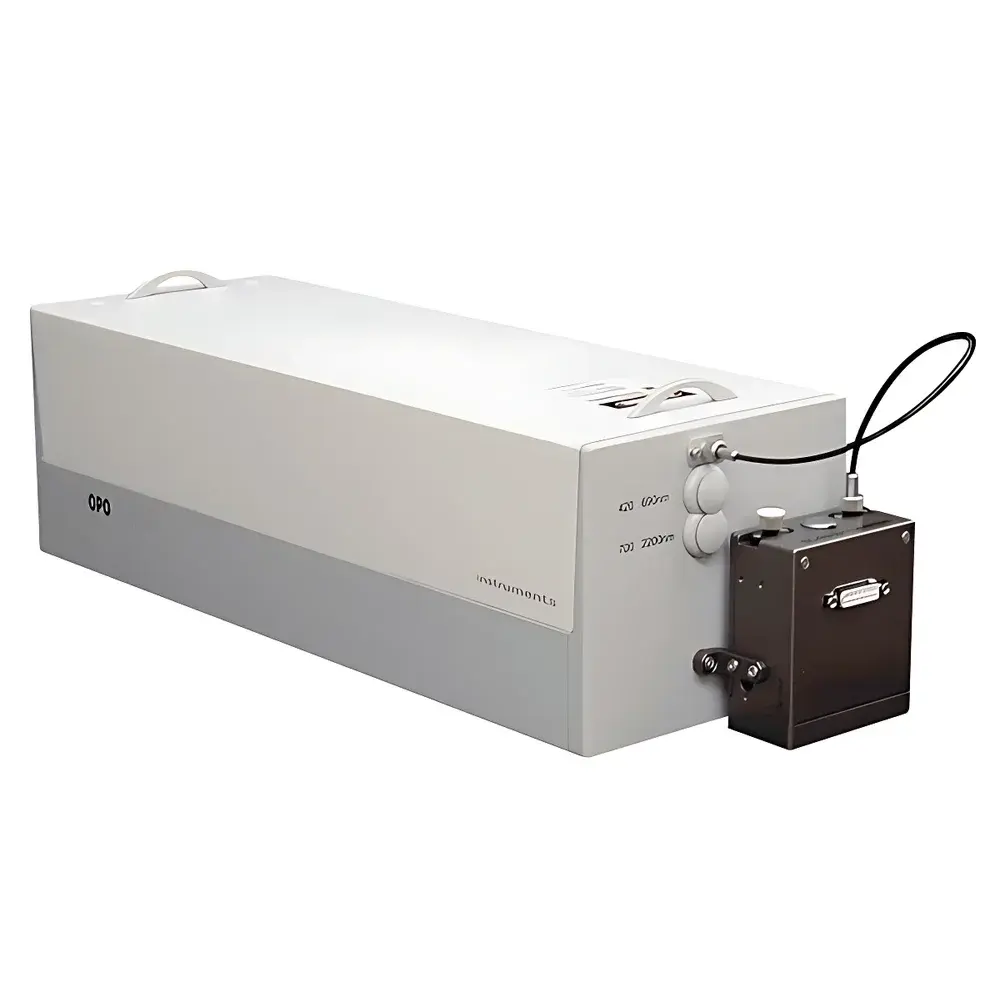
High-Energy OPO Tunable Laser System
| Origin | Imported |
|---|---|
| Manufacturer Type | Authorized Distributor |
| Model | OPO |
| Price | Upon Request |
| Tuning Range | Signal 414–709 nm, Idler 710–2200 nm, SHG 220–350 nm |
| Pulse Width | <1–2 ns (FWHM) |
| Peak Pulse Energy | >12 mJ (Signal), up to 60 mJ @ 355 nm pump with 150 mJ input |
| Repetition Rate | 50 Hz |
| Linewidth | 0.15 nm @ 500 nm |
| Conversion Efficiency | Up to 40% (Signal + Idler) |
| Pump Compatibility | Nd:YAG (266/355/532/1064 nm), including third-harmonic 355 nm |
| Nonlinear Crystal | BBO (broadband, pre-screened & certified) |
| Control Interface | PC-based automated software with real-time parameter logging and remote operation capability |
| Enclosure | Hermetically sealed, compact OEM-grade housing |
| Lifetime | >1 × 10⁶ shots (BBO crystal & optics qualified per MIL-STD-883 optical aging protocols) |
Overview
The High-Energy OPO Tunable Laser System is a fully integrated, optically pumped optical parametric oscillator engineered for precision spectroscopic applications requiring broad spectral coverage, high pulse energy, and long-term operational stability. Based on intracavity synchronous pumping architecture and optimized BBO (beta-barium borate) nonlinear crystal geometry, the system leverages difference-frequency generation (DFG) and sum-frequency mixing principles to deliver widely tunable output across the UV–NIR spectrum. Its core design eliminates mechanical sensitivity through monolithic cavity alignment and thermally stabilized mounting—ensuring passive alignment retention over extended duty cycles. The laser operates at a fixed 50 Hz repetition rate synchronized to Q-switched Nd:YAG pump sources (266 nm, 355 nm, 532 nm, or 1064 nm), enabling seamless integration into time-resolved fluorescence, CARS microscopy, LIDAR calibration, and photochemical reaction studies where shot-to-shot reproducibility is critical.
Key Features
- Automated wavelength tuning across three spectral bands: signal (414–709 nm), idler (710–2200 nm), and second-harmonic (220–350 nm) via motorized grating and crystal angle positioning
- Hermetically sealed, vibration-damped enclosure compliant with IEC 60825-1 Class 4 laser safety standards and suitable for cleanroom environments
- BBO crystals individually characterized for damage threshold (>500 MW/cm² at 355 nm, 10 ns), phase-matching bandwidth, and transmission homogeneity; lot traceability provided
- Intracavity optical design minimizes misalignment drift—no manual cavity re-optimization required over >10⁶ shots
- UV-compatible replaceable focusing module supports variable pump beam diameters (3–8 mm) and divergence tolerances, enabling compatibility with commercial and custom Nd:YAG systems
- Real-time monitoring of pulse energy (via calibrated photodiode), temporal profile (optional autocorrelator interface), and crystal temperature (±0.1 °C resolution)
Sample Compatibility & Compliance
This OPO system is designed for use with solid-state nanosecond Nd:YAG pump lasers meeting ISO 11146 beam quality specifications (M² < 2.0) and pulse energy stability ≤ ±1.5% RMS over 1 hour. It complies with EU Directive 2014/30/EU (EMC), 2014/35/EU (LVD), and carries CE marking under EN 60825-1:2014. All firmware and control software adhere to FDA 21 CFR Part 11 requirements for audit trail, electronic signature, and data integrity when operated in regulated GLP/GMP environments. Calibration certificates traceable to NIST standards are supplied with each unit, including spectral output verification at ≥5 reference wavelengths across the tuning range.
Software & Data Management
The included Windows-based control suite provides deterministic command-line and GUI interfaces for full parameter orchestration—including wavelength setpoint, crystal temperature, delay timing (for pump–probe experiments), and energy normalization routines. Raw pulse energy logs, tuning history, and error codes are stored in HDF5 format with embedded metadata (timestamp, operator ID, environmental conditions). Export options include CSV, MATLAB .mat, and XML schemas compatible with LabVIEW and Python-based analysis pipelines (e.g., SciPy, PyTorch for spectral fitting). Remote operation via TCP/IP is supported with TLS 1.2 encryption, enabling integration into centralized facility management systems.
Applications
- Time-resolved Raman and fluorescence spectroscopy requiring narrow linewidth (<0.2 nm) and high peak power in the visible–NIR
- Photoacoustic imaging source for multi-wavelength tissue characterization (e.g., hemoglobin/oxyhemoglobin differentiation between 700–900 nm)
- Calibration of hyperspectral sensors and monochromator linearity verification from 220 nm to 2.2 µm
- Ultrafast pump–probe experiments using dual-output configuration (signal + idler) with adjustable inter-pulse delay (0–500 ps)
- Atmospheric trace gas detection via tunable diode laser absorption spectroscopy (TDLAS) reference source generation
- Nonlinear optical material characterization (e.g., two-photon absorption cross-section mapping)
FAQ
What pump laser specifications are required for optimal OPO conversion efficiency?
The system is optimized for Q-switched Nd:YAG lasers delivering ≥150 mJ at 355 nm (third harmonic), with pulse duration 5–8 ns, beam diameter 4–6 mm (1/e²), and M² ≤ 1.8. Pump energy stability must be ≤ ±1.2% RMS over 60 minutes.
Is vacuum or purged operation necessary for UV output below 250 nm?
Yes. For sustained operation below 240 nm, the SHG module requires nitrogen purge (≤5 ppm H₂O/O₂) or vacuum (≤1 × 10⁻² mbar) to prevent ozone generation and fused silica transmission degradation.
Can the system be upgraded to support higher repetition rates?
No. The thermal management and crystal lifetime are validated only at 50 Hz. Higher rep rates would exceed the BBO average power limit (≤1.5 W) and compromise phase-matching stability.
Does the control software support scripting for automated spectral sweeps?
Yes. Python API (pyOPO) and MATLAB instrument driver packages are included, supporting programmable wavelength ramps, energy-triggered acquisition, and conditional logic loops.
What maintenance intervals are recommended for long-term reliability?
Optical inspection and energy calibration every 6 months; BBO crystal replacement recommended after 8 × 10⁵ shots or if spectral bandwidth degrades by >15% (measured via scanning Fabry–Pérot interferometer).



