
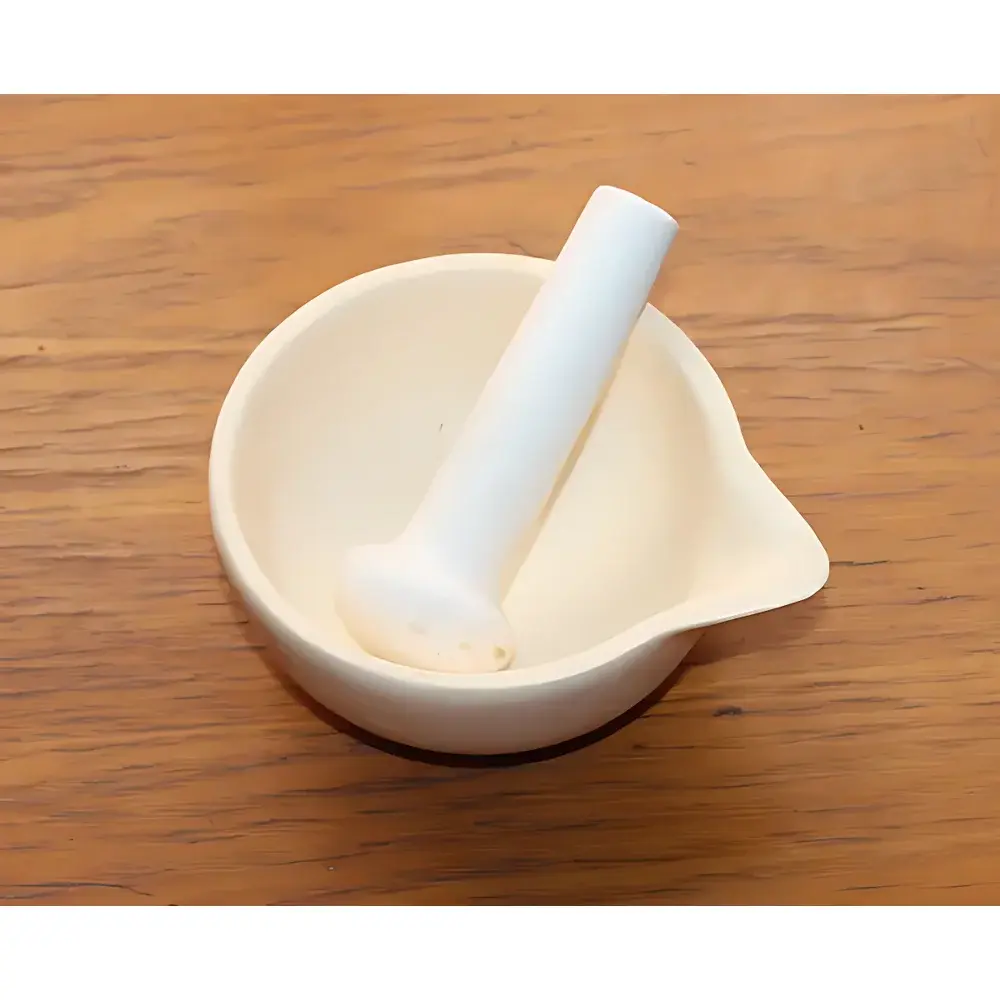
Zhongke Aobo Mortar Set – Alumina Ceramic Mortar and Pestle (Φ300 / Φ250 / Φ200 / Φ150 / Φ120 mm)
| Brand | Zhongke Aobo |
|---|---|
| Origin | Beijing, China |
| Model | Φ300 / Φ250 / Φ200 / Φ150 / Φ120 mm |
| Material | ≥99% Al₂O₃ High-Purity Alumina Ceramic |
| Bulk Density | ≥3.80 g/cm³ |
| Apparent Porosity | <1% |
| Flexural Strength | >350 MPa |
| Compressive Strength | >12,000 MPa |
| Dielectric Constant (1 MHz) | ~9.8 |
| Vickers Hardness | ~1700 HV (equivalent to HRA 88) |
| Max Feed Size | 15 mm |
| Minimum Output Particle Size | ≥0.5 mm |
| Batch Capacity | 100 g |
| Sample Compatibility | Hard, brittle, non-fibrous inorganic materials (e.g., oxides, salts, pharmaceutical excipients, catalysts) |
| Compliance | ASTM C704, ISO 6474-1, GB/T 7917.1–1987 |
Overview
The Zhongke Aobo Mortar Set is a precision-engineered laboratory mortar and pestle system fabricated from high-purity (>99% Al₂O₃) alumina ceramic. Designed for rigorous sample preparation in analytical chemistry, materials science, and pharmaceutical R&D laboratories, this mortar operates on the principle of mechanical attrition—applying controlled compressive and shear forces via manual or assisted grinding to reduce particle size while minimizing contamination and thermal degradation. Unlike metal or agate mortars, alumina ceramic offers exceptional chemical inertness, negligible leaching of metallic ions, and outstanding resistance to acids (including HF-free mineral acid mixtures), alkalis, and organic solvents. Its ultra-low porosity (<1%) and high density (≥3.80 g/cm³) ensure minimal adsorption of analytes and facilitate complete recovery of trace-level samples—critical for ICP-MS, XRD, and dissolution testing workflows.
Key Features
- High-Purity Alumina Construction: Compliant with ISO 6474-1 specifications for dense technical ceramics; Al₂O₃ content ≥99%, Fe₂O₃ ≤0.1%, R₂O ≤0.2%, SiO₂ ≤0.2%—ensuring spectroscopic-grade purity and low background interference.
- Exceptional Mechanical Robustness: Flexural strength >350 MPa and compressive strength >12,000 MPa enable consistent performance under repetitive high-load grinding without chipping or microcracking.
- Dimensional Precision & Surface Finish: Inner bowl surface polished to Ra ≤0.4 µm; tight geometric tolerance (±0.15 mm diameter control) ensures uniform contact area between pestle and mortar base—maximizing grinding efficiency and reproducibility across batches.
- Thermal & Dielectric Stability: Stable up to 1600°C; dielectric constant ~9.8 at 1 MHz supports compatibility with electrostatic-sensitive applications and avoids interference in impedance-based characterization protocols.
- Modular Sizing Options: Five standardized diameters (Φ120, Φ150, Φ200, Φ250, Φ300 mm) accommodate varying throughput requirements—from micro-scale QC sampling (10–50 g) to preparative batch grinding (up to 100 g per cycle).
Sample Compatibility & Compliance
This mortar set is validated for use with hard, non-ductile, non-fibrous inorganic solids including metal oxides (e.g., TiO₂, ZnO), silicates, carbonates, phosphates, and crystalline APIs. It is not recommended for soft polymers, hydrated salts prone to deliquescence, or hygroscopic compounds requiring inert-atmosphere handling. All units conform to ASTM C704 for abrasion resistance of refractory materials and meet the dimensional and purity criteria outlined in Chinese national standard GB/T 7917.1–1987 for ceramic labware. Documentation includes material certification (CoA) with batch-specific XRF trace element analysis and density verification reports—supporting GLP-compliant recordkeeping and audit readiness.
Software & Data Management
As a manually operated passive tool, this mortar set does not incorporate embedded electronics, firmware, or digital interfaces. However, it is fully compatible with structured laboratory documentation systems. Users may integrate grinding parameters—including batch ID, operator name, start/end time, feed mass, number of strokes, and post-grinding sieve analysis results—into LIMS or ELN platforms (e.g., LabWare, Benchling, or Veeva Vault) using standardized SOP templates aligned with FDA 21 CFR Part 11 requirements for electronic records and signatures. Optional engraved serial numbering and QR-coded asset tags are available upon request to support instrument lifecycle tracking.
Applications
- Homogenization and particle size reduction prior to X-ray fluorescence (XRF) or inductively coupled plasma (ICP-OES/MS) analysis.
- Preparation of reference standards and calibration blends for solid-state NMR and Raman spectroscopy.
- Manual comminution of sintered ceramic pellets or metallurgical samples for SEM-EDS cross-sectioning.
- Pharmaceutical pre-formulation studies involving active pharmaceutical ingredient (API) micronization and excipient blending under GMP Annex 11-aligned manual processing conditions.
- Geochemical sample preparation for whole-rock major/minor element analysis following USGS CRPG protocols.
FAQ
Is this mortar suitable for grinding samples containing hydrofluoric acid (HF)?
No. Although highly resistant to most mineral acids, high-purity alumina reacts with HF. For HF-containing matrices, fused silica or PTFE-lined tools are recommended.
Can the mortar be autoclaved?
Yes. Fully compatible with steam sterilization at 121°C, 15 psi for 20 minutes. Thermal shock resistance supports rapid cooling after autoclaving without cracking.
What is the expected service life under daily QC use?
With proper cleaning (non-abrasive detergent, ultrasonic rinse, air-drying) and avoidance of impact loading, typical service life exceeds 5 years in high-throughput labs performing ≥10 grinding cycles/day.
Do you provide calibration or metrology documentation?
While no calibration is required for passive tools, we supply dimensional inspection reports (CMM-measured inner diameter, depth, and pestle taper angle) and material CoA with traceable NIST-traceable density and hardness verification.
Is custom geometry available for specialized sample containment needs?
Yes. Non-standard bowl profiles (e.g., conical, stepped, or recessed base designs), custom pestle curvature, and integrated weighing tare features can be engineered per ISO 80000-1 dimensional specification requirements.



