
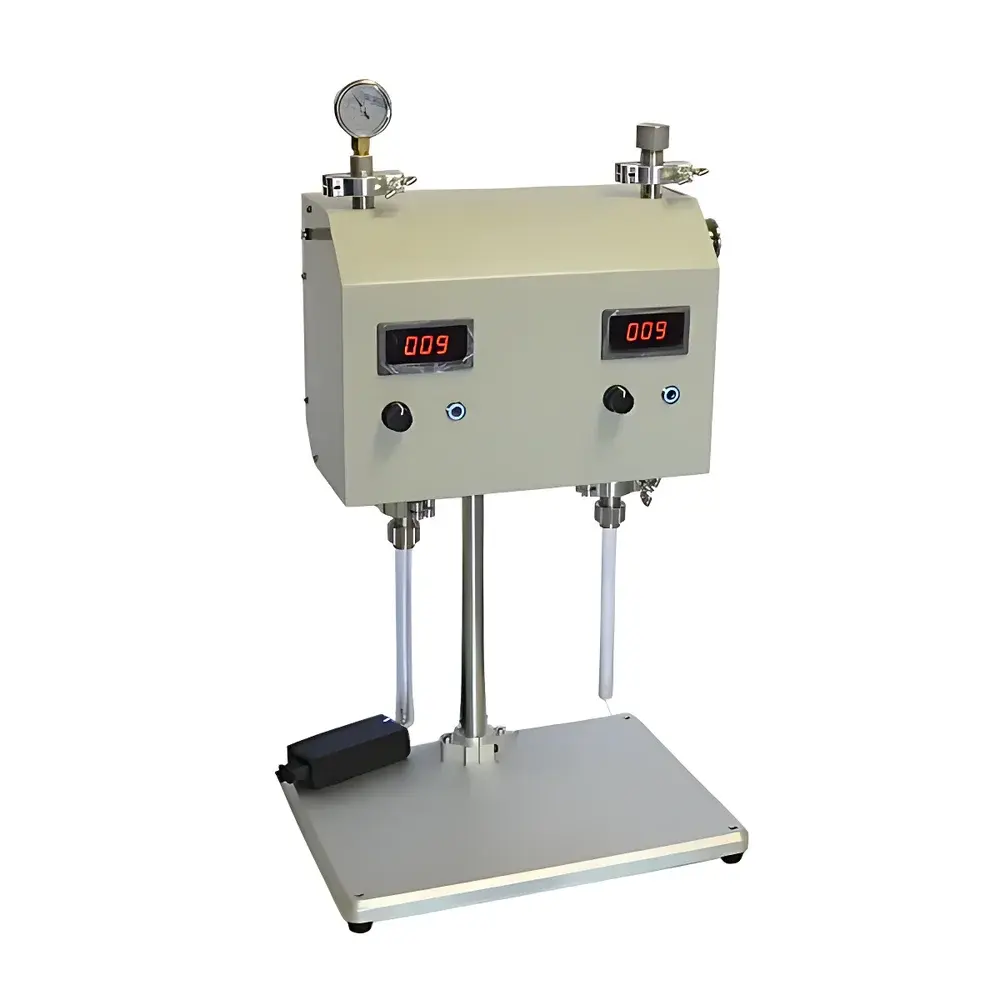
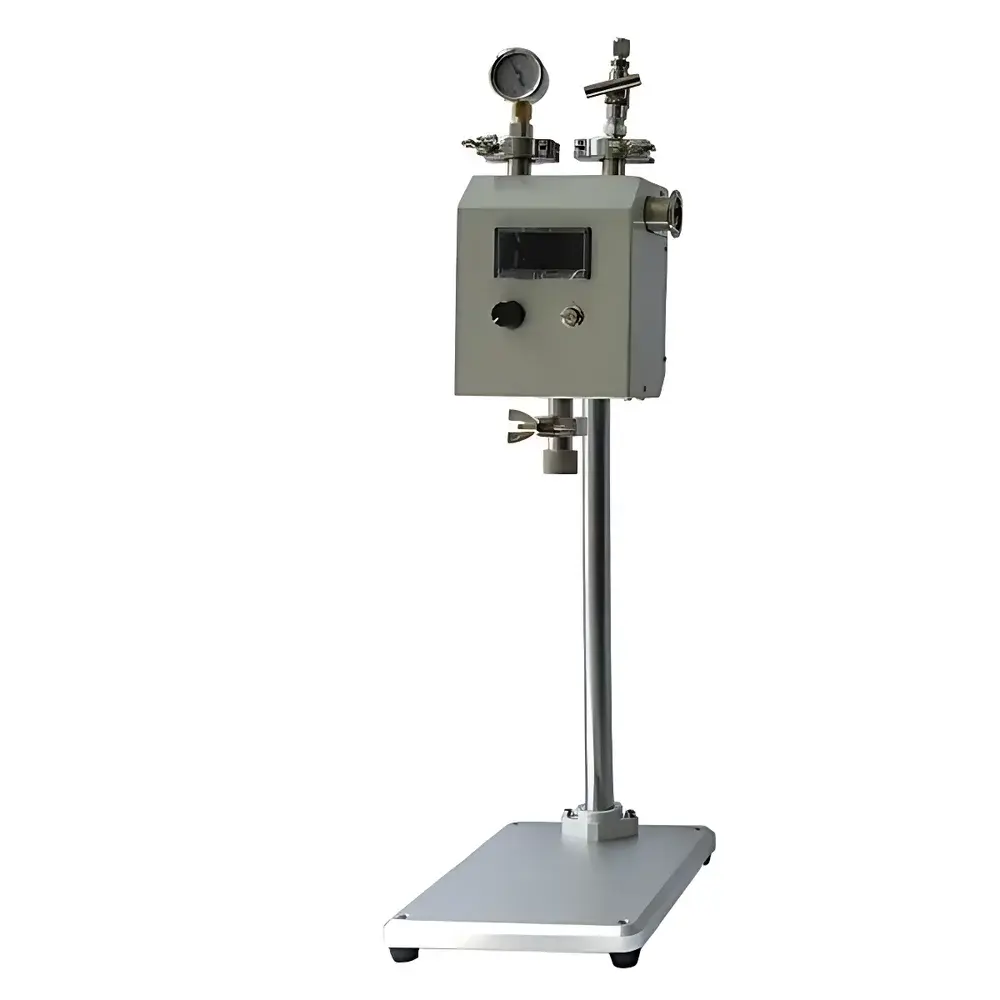
Quartz Tube Vacuum Sealing Machine FGJ
| Brand | Zhongke Aobo |
|---|---|
| Origin | Beijing, China |
| Manufacturer Type | Authorized Distributor |
| Country of Origin | China |
| Model | FGJ |
| Price | USD 2,100 (approx.) |
| Construction Material | Borosilicate Glass & Stainless Steel (KF Vacuum Components) |
| Operating Pressure Range | Low Vacuum to High Vacuum (Mechanical Pump: ≤50 Pa |
| Turbo-Molecular Pump | ≤5×10⁻⁴ Pa) |
| Leak Rate | ≤2×10⁻¹¹ Pa·m³/s |
| Tube Capacity | Up to 1 L |
| Max. Tube OD | 45 mm |
| Min. Tube OD | 8 mm |
| Max. Tube Wall Thickness | 2 mm |
| Max. Tube Length | 500 mm |
| Rotational Speed | 0–20 rpm (adjustable via precision potentiometer, digitally displayed) |
| Vacuum Interface | KF25 |
| Inlet Fitting | 6 mm Swagelok compression |
| Included Accessories | KF25 Gate Valve ×1, KF25 Bellows ×1, KF16 Vent Valve ×1, KF16 Mechanical Vacuum Gauge ×1, Torch Mounting Fixture ×1, Polarizing Viewer ×1, High-Temperature Gloves ×1, Quartz Tubes (with quartz rods) ×2, Quartz Tube Adapter ×1, KF16 Clamp Set ×1, KF25 Clamp Set ×2, 6 mm Inlet Tubing (3 m), Power Adapter ×1 |
Overview
The FGJ Quartz Tube Vacuum Sealing Machine is an engineered vacuum processing system designed for inert-atmosphere encapsulation of air- and moisture-sensitive materials in fused silica or borosilicate glass tubing. It operates on the principle of localized high-temperature fusion under controlled vacuum conditions—using a precisely regulated oxy-hydrogen or propane-oxygen flame—to melt and hermetically seal the open end of a pre-evacuated tube. This process eliminates residual gas phase contaminants and prevents oxidation, hydrolysis, or decomposition during subsequent thermal treatment (e.g., annealing, sintering), long-term storage, or transfer between gloveboxes and analytical instruments. The system integrates a high-integrity rotating vacuum feedthrough, KF-standard ultra-high-vacuum (UHV)-rated components, and real-time rotational speed feedback—enabling reproducible, operator-independent sealing across diverse tube geometries (8–45 mm OD, ≤2 mm wall thickness, up to 500 mm length). Its modular architecture supports single- to triple-station configurations and optional integration with turbomolecular pumping systems for ultimate base pressure performance (<5×10⁻⁴ Pa).
Key Features
- High-reproducibility rotational sealing: Motorized, digitally monitored rotation (0–20 rpm) ensures uniform heat distribution and consistent neck formation without manual tube manipulation.
- UHV-compatible vacuum architecture: All metallic seals conform to ISO-KF standards; leak rate certified at ≤2×10⁻¹¹ Pa·m³/s per ISO 20483 and ASTM E1587.
- Dual-stage vacuum capability: Standard configuration includes mechanical roughing pump (base pressure ≤50 Pa); optional turbo-molecular pump upgrade enables high-vacuum operation (≤5×10⁻⁴ Pa) for ultra-sensitive synthesis (e.g., superconducting precursors, alkali metal intercalation compounds).
- Modular station design: Configurable 1-, 2-, or 3-position sealing heads accommodate parallel processing while maintaining individual vacuum isolation and flame control.
- Integrated safety and diagnostics: Built-in KF16 mechanical vacuum gauge, KF25 gate valve, vent valve, and flame alignment viewer (polarizing optic) support GLP-compliant procedural validation and operator training.
- Material compatibility: Optimized for fused quartz (SiO₂ >99.995%) and borosilicate glass (e.g., Pyrex® 7740), with validated sealing integrity across wall thicknesses up to 2 mm and diameters from 8 mm to 45 mm.
Sample Compatibility & Compliance
The FGJ system is routinely employed in academic and industrial laboratories for encapsulating hygroscopic, pyrophoric, or oxygen-labile samples—including transition metal chalcogenides, rare-earth intermetallics, lithium battery cathode precursors, and organometallic complexes. Sealed tubes meet ASTM E2913 requirements for inert-gas containment integrity and are compatible with downstream processes such as tube furnace annealing (up to 1200 °C), XRD sample mounting, and synchrotron beamline transfer under nitrogen-purged environments. Vacuum integrity is traceable per ISO/IEC 17025 calibration protocols when used with certified pressure gauges and leak detectors. The system’s mechanical and electrical design complies with IEC 61010-1:2010 for laboratory equipment safety.
Software & Data Management
The FGJ operates as a hardware-controlled analog-digital hybrid system: rotational speed is set via calibrated potentiometer and displayed on a 4-digit LED readout; vacuum status is monitored using analog KF16 mechanical gauges (no embedded firmware or software interface). For audit-trail compliance in regulated environments (e.g., GMP pilot-scale synthesis), users may integrate external data loggers (e.g., Omega OM-DAQPRO-5300) connected to vacuum transducers and tachometer outputs. All operational parameters—including pump-down time, final pressure, rotation duration, and flame dwell time—are manually recorded in lab notebooks aligned with 21 CFR Part 11–compatible electronic lab notebook (ELN) templates.
Applications
- Encapsulation of air-sensitive catalysts (e.g., Ni-based hydrogenation catalysts) prior to activation studies.
- Preparation of sealed ampoules for solid-state reaction synthesis (e.g., LiCoO₂, YBCO, MgB₂).
- Long-term archival storage of reference standards requiring zero O₂/H₂O exposure.
- Glovebox-to-furnace transfer of reactive intermediates without atmospheric contact.
- Controlled atmosphere annealing of thin films and nanomaterials under static vacuum or backfilled inert gas.
- Calibration standard preparation for mass spectrometry and thermal analysis (TGA/DSC) where sample volatility must be suppressed.
FAQ
What vacuum level is required for optimal sealing of moisture-sensitive compounds?
For most hygroscopic or redox-labile materials (e.g., alkali metal halides), a base pressure ≤1×10⁻³ Pa—achievable with the optional turbo-molecular pump—is recommended to minimize residual H₂O partial pressure.
Can the FGJ seal tubes containing volatile solvents or low-boiling-point precursors?
Yes, provided the solvent is fully removed via pre-pump-out at room temperature or gentle heating (<60 °C) before flame sealing; rapid vapor expansion during melting may otherwise cause tube rupture.
Is flame alignment adjustable for different tube diameters?
Yes—the torch mounting fixture allows three-axis micrometer adjustment, and the included polarizing viewer enables real-time visualization of melt front symmetry across tube cross-sections.
Are replacement quartz tubes and consumables available through OEM channels?
Zhongke Aobo supplies certified fused quartz tubing (OH content <10 ppm), quartz rods, and KF vacuum components with full material test reports (MTRs) and dimensional certification.
Does the system support automated pressure ramping or programmable sealing sequences?
No—the FGJ is a manually operated, operator-validated platform; automation requires third-party PLC integration and is not supported out-of-the-box.



