
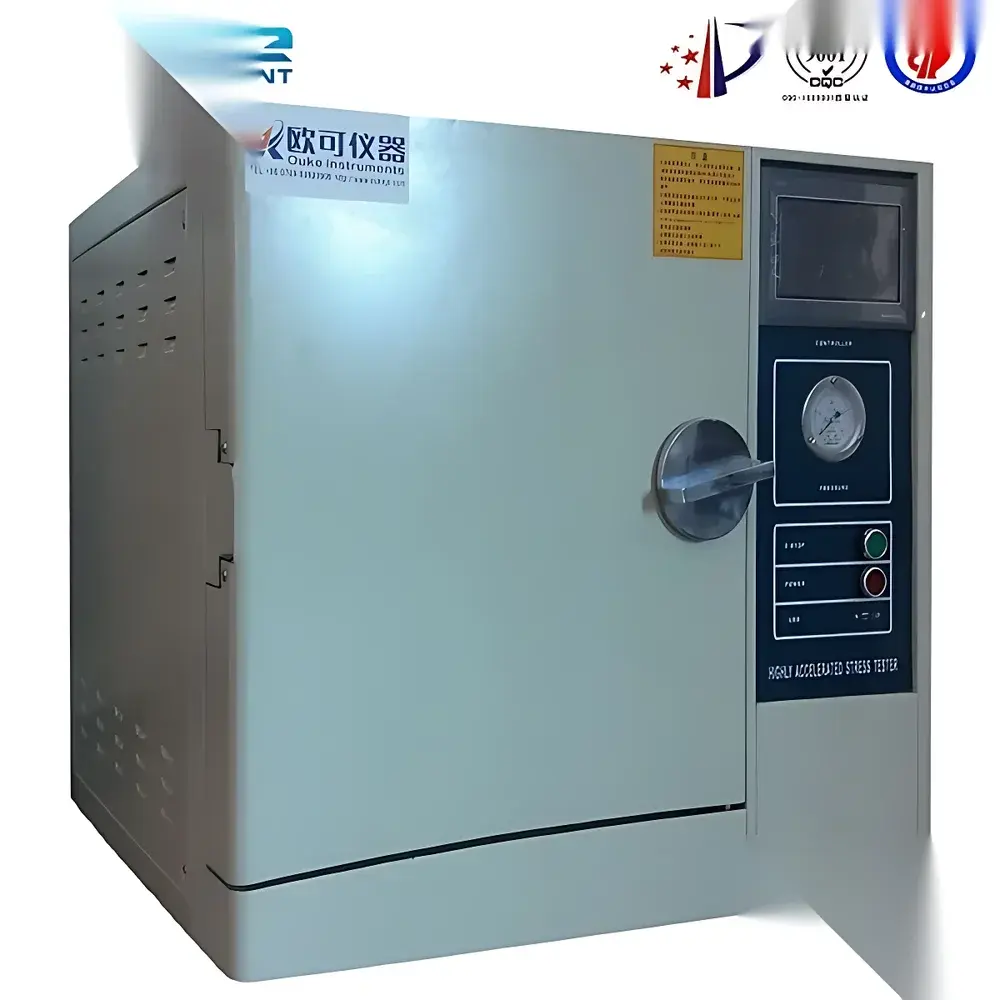
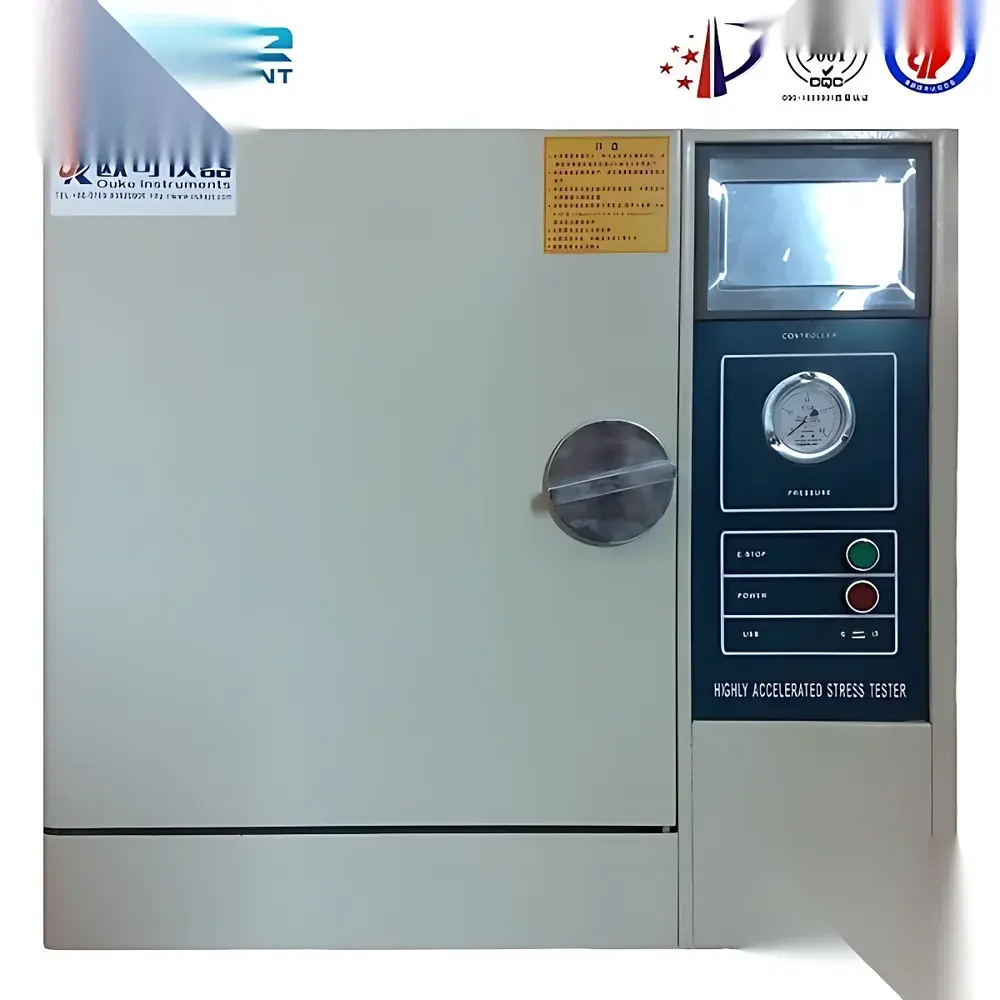
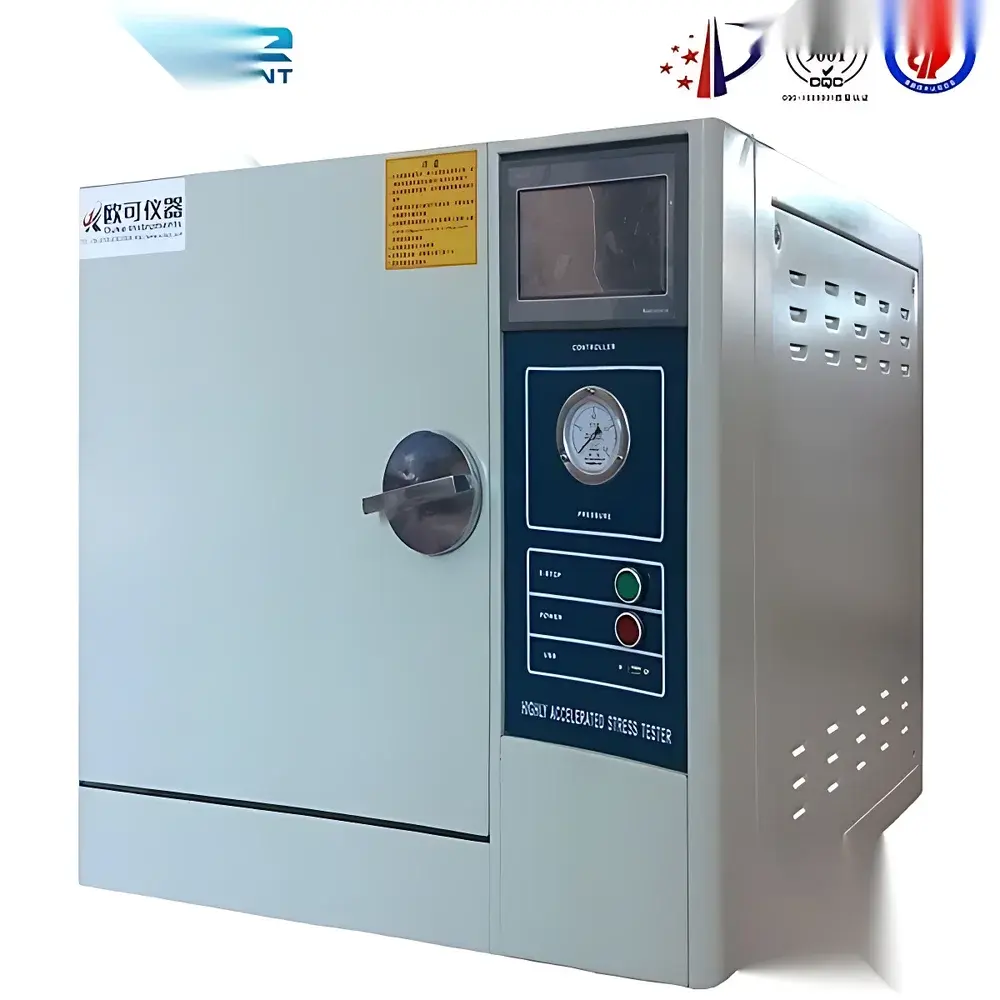
HAST High-Pressure Accelerated Stress Test Chamber
| Brand | Other Brands |
|---|---|
| Origin | Imported |
| Manufacturer Type | Authorized Distributor |
| Price | USD 13,500 (FOB) |
| Internal Dimensions (Ø × H) | Φ250×300 mm to Φ650×600 mm |
| External Dimensions (W×H×D) | 500×500×700 mm to 950×900×1100 mm |
| Operating Temperature Range | 105–135 °C (143 °C optional) |
| Relative Humidity Range | 70–100 % RH |
| Steam Pressure Range | 0–2.0 kg/cm² (gauge), up to 3.0 kg/cm² on special order |
| Power Supply | AC 220 V / 380 V, 50/60 Hz |
| Safety Features | Dual overheat protection, door interlock, pressure relief valve, low-water cutoff, automatic steam purge, auto-fill and manual drain functions |
| Compliance | Designed per JESD22-A110, JEDEC Standard for HAST |
Overview
The HAST High-Pressure Accelerated Stress Test Chamber is an engineered environmental stress screening system designed to perform non-saturated high-pressure accelerated aging tests on semiconductor devices, LED modules, photovoltaic cells, magnetic components, printed circuit boards (PCBs), and other electronic assemblies. Unlike traditional temperature-humidity-bias (THB) testing, HAST applies elevated temperature and saturated or near-saturated steam pressure—without full saturation—to accelerate moisture diffusion into encapsulants, die attach interfaces, and wire bonds. This enables rapid identification of latent defects such as corrosion, delamination, and intermetallic growth within days rather than weeks or months. The chamber operates on a controlled steam generation and forced convection principle, maintaining precise thermodynamic equilibrium between pressure, temperature, and relative humidity throughout the test cycle. Its design conforms to industry-standard HAST protocols defined in JEDEC JESD22-A110 and supports qualification-level reliability assessment under GLP-compliant laboratory environments.
Key Features
- Automated water replenishment system with real-time level monitoring and fail-safe low-water cutoff—ensures uninterrupted test integrity during extended cycles.
- Digital LED temperature controller with ±0.5 °C accuracy and programmable setpoint ramping for stable thermal profiling across the 105–135 °C operational range.
- Intelligent digital timer activated only after chamber reaches target temperature—eliminates timing drift and guarantees accurate exposure duration per test standard.
- Calibrated dual-scale pressure–temperature gauge displaying both absolute pressure (kg/cm²) and corresponding saturation-equivalent temperature for traceable process validation.
- Steam quality optimization via continuous uncondensed vapor purge—minimizes condensate carryover and maintains consistent dew point control.
- Seamless silicone door gasket with compression-molded geometry ensures >99.9% sealing efficiency and exceeds 10,000-cycle durability under repeated thermal cycling.
- Electropolished stainless steel interior chamber surface—resists oxidation, facilitates cleaning, and prevents particulate shedding critical for cleanroom-compatible operation.
- Interlocked door safety mechanism—prevents power-on unless latch engagement is verified by dual mechanical and proximity sensors.
- ASME-certified spring-loaded pressure relief valve rated for 2.5 kg/cm² max operating pressure—provides redundant overpressure protection independent of electronic controls.
- Dual-stage thermal protection: primary solid-state thermostat and secondary bimetallic cutout—triggers audible alarm and cuts heating power within <2 seconds of exceeding threshold.
Sample Compatibility & Compliance
The HAST chamber accommodates diverse sample configurations—including wafer-level packages, QFNs, SOICs, BGAs, and multi-layer PCBs—via adjustable stainless steel trays (standard two-tier configuration). Internal volume options (25 L to 65 L) support scalability from R&D benchtop validation to production lot qualification. All models comply with JEDEC JESD22-A110 (HAST Method), IPC-9708 (Moisture Sensitivity Level classification), and IEC 60068-2-66 (damp heat, accelerated test). Optional calibration documentation includes NIST-traceable certificates for temperature and pressure transducers. For regulated industries, the system supports audit-ready data logging aligned with FDA 21 CFR Part 11 requirements when integrated with compliant software platforms.
Software & Data Management
While the base model features embedded microcontroller-based operation with local LED interface, optional Ethernet-enabled data acquisition modules enable remote monitoring and CSV-exported time-series logging of temperature, pressure, humidity, and runtime status. Logged parameters are timestamped with UTC synchronization and support post-test analysis using third-party statistical tools (e.g., Weibull++, JMP). Audit trails include operator ID, test start/stop events, alarm triggers, and calibration history—fully configurable to meet ISO/IEC 17025 and GMP documentation standards.
Applications
- Qualification of moisture-sensitive devices (MSL 2a–6) prior to surface-mount assembly.
- Failure mode analysis of epoxy molding compounds under combined thermal–hygroscopic stress.
- Reliability screening of automotive-grade electronics subjected to AEC-Q200 stress profiles.
- Process validation of conformal coating adhesion and barrier performance on flex-rigid PCBs.
- Accelerated life testing of SiC and GaN power modules exposed to high-humidity operational environments.
FAQ
What is the difference between saturated and unsaturated HAST?
Unsaturated HAST (used in this chamber) maintains steam pressure below full saturation—typically 0–2.0 kg/cm² gauge—allowing controlled moisture ingress without condensation-induced mechanical stress. Saturated HAST requires strict dew-point control and is less common for package-level qualification.
Can the chamber be calibrated to national metrology standards?
Yes—optional factory calibration includes NIST-traceable verification of PT100 temperature sensors and piezoresistive pressure transducers, with full uncertainty budgets per ISO/IEC 17025 Annex A.
Is custom internal dimension engineering available?
Yes—structural modifications for non-standard sample carriers or fixtures can be implemented under OEM engineering review, subject to pressure vessel code compliance (ASME BPVC Section VIII, Div. 1).
Does the system support automated test sequencing?
When equipped with the optional PC interface module, users may define multi-step profiles (e.g., ramp-soak-pressurize-hold-depressurize) with conditional logic and pass/fail thresholds.
What maintenance intervals are recommended?
Quarterly inspection of door gasket integrity, biannual verification of pressure relief valve function, and annual recalibration of all sensing elements—documented per manufacturer’s Maintenance Log Template (provided).



