
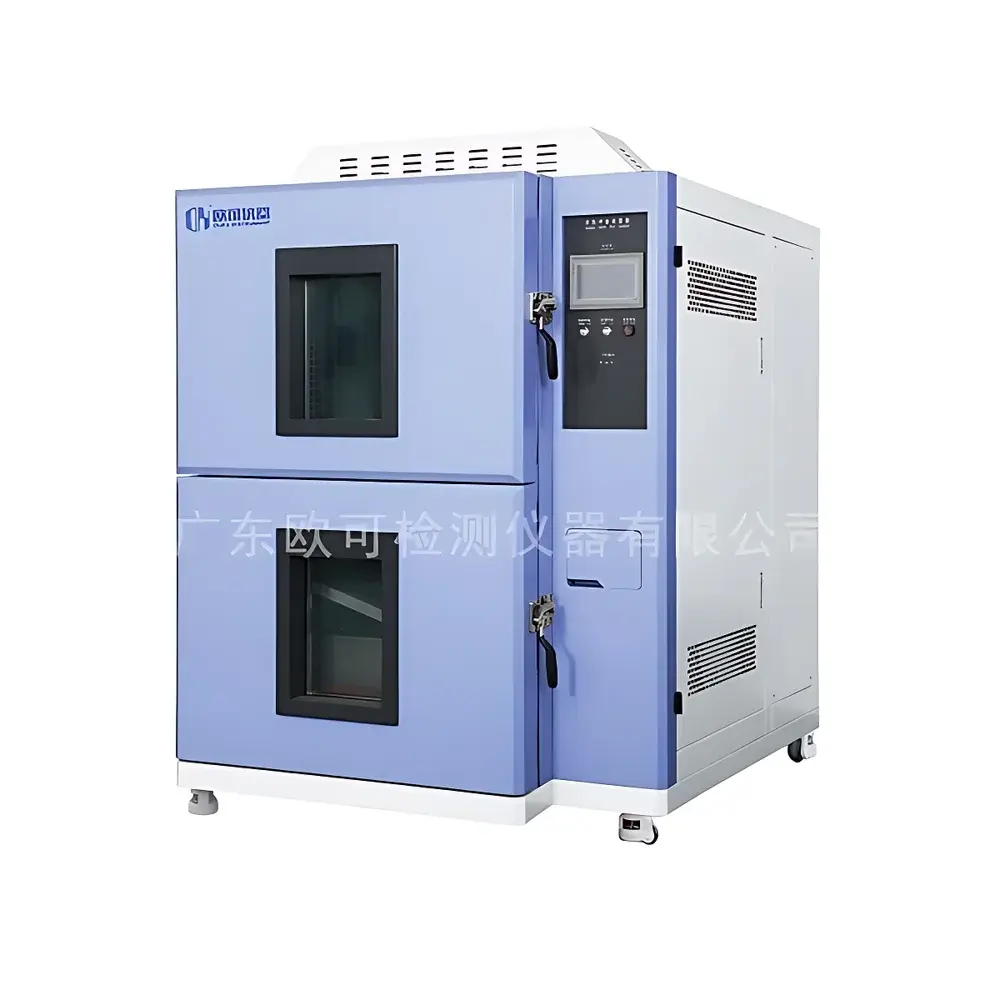
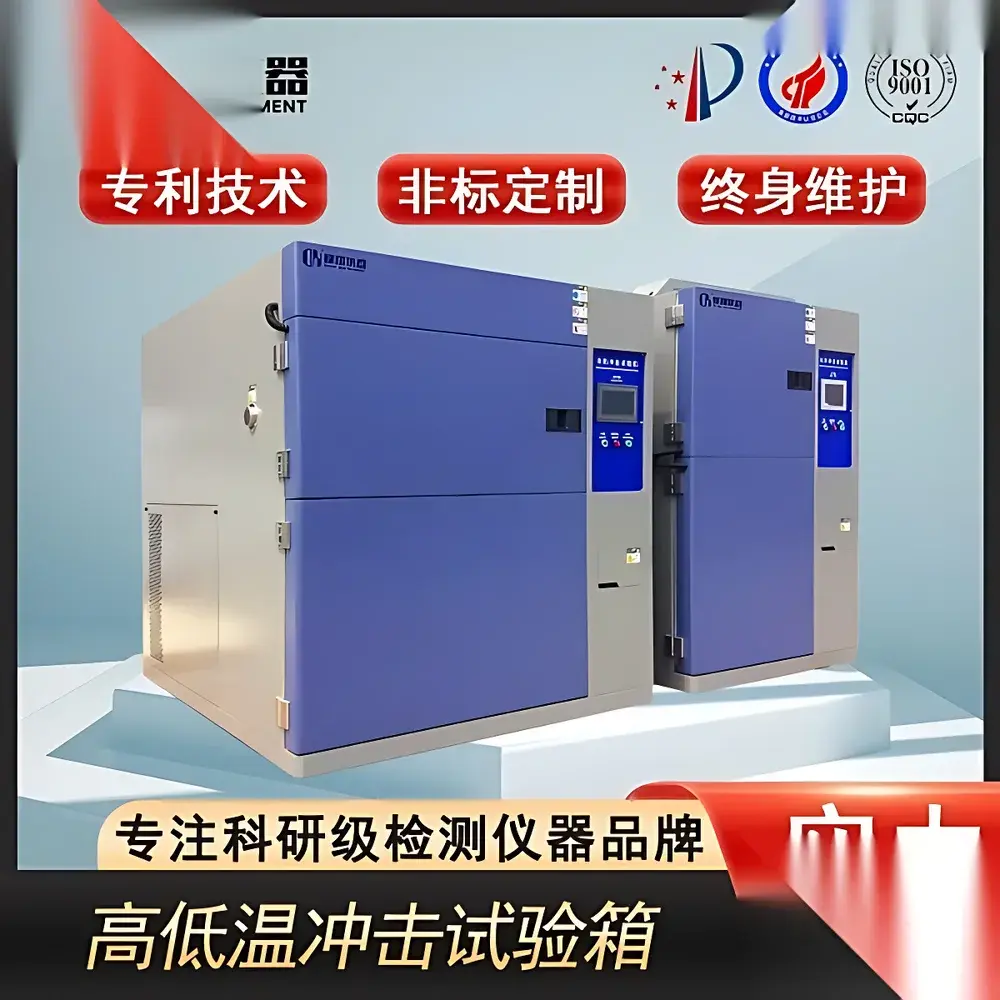
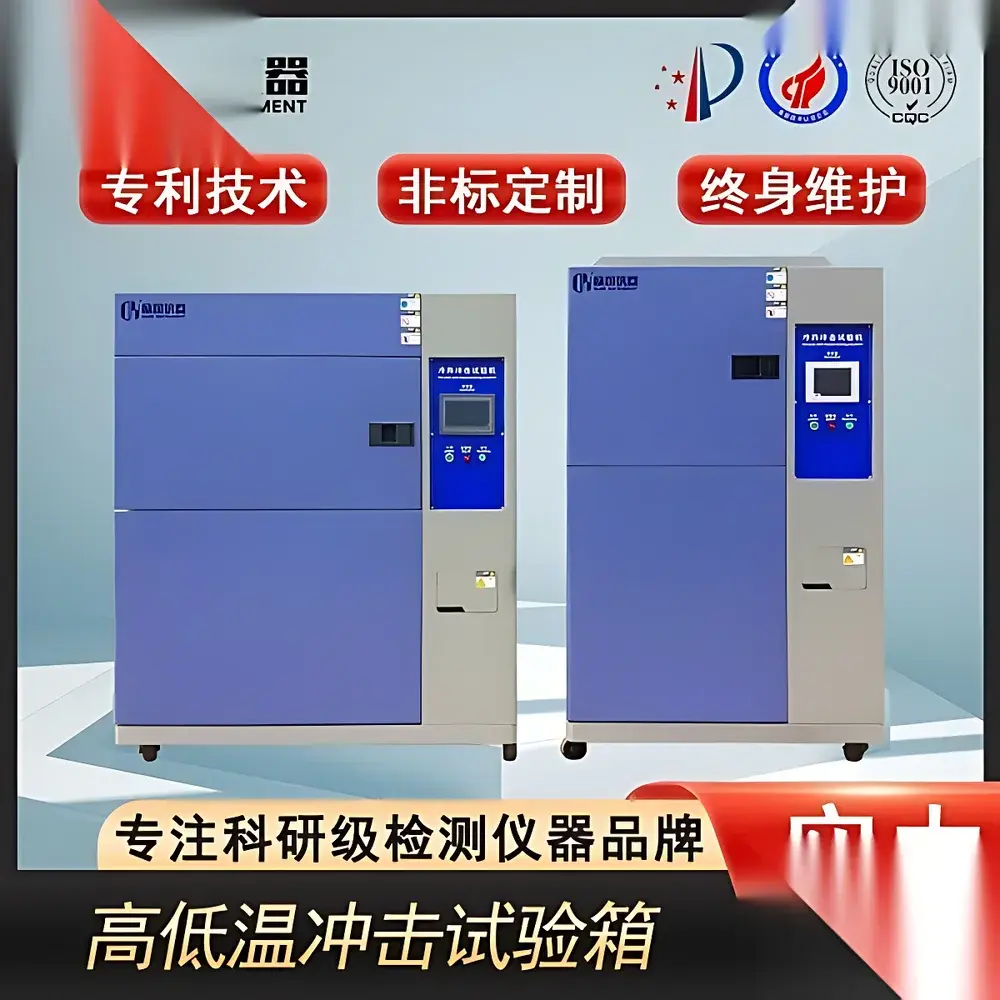
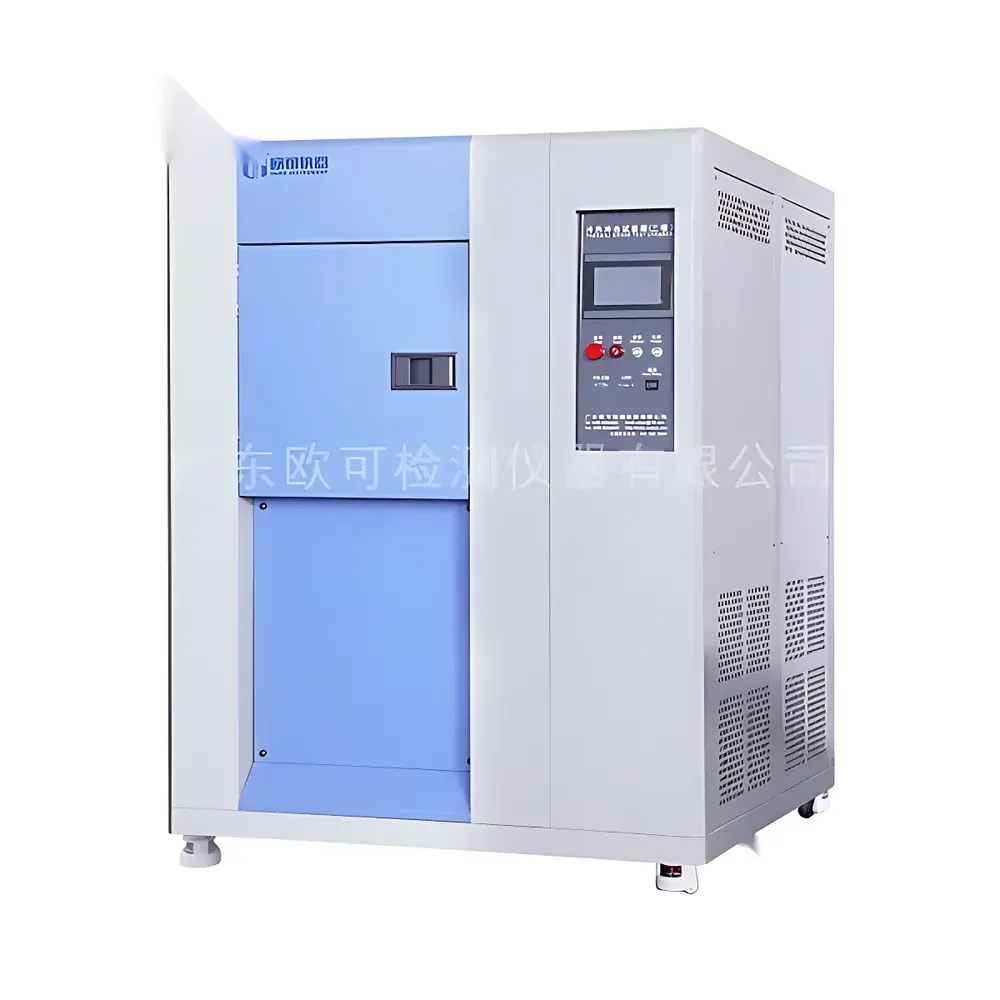
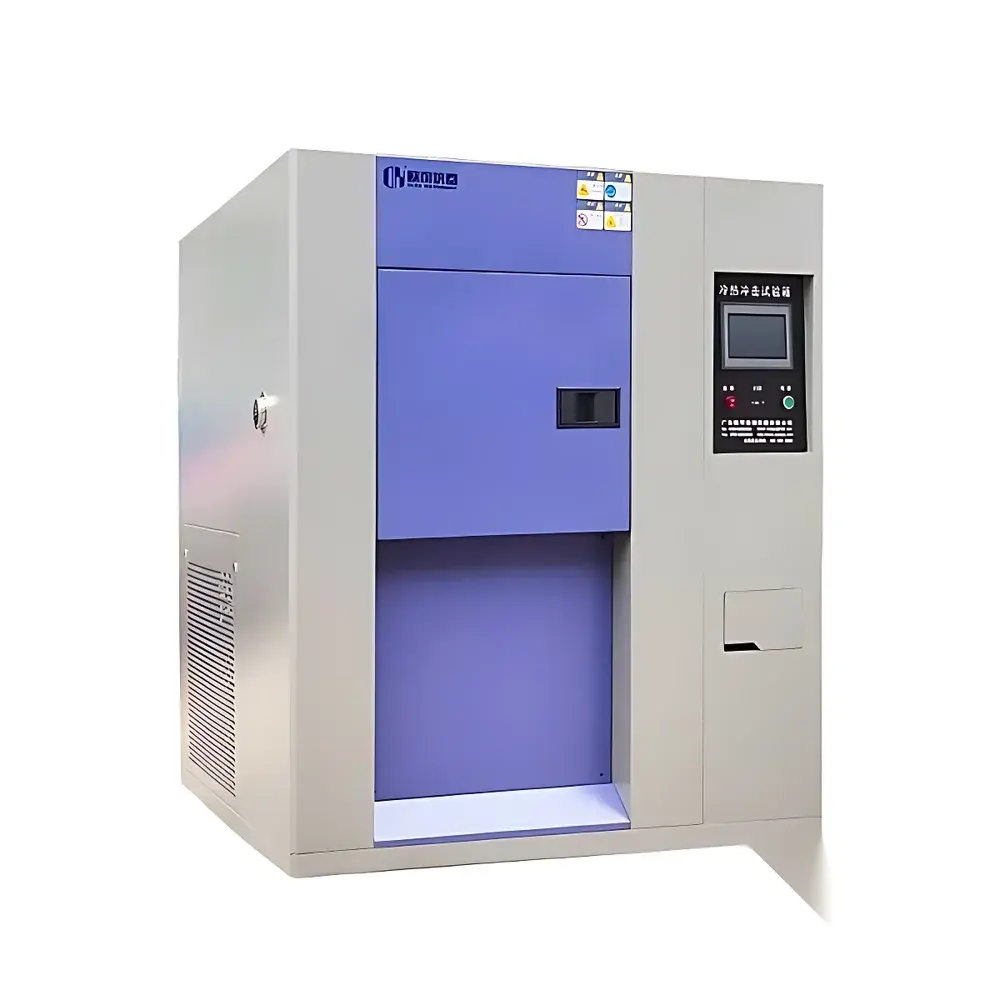
Thermal Shock Test Chamber – Rapid Temperature Transition Environmental Test System
| Brand | OEM |
|---|---|
| Origin | Imported |
| Manufacturer Type | Authorized Distributor |
| Power Supply | 3-Phase 380 VAC, 16 kW |
| Operating Ambient | 15–35 °C, ≤85% RH |
| Weight | ~450 kg |
| Safety Protections | Dual SSR zero-crossing controllers, compressor high-pressure/overload/overcurrent protection, phase-loss & reverse-phase protection, 16A 3P + 1P 6A circuit breakers, dryers, oil separators, refrigerant sight glass |
| Refrigeration System | Hermetic French Tecumseh compressors, eco-friendly R404A/R23 cascade refrigerant, finned condenser with forced-air cooling, multi-stage finned evaporator with auto-capacity modulation |
Overview
The Thermal Shock Test Chamber – Rapid Temperature Transition Environmental Test System is an engineered solution for evaluating material and component resilience under extreme, accelerated thermal transients. Designed in accordance with the fundamental principles of two-zone (hot/cold) or single-chamber air-impingement thermal shock testing, this system enables rapid transitions between predefined high- and low-temperature extremes—typically ranging from −65 °C to +150 °C—with programmable dwell times and transition rates compliant with ASTM D5229, MIL-STD-810H Method 503.5, IEC 60068-2-14, and JIS Z 8701-4. Its architecture supports both static and dynamic thermal stress profiling, making it suitable for qualification testing of electronic assemblies, PCB laminates, solder joints, automotive ECUs, aerospace composites, and medical device housings subjected to field-relevant thermal cycling.
Key Features
- Robust dual-compartment or single-chamber configuration with independent hot (up to +150 °C) and cold (down to −65 °C) zones, enabling sub-15-second transfer times via pneumatic or mechanical shuttle mechanisms (configuration-dependent)
- Hermetically sealed French Tecumseh compressors operating on environmentally compliant R404A/R23 mixed-refrigerant cascade system for stable ultra-low temperature performance
- Finned-tube condenser with axial-flow cooling fans and multi-stage finned evaporator with automatic capacity modulation to maintain thermal stability across load variations
- Comprehensive safety architecture including dual solid-state relays (SSR) with zero-crossing switching, compressor high-pressure cut-off, overcurrent and overload protection, phase-loss/reverse-phase monitoring, and redundant circuit breakers (16A 3P + 1P 6A)
- Integrated refrigerant management components: desiccant dryer, oil separator, and transparent refrigerant flow sight glass for real-time system diagnostics and preventive maintenance
- Structural design optimized for laboratory and production floor deployment: level-adjustable feet, minimum 600 mm service clearance on all sides, vibration-isolated mounting, and EMI-shielded control cabinet
Sample Compatibility & Compliance
This chamber accommodates test specimens up to standard industrial dimensions (e.g., 400 × 400 × 400 mm internal volume variants), with optional custom cavity configurations available upon engineering review. It supports non-hazardous solid samples—including metallic alloys, polymer enclosures, hybrid modules, and multilayer ceramic substrates—under non-condensing ambient conditions (≤85% RH, 15–35 °C). The system meets electromagnetic compatibility requirements per EN 61326-1 and conforms to electrical safety standards IEC 61010-1. Its operational envelope and protection logic align with GLP-compliant environmental validation protocols and support audit-ready documentation for ISO/IEC 17025-accredited laboratories.
Software & Data Management
Equipped with a programmable 7-inch TFT touchscreen controller featuring embedded data logging (≥100,000-point memory), USB export, and RS485/Modbus RTU interface for SCADA integration. Preloaded test profiles include standard thermal shock cycles (e.g., 30-min dwell/10-min transition), ramp-hold sequences, and user-defined multi-step programs with alarm-triggered event capture. Optional PC-based software provides advanced analysis tools—statistical process control (SPC) charting, deviation trend mapping, and CSV/PDF report generation—fully traceable with time-stamped operator login, parameter change history, and digital signature capability compatible with FDA 21 CFR Part 11 requirements when deployed with validated authentication modules.
Applications
- Qualification of solder interconnect integrity in high-density PCBAs per IPC-9701A
- Accelerated aging studies of thermoplastic elastomers and encapsulants used in automotive lighting systems
- Validation of hermetic seal reliability in MEMS sensors and implantable electronics
- Material coefficient-of-thermal-expansion (CTE) mismatch evaluation in chip-scale packages
- Pre-shipment stress screening (HASS) for avionics line-replaceable units (LRUs)
- Research into microcrack initiation thresholds in ceramic matrix composites under cyclic thermal gradients
FAQ
What is the typical temperature transition time between extremes?
Transition time depends on chamber configuration and load mass; standard two-zone models achieve ≤15 seconds for 100 g aluminum reference blocks between −55 °C and +125 °C.
Does the system support automated test sequencing and reporting?
Yes—the controller supports up to 99 programmable steps per cycle, with onboard logging and exportable timestamped datasets compatible with LIMS and MES platforms.
Is calibration and IQ/OQ documentation available?
Factory calibration certificates (NIST-traceable sensors) and optional vendor-supported Installation Qualification (IQ) and Operational Qualification (OQ) protocols are provided upon request.
Can the chamber operate continuously for extended reliability testing?
Designed for unattended 7×24 operation with redundant safety interlocks, thermal fuse backup, and predictive maintenance alerts based on compressor runtime and refrigerant pressure trends.
What utility connections are required beyond power?
No external water or gas supply is needed; only dedicated 3-phase 380 VAC/16 kW supply with proper grounding and upstream 32A breaker is mandatory. Compressed air (if shuttle mechanism equipped) requires clean, dry 0.6 MPa supply at ≤10 L/min.



