
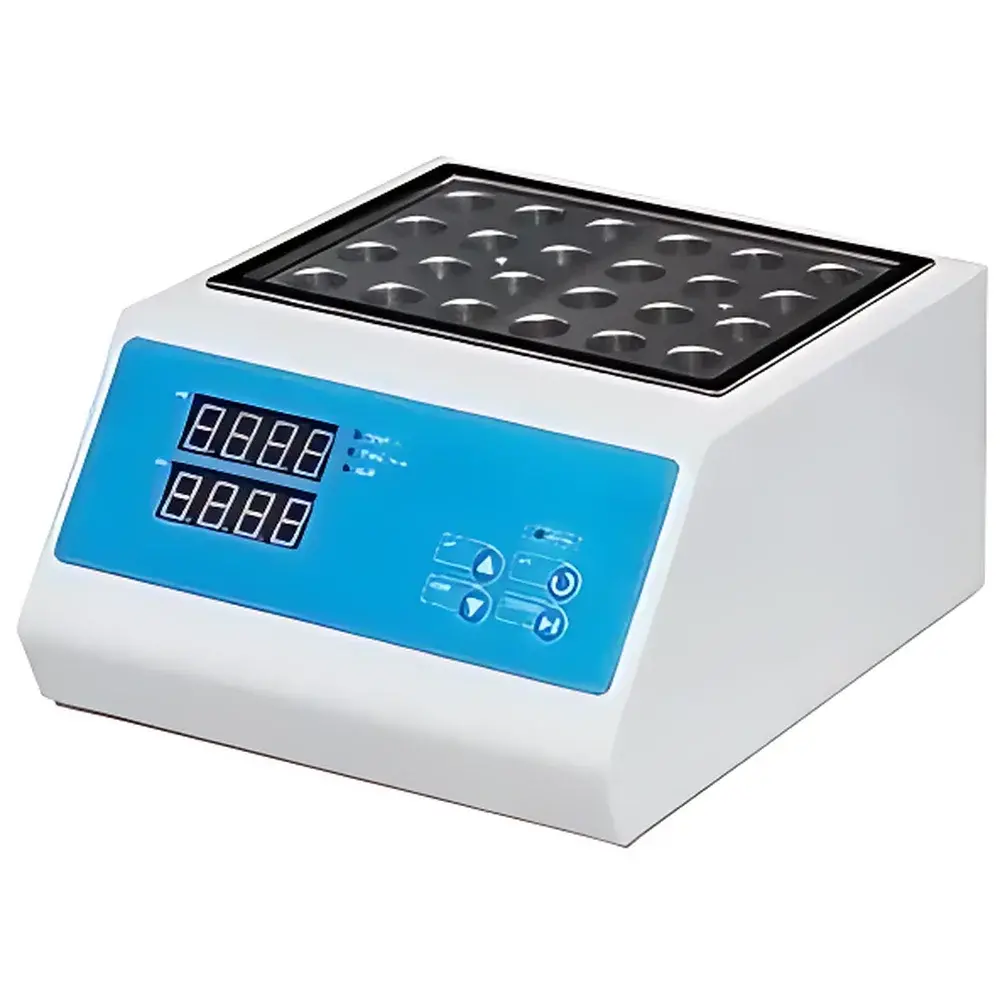
Zhongke Aobo UMB Series Dry Block Heaters
| Brand | Zhongke Aobo |
|---|---|
| Model | UMB-12 / UMB-24 / UMB-36 |
| Temperature Range | RT+5°C to 150°C |
| Temperature Accuracy | ±0.3°C |
| Temperature Resolution | ±0.1°C |
| Timer Range | 0–99 h 59 min (with audible alarm and continuous mode) |
| Heating Power | 150 W (UMB-12), 200 W (UMB-24), 300 W (UMB-36) |
| Dimensions (L×W×H) | 200×220×120 mm (UMB-12/24), 280×240×120 mm (UMB-36) |
| Net Weight | 2.7 kg (UMB-12), 3.8 kg (UMB-24), 5.2 kg (UMB-36) |
| Input Voltage | 220 V ±10%, 50 Hz ±1 Hz |
| Standard Block Configuration | 12/24/36 × φ17 mm wells |
Overview
The Zhongke Aobo UMB Series Dry Block Heaters are precision-engineered thermal incubation systems designed for consistent, uniform, and contamination-free temperature control of samples in molecular biology, clinical diagnostics, and analytical chemistry laboratories. Unlike traditional water baths—prone to evaporation, microbial growth, and cross-contamination—these dry block heaters utilize solid aluminum heating blocks with optimized thermal conductivity and low thermal inertia. Each unit operates on a closed-loop PID temperature regulation system, ensuring stable setpoint maintenance across the full operating range (RT+5°C to 150°C) with high reproducibility and minimal overshoot. The modular architecture supports rapid thermal equilibration (typical warm-up to 100°C in under 20 minutes), making it suitable for time-sensitive protocols such as enzyme inactivation, DNA denaturation, PCR setup, and sample concentration workflows.
Key Features
- PID-controlled digital temperature regulation with ±0.3°C accuracy and 0.1°C resolution, verified per ISO/IEC 17025 traceable calibration practices;
- Intuitive touch-sensitive interface with real-time digital display of setpoint, actual temperature, and remaining timer duration;
- Extended programmable timer (0–99 h 59 min) with audible alert and auto-hold function; optional continuous operation mode for unattended incubation;
- Robust anodized aluminum heating blocks engineered for long-term thermal stability and corrosion resistance;
- Interchangeable block configurations: standard 12-, 24-, or 36-position blocks with 17 mm diameter wells; custom well diameters and layouts available upon request;
- Over-temperature protection circuitry and thermal fuse safeguard against runaway conditions, compliant with IEC 61010-1 safety standards for laboratory equipment;
- Low-power consumption design (150–300 W depending on model) with efficient heat distribution minimizing peripheral surface temperature rise.
Sample Compatibility & Compliance
The UMB Series accommodates common labware including 0.2 mL, 0.5 mL, 1.5 mL, and 2.0 mL microcentrifuge tubes, PCR strips, and small vials. Its uniform thermal profile across all wells ensures parallel processing without inter-well variability—a critical requirement for quantitative assays and GLP-compliant workflows. Units are CE-marked and conform to EN 61326-1 (EMC) and EN 61010-1 (safety). While not FDA-cleared as a medical device, the system meets general requirements for use in ISO 15189-accredited clinical labs and supports audit readiness for ISO/IEC 17025 quality management systems. All models operate within specified voltage tolerances (220 V ±10%) and frequency stability (50 Hz ±1 Hz), ensuring reliable performance in diverse regional power environments.
Software & Data Management
The UMB Series operates as a standalone instrument without proprietary software dependency—ideal for cleanroom and regulated environments where IT validation overhead must be minimized. Temperature and timer settings are retained in non-volatile memory during power cycling. For laboratories requiring electronic record integrity, optional RS-232 or USB-to-serial interfaces (available via third-party adapters) enable integration with LIMS or ELN platforms for timestamped parameter logging. When used in conjunction with validated external data acquisition systems, the heater supports 21 CFR Part 11 compliance through user authentication, audit trail generation, and electronic signature capabilities—provided the host software implements appropriate controls.
Applications
- Thermal inactivation of restriction enzymes, phosphatases, and proteases prior to downstream analysis;
- Pre-heating reagents and reaction mixes in qPCR, RT-PCR, and isothermal amplification workflows;
- Controlled evaporation of solvents from small-volume samples (e.g., ethanol precipitation, LC-MS sample prep);
- Incubation of immunoassay plates, antigen-antibody binding steps, and ELISA development;
- Standardization of viscosity measurements for temperature-dependent fluids in QC/QA labs;
- Routine warming of culture media, antibiotics, or serum supplements prior to cell handling.
FAQ
What is the maximum recommended operating temperature for continuous use?
The UMB Series is rated for continuous operation up to 150°C. For extended dwell times above 120°C, ensure adequate ventilation around the unit and avoid placing flammable materials nearby.
Can I use non-standard tube sizes with this heater?
Yes—custom heating blocks with alternative well diameters (e.g., φ10 mm, φ20 mm) or multi-diameter configurations can be ordered directly from Zhongke Aobo’s OEM service division.
Is calibration documentation provided with the instrument?
Each unit ships with a factory calibration certificate indicating verification points at 37°C, 70°C, and 100°C using NIST-traceable reference thermometers. Full calibration services—including IQ/OQ documentation—are available upon request.
How does the UMB Series compare to circulating water baths in terms of temperature uniformity?
Independent testing shows ±0.4°C inter-well variation across the full block at 95°C, outperforming typical water baths (±0.8–1.2°C) due to direct conductive heating and absence of convection-driven gradients.
Does the unit support external temperature probes for independent verification?
No built-in probe port is included, but the front-panel display can be cross-validated using a calibrated handheld thermometer inserted into an empty well adjacent to active samples.



