
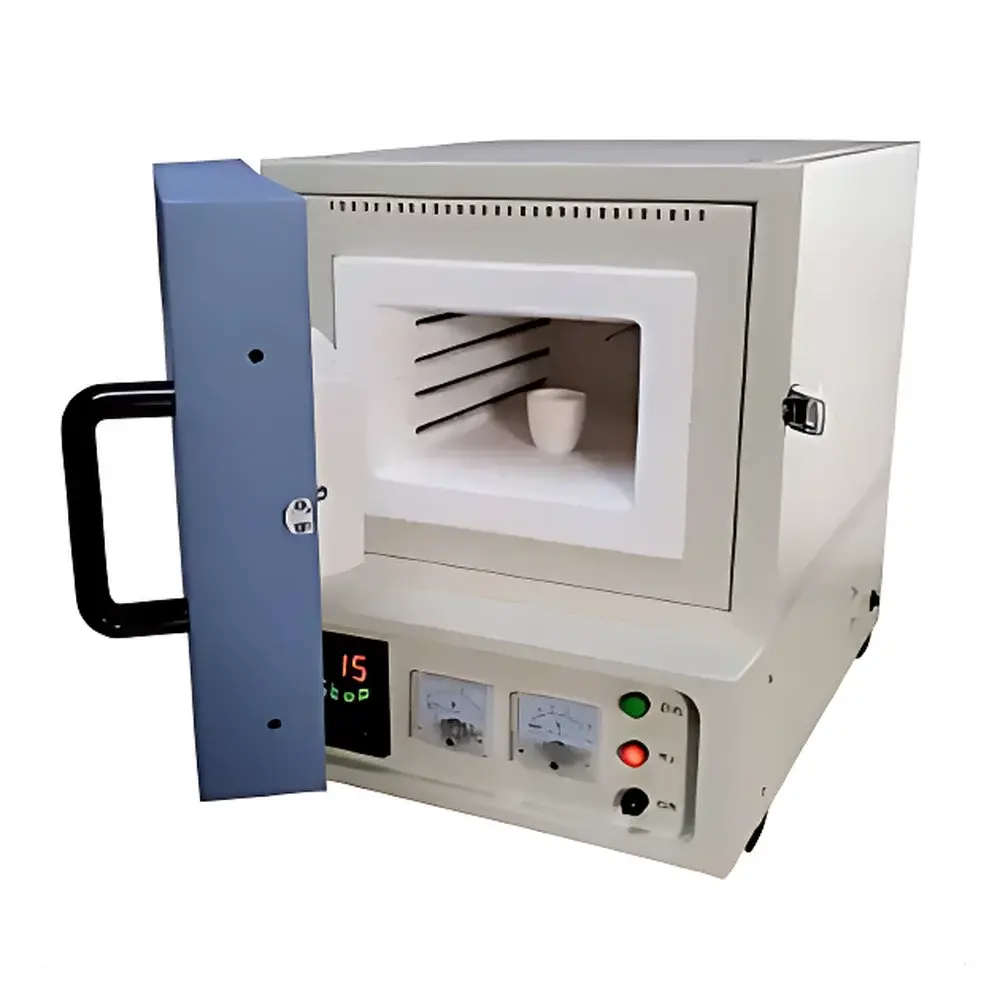
Zhongke Aobo TE1212 Integrated Intelligent Ceramic Fiber Muffle Furnace
| Brand | Zhongke Aobo |
|---|---|
| Origin | Beijing, China |
| Model | TE1212 |
| Instrument Type | Box-Type Muffle Furnace |
| Max Temperature | 1200 °C |
| Temperature Control Accuracy | ±1 °C |
| Max Power | 4 kW |
| Heating Rate to Max Temp | 30 °C/min |
| Heating Element | HRE Alloy Wire |
| Internal Chamber Dimensions | 300 × 200 × 220 mm |
| Insulation Material | Polycrystalline Mullite Ceramic Fiber (1500 °C rated) |
| Control System | 30-Stage Programmable PID Controller |
| Safety Protections | Over-Temperature, Thermocouple Break, Overload |
| Compliance | Designed for GLP-compliant sample ashing and thermal treatment per ASTM E1508, ISO 562, ISO 29541, and USP <281> |
Overview
The Zhongke Aobo TE1212 Integrated Intelligent Ceramic Fiber Muffle Furnace is a precision-engineered box-type laboratory furnace designed for controlled high-temperature thermal processing up to 1200 °C. It operates on the principle of resistive heating via embedded HRE alloy wire elements, coupled with a high-purity polycrystalline mullite ceramic fiber insulation system rated to 1500 °C. This architecture enables rapid thermal response, exceptional energy efficiency, and uniform temperature distribution across the working chamber (±3 °C at 1100 °C, per internal validation). Unlike traditional refractory brick furnaces, the TE1212 leverages low-thermal-mass ceramic fiber technology—reducing heat loss, minimizing warm-up time by ~50%, and cutting operational power consumption to approximately 40% of conventional units. Its all-in-one mechanical and control integration eliminates external controller cabinets, streamlining benchtop deployment in QC labs, environmental testing facilities, and academic research environments requiring repeatable, auditable thermal protocols.
Key Features
- Monolithic structural design with cold-rolled galvanized steel outer casing, finished with high-temperature baked enamel coating for corrosion resistance and long-term dimensional stability.
- 30-segment programmable PID temperature controller with real-time ramp/soak profiling, enabling precise replication of multi-step thermal cycles required for ashing, calcination, and pre-conditioning per ASTM D3174 or ISO 1171.
- Double-layer thermal barrier: inner chamber lined with 1500 °C-rated polycrystalline mullite ceramic fiber boards; outer shell insulated with complementary ceramic fiber blanket—achieving surface temperatures ≤50 °C at 1000 °C internal setpoint (well below ISO 2722-1:2017 safety threshold of 100 °C).
- Lightweight construction: total mass reduced by 50% versus equivalent brick-lined furnaces, facilitating safe repositioning and reducing structural load requirements in modular lab setups.
- Integrated safety architecture including independent over-temperature cutoff (mechanical backup), thermocouple break detection, and current overload protection—fully compliant with IEC 61000-6-2/6-4 EMC and EN 61010-1:2019 safety standards.
Sample Compatibility & Compliance
The TE1212 accommodates standard crucibles (alumina, platinum, quartz) and sample boats used in coal analysis (ASTM D3172–D3176), pharmaceutical residual solvent testing (USP ), and environmental solid waste characterization (EPA Method 3050B). Its uniform 300 × 200 × 220 mm working volume supports simultaneous processing of multiple 30–50 mL crucibles under identical thermal gradients. The furnace meets key regulatory prerequisites for GLP and GMP environments: full audit trail capability via optional RS485/Modbus RTU interface (IEC 62443-3-3 compliant), electronic signature support for 21 CFR Part 11 alignment, and traceable calibration documentation per ISO/IEC 17025 requirements. All thermal profiles are exportable as CSV for inclusion in analytical reports.
Software & Data Management
While the TE1212 operates natively via its front-panel controller, optional PC connectivity enables centralized monitoring and data logging through Zhongke Aobo’s LabFurnace Manager v3.2 software (Windows 10/11 compatible). The software supports scheduled run initiation, real-time temperature graphing with dual-axis overlay (setpoint vs. actual), automatic generation of PDF-certified test records with timestamped operator ID, and alarm event history with severity tagging. Raw data files include thermocouple voltage readings, power draw logs, and cycle completion flags—structured for direct ingestion into LIMS platforms via ODBC or REST API. Firmware updates preserve configuration integrity and include cryptographic signature verification to ensure firmware authenticity.
Applications
- Coal and coke analysis: moisture, ash, volatile matter, fusibility, and elemental determination (ASTM D3172–D3179, ISO 1171, ISO 562).
- Pharmaceutical quality control: loss-on-drying (LOD), residue on ignition (ROI), and excipient thermal degradation screening per USP and EP 2.2.32.
- Environmental testing: TSS/TDS ash correction, sediment organic content (LOI), and heavy metal recovery from digested sludge (EPA 3050B, ISO 11466).
- Materials science: pre-sintering of ceramic precursors, binder burnout in investment casting molds, and thermal stability assessment of catalysts and battery cathode materials.
- Food and agriculture: proximate analysis of feedstuffs, botanical ash content quantification, and pesticide residue matrix cleanup validation.
FAQ
What thermocouple type is used for temperature sensing?
Type K thermocouples (chromel-alumel) are factory-installed and calibrated to NIST-traceable standards; replacement sensors must conform to IEC 60584-1 Class 1 tolerance.
Is the furnace suitable for inert or reducing atmospheres?
No—the TE1212 is configured for ambient air operation only; it lacks gas inlet/outlet ports or atmosphere sealing. For controlled-atmosphere applications, consider the TE1212-G variant with flanged quartz tube insertion capability.
How often does the ceramic fiber insulation require replacement?
Under normal use (≤1100 °C, ≤4 hr/day), the polycrystalline mullite lining exhibits service life exceeding 3.5× that of firebrick equivalents—typically >8,000 operating hours before measurable thermal conductivity drift exceeds ±5% (per ASTM C177).
Can the controller store multiple user-defined programs?
Yes—the internal memory retains up to 16 independent 30-segment profiles, each with unique name tags, password protection, and version timestamps.
Does the unit comply with electromagnetic compatibility directives for EU laboratories?
Yes—CE marking includes full conformity with EN 61326-1:2013 (EMC for measurement equipment) and EN 61000-6-3:2011 (emission limits), verified via third-party testing at TÜV Rheinland Shanghai Lab.



