
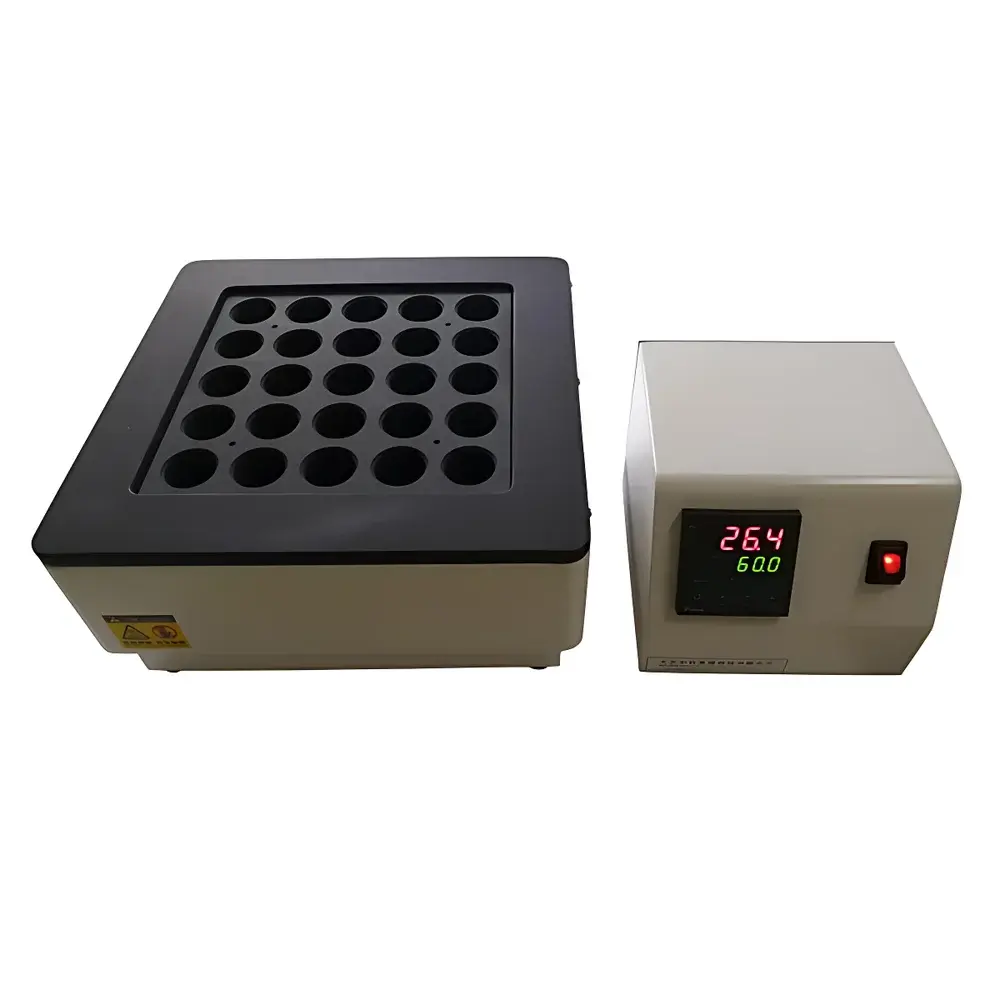
Zhongke Aobo XY Series Split-Design Graphite Block Digestion System
| Brand | Zhongke Aobo |
|---|---|
| Origin | Beijing, China |
| Manufacturer Type | Authorized Distributor |
| Origin Category | Domestic (China) |
| Model | XY31-36F / XY44-25F |
| Instrument Type | Graphite Block Digestion System |
| Automation Level | Semi-Automatic |
| Digestion Positions | 36 × 50 mL or 25 × 100 mL |
| Max Heating Temperature | 450 °C |
| Temperature Control Accuracy | ±1 °C |
| Heating Principle | Isostatically Pressed Graphite Block with PTFE Coating |
| Reagent Channels | 36 independent digestion wells |
| Power Supply | 220 V / 50 Hz |
| Heating Power | 3000 W (XY31-36F) / 3200 W (XY44-25F) |
| Control Method | Intelligent PID Programmable Temperature Controller |
| Temperature Ramp Steps | Up to 30 segments |
| Temperature Display Resolution | 0.1 °C |
| Inter-well Uniformity | ±2 °C |
| Digestion Well Dimensions | Φ31 mm × H50 mm or Φ44 mm × H50 mm |
| Heater Block Dimensions (L×W×H) | 400×400×220 mm or 420×420×220 mm |
| Controller Dimensions (L×W×H) | 250×250×205 mm |
| Net Weight | 28 kg / 33 kg |
Overview
The Zhongke Aobo XY Series Split-Design Graphite Block Digestion System is a semi-automated, high-temperature sample preparation instrument engineered for open-vessel acid digestion and post-microwave acid evaporation (“acid removal” or “赶酸”). It operates on the principle of conductive heating via an isostatically pressed graphite block — a material selected for its exceptional thermal mass, uniform heat distribution, chemical inertness, and resistance to thermal shock. The system’s split architecture physically isolates the temperature controller from the heated digestion block, significantly reducing electromagnetic interference and enhancing operational safety during extended high-temperature runs (up to 48 hours continuously at 450 °C). This design also simplifies maintenance, calibration, and field service. The graphite surface is coated with high-purity polytetrafluoroethylene (PTFE), providing robust resistance to concentrated nitric, hydrochloric, hydrofluoric, and perchloric acids under elevated temperatures — critical for trace metal analysis workflows requiring ultra-low background contamination.
Key Features
- Split-system configuration: Independent controller and heating module ensure electrical isolation, thermal stability, and reduced risk of controller overheating.
- Isostatically pressed graphite heating block with PTFE coating: Delivers superior thermal homogeneity (±2 °C inter-well uniformity) and long-term corrosion resistance in aggressive acidic environments.
- Intelligent PID programmable temperature control: Supports up to 30-step ramp-and-hold protocols with 0.1 °C display resolution and ±1 °C accuracy across the full 30–450 °C operating range.
- Two standard configurations: XY31-36F (36 positions for 50 mL vessels) and XY44-25F (25 positions for 100 mL vessels), both accommodating custom well diameters, depths, and layouts upon request.
- Integrated safety systems: Thermocouple failure detection (open-couple alarm), over-temperature cutoff, and real-time fault logging compliant with GLP documentation requirements.
- Energy-efficient thermal insulation: Low-heat-loss enclosure minimizes ambient energy dissipation while maintaining consistent block temperature profiles.
- One-vessel workflow compatibility: Enables complete sample processing — digestion, acid evaporation, and final volume adjustment — within a single quartz or PFA digestion tube, reducing cross-contamination and handling errors.
Sample Compatibility & Compliance
The XY Series supports a broad spectrum of solid and semi-solid matrices including soils, sediments, biological tissues, foodstuffs, pharmaceutical excipients, polymers, and electronic components. It is validated for use with major regulatory digestion methods: EPA Methods 3010A, 3020B, 3050B, 3060, 200.2, 200.7–200.9, and 365.1; Chinese national standards GB/T 17138–1997, GB/T 5009.11–2003, GB/T 5009.17–1996, GB/T 22105.1–2008 through 22105.3–2008, GB/T 22788–2008, and SJ/T 11365–2006. Its construction and control architecture support audit-ready operation under ISO/IEC 17025, USP , and FDA 21 CFR Part 11 environments when paired with validated electronic lab notebook (ELN) integration and user-access-controlled method storage.
Software & Data Management
While the base unit features a standalone touchscreen controller with non-volatile memory for method storage and event logging, optional RS-232 or USB-to-PC connectivity enables remote monitoring, method upload/download, and raw temperature/time data export in CSV format. All logged events — including setpoint changes, alarm triggers, power cycles, and thermocouple faults — are time-stamped and user-identifiable, supporting full traceability per GLP and GMP requirements. Firmware updates are performed via secure USB key to maintain version control and cybersecurity integrity.
Applications
This system serves as a primary digestion platform for laboratories performing elemental analysis by ICP-OES, ICP-MS, AAS, and HG-AFS. Typical applications include total recoverable metal quantification in wastewater sludge (EPA 3050B), iodine determination in urine (GB/T 5009.269–2016), lead and cadmium screening in food packaging (GB/T 5009.15–2014), arsenic speciation support in rice (GB/T 21913–2008), and RoHS-compliant heavy metal screening in printed circuit boards (SJ/T 11365–2006). Its reliability in high-throughput environmental and food safety labs has been demonstrated in routine QC/QA programs requiring >200 digestions per week with <2% relative standard deviation in recovery rates for certified reference materials (CRMs) such as NIST SRM 2711a and GBW(E) 080389.
FAQ
What sample vessel types are compatible with the XY31-36F and XY44-25F configurations?
Standard compatibility includes borosilicate glass, quartz, PFA, and ETFE digestion tubes meeting ASTM D5685 specifications. Custom inserts for Teflon-lined stainless steel or ceramic crucibles can be supplied upon engineering review.
Does the system support method validation per ISO 17025?
Yes — the documented temperature uniformity (±2 °C), repeatability (<0.5 °C over 8-hour hold), and alarm response latency (<2 s) meet ISO/IEC 17025 clause 5.4.2 requirements for equipment qualification. Full IQ/OQ documentation packages are available.
Can the controller interface with LIMS or ELN systems?
Via optional serial or USB communication modules, the controller exports timestamped temperature logs and alarm records in ASCII/CSV format, enabling direct ingestion into validated LIMS platforms supporting ASTM E1384 or ISO/IEC 17025 Annex A.2 data integrity protocols.
Is HF acid digestion supported?
Yes — the PTFE-coated isostatic graphite block and sealed housing design provide full compatibility with HF-containing mixtures (e.g., HNO₃–HF–HClO₄) at temperatures ≤220 °C. Use of quartz or PFA vessels is mandatory for HF applications.
What maintenance intervals are recommended for long-term operation?
Visual inspection of PTFE coating integrity every 200 h; thermocouple calibration verification every 6 months or 1000 h (whichever occurs first); graphite block surface cleaning with 10% NaOH followed by deionized water rinse after each HF run.



