
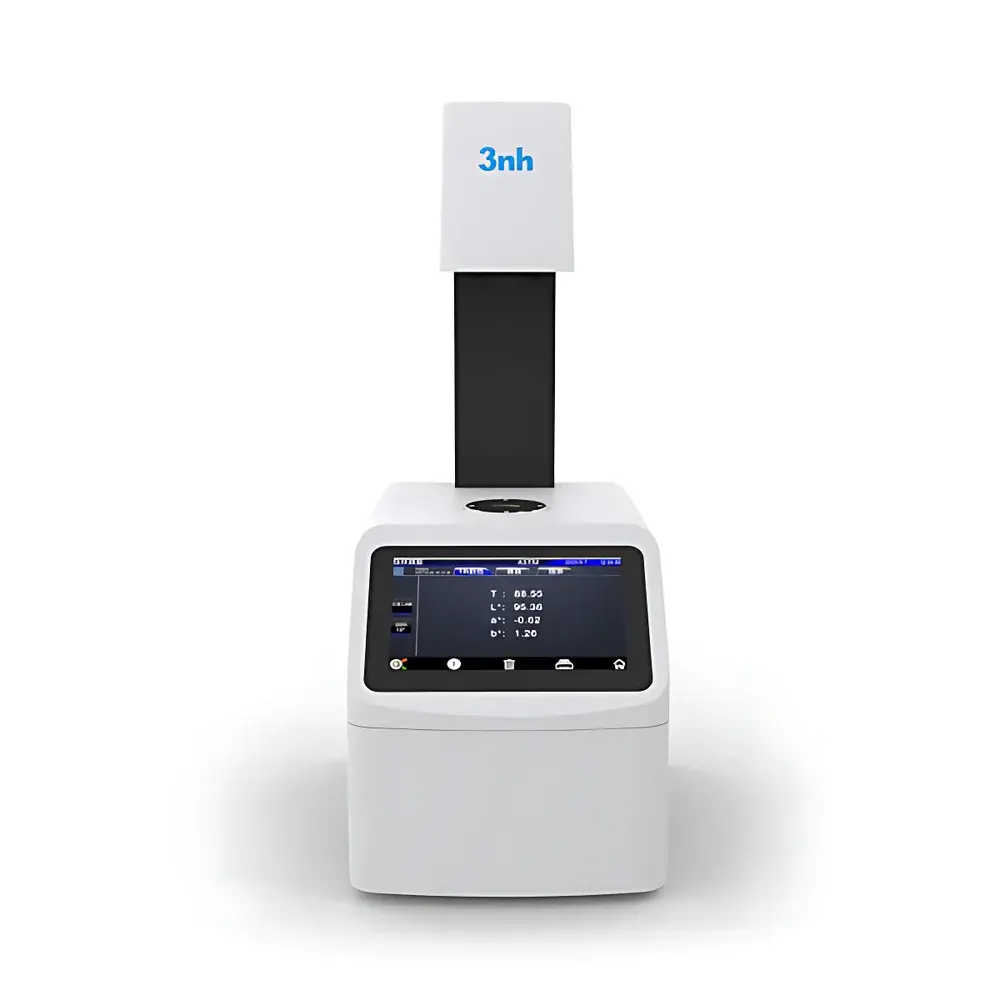
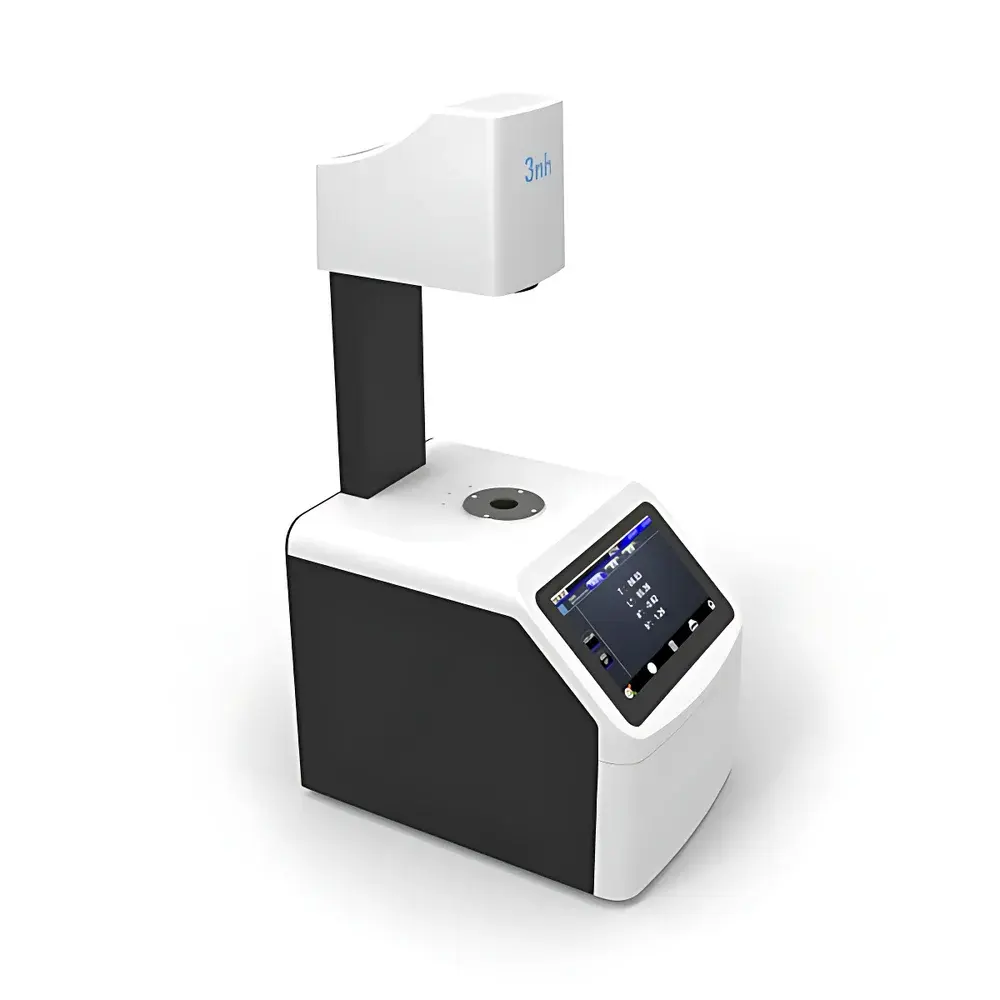
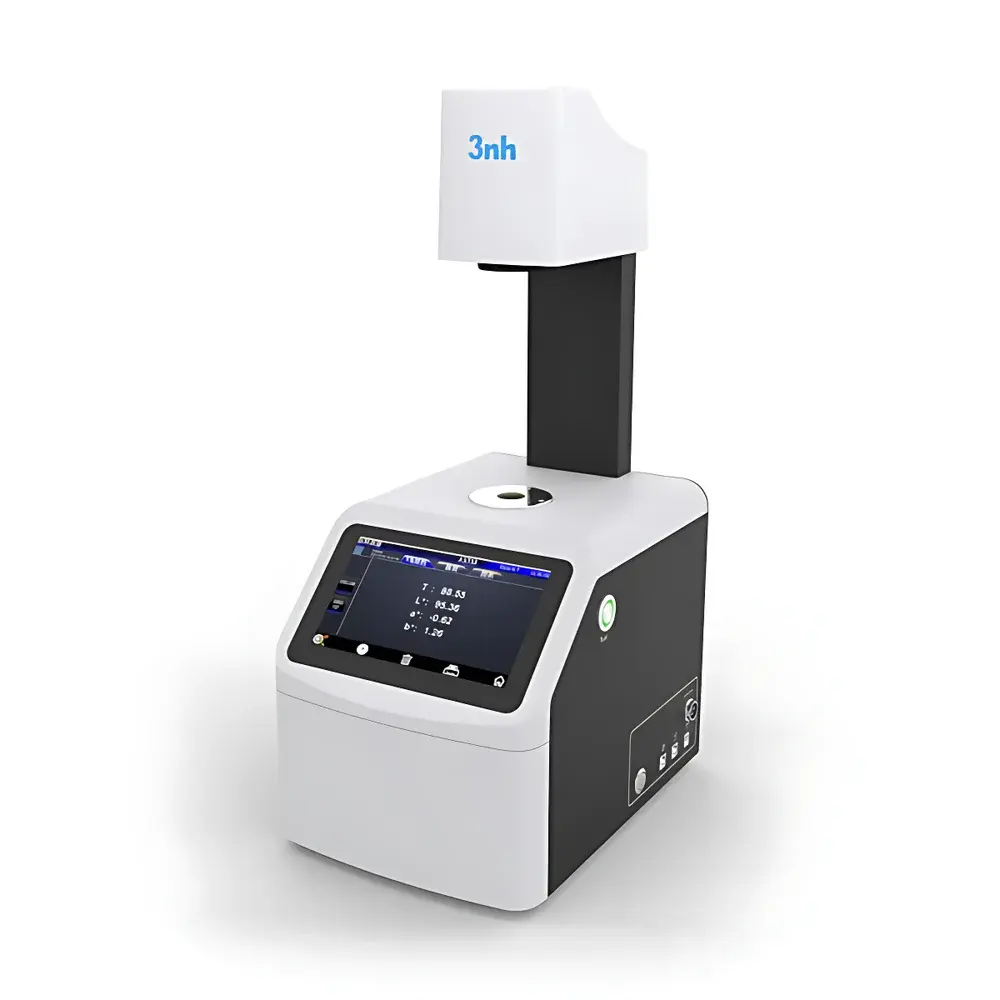
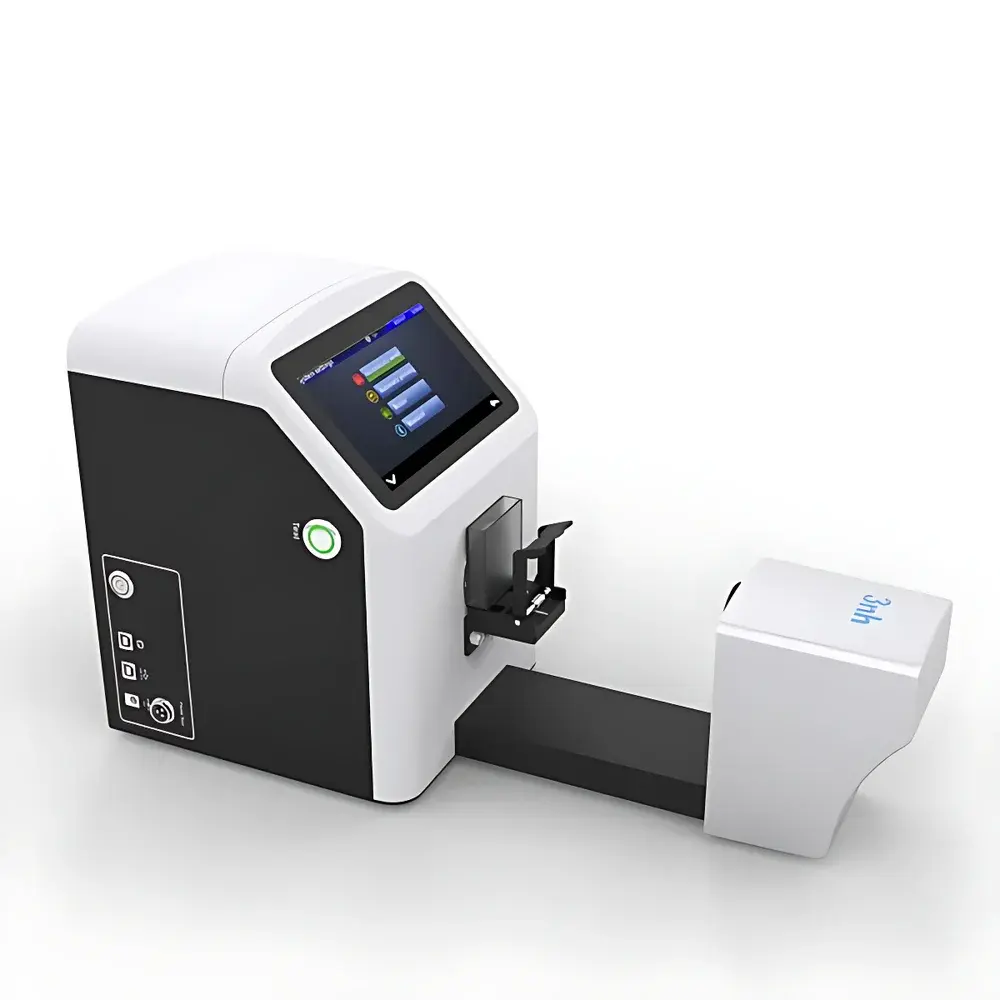
3nh YH600 Vertical Haze and Transmittance Meter
| Brand | 3nh |
|---|---|
| Origin | Guangdong, China |
| Manufacturer Type | Direct Manufacturer |
| Product Type | Manual Benchtop Instrument |
| Model | YH600 |
| Haze Range | 0–100% |
| Transmittance Range | 0–100% |
| Haze Repeatability (Φ20 mm aperture) | < 0.15 |
| Transmittance Repeatability (Φ20 mm aperture) | < 0.15 |
Overview
The 3nh YH600 Vertical Haze and Transmittance Meter is a precision optical measurement instrument engineered for reliable, standardized evaluation of light scattering and transmission characteristics in transparent and translucent materials. It operates on the principle of collimated beam transmission with diffuse reception (0/D geometry), conforming to the fundamental photometric configuration specified in ASTM D1003 for haze measurement by the non-compensating method. The instrument integrates a spectrally calibrated PD (photodiode) array detector that adheres to the CIE 1931 2° standard observer spectral luminous efficiency function V(λ), ensuring metrological traceability to international photometric standards. Its vertical open-chamber design enables flexible sample orientation—both upright and horizontal positioning—accommodating rigid sheets, flexible films, molded plastics, glass substrates, and liquid cuvettes up to 170 mm in thickness. With a 154 mm integrating sphere, broadband LED illumination (400–700 nm), and real-time thermal monitoring of the optical path, the YH600 delivers high reproducibility under variable ambient conditions.
Key Features
- Compliant optical architecture meeting ASTM D1003 / D1044, ISO 14782, GB/T 2410, JIS K7105, JIS K7361, JIS K7136, and CIE 15.2 requirements for haze and total transmittance measurement
- True 0/D (collimated incident light / diffuse-received) illumination geometry with integrated 154 mm integrating sphere for accurate separation of direct and scattered light components
- PD array detector with spectral response matched to CIE V(λ) 2° observer function—enabling photometrically correct haze (HASTM) and total transmittance (Tt) calculations
- Multi-aperture support (Φ4 mm, Φ8 mm, Φ15 mm, Φ20 mm)—user-selectable single aperture for optimized signal-to-noise ratio across diverse sample sizes and homogeneity profiles
- Real-time thermal compensation via embedded temperature sensor; dynamic stabilization of LED source output ensures long-term photometric consistency over >3 million measurements
- 7-inch capacitive TFT touchscreen interface with intuitive English/Chinese bilingual navigation; measurement completed in ≈1.5 seconds per sample
- USB 2.0 interface for raw data export and integration with LIMS or QA/QC laboratory systems; optional RS232 serial port for legacy printer connectivity
Sample Compatibility & Compliance
The YH600 accommodates flat, curved, rigid, and flexible specimens—including float glass, polycarbonate sheets, PET and PP films, OLED cover lenses, pharmaceutical vials, and cosmetic packaging—without requiring custom fixtures. Its open vertical chamber permits rapid insertion of oversized or irregularly shaped samples (max height: 511 mm; max thickness: 170 mm). All reported haze and transmittance values are traceable to NIST-traceable reference standards and validated against certified haze reference plates (e.g., 30%, 50%, 70% NIST-traceable standards). The instrument satisfies GLP documentation requirements through timestamped audit logs, operator ID tagging (via software), and full measurement history retention. Its calibration protocol aligns with JJF 1303–2011 (Chinese national verification regulation for haze meters) and supports FDA 21 CFR Part 11 compliance when deployed with validated 3nh Quality Management Software (QMS).
Software & Data Management
The included 3nh Quality Management Software (QMS) provides comprehensive post-acquisition analysis for haze and transmittance datasets. It supports statistical process control (SPC) charting (X-bar/R, Cp/Cpk), batch comparison, pass/fail threshold assignment per material grade, and automated report generation in PDF/Excel formats. Up to 1,000 standard references and 10,000 sample records can be stored locally on the host PC. QMS enforces data integrity through electronic signatures, version-controlled calibration logs, and immutable audit trails—meeting requirements for ISO/IEC 17025 accredited laboratories and regulated manufacturing environments (e.g., medical device packaging, automotive glazing, pharma primary containers). Raw spectral data is not exported; only final ASTM-compliant haze (%) and transmittance (%) values are transmitted to ensure interoperability with enterprise quality databases.
Applications
The YH600 serves as a core metrology tool in R&D labs and production QC departments across multiple regulated and high-precision industries. In plastic extrusion and injection molding, it verifies batch-to-batch consistency of optical clarity in automotive lighting lenses and food-grade packaging films. For display manufacturers, it quantifies haze drift during anti-reflective coating deposition or OLED encapsulation processes. Glass processors use it to validate low-haze performance of tempered architectural panels and touch screen cover glass. Pharmaceutical companies apply it to assess container clarity for parenteral solutions per USP and EP 3.2.1. Additionally, it supports ASTM D1003-based qualification of protective films, solar panel cover glass, and optical adhesives where light diffusion control directly impacts functional performance.
FAQ
Does the YH600 comply with ASTM D1003 Section 8 (non-compensating method)?
Yes—the instrument implements true 0/D geometry with a collimated 400–700 nm LED source and diffuse-receiving integrating sphere, satisfying all geometric and spectral requirements of ASTM D1003–22 Section 8.
Can haze and transmittance be measured simultaneously on a single sample run?
Yes—each measurement cycle reports both ASTM haze (%) and total transmittance (%) concurrently, derived from the same optical acquisition event.
Is inter-instrument agreement (IIA) supported for multi-site quality control networks?
Yes—inter-unit variation is controlled to ≤0.5 haze units (Φ20 mm aperture, using certified reference standards), enabling cross-facility data harmonization.
What is the recommended recalibration interval under continuous operation?
Annual verification against NIST-traceable standards is recommended; daily zero/full-scale calibration using supplied 0% and 100% reference tiles maintains short-term stability.
Does the software support automated pass/fail flagging based on user-defined specification limits?
Yes—QMS allows configurable upper/lower tolerance bands per parameter, with visual alerts and exportable non-conformance logs.



