
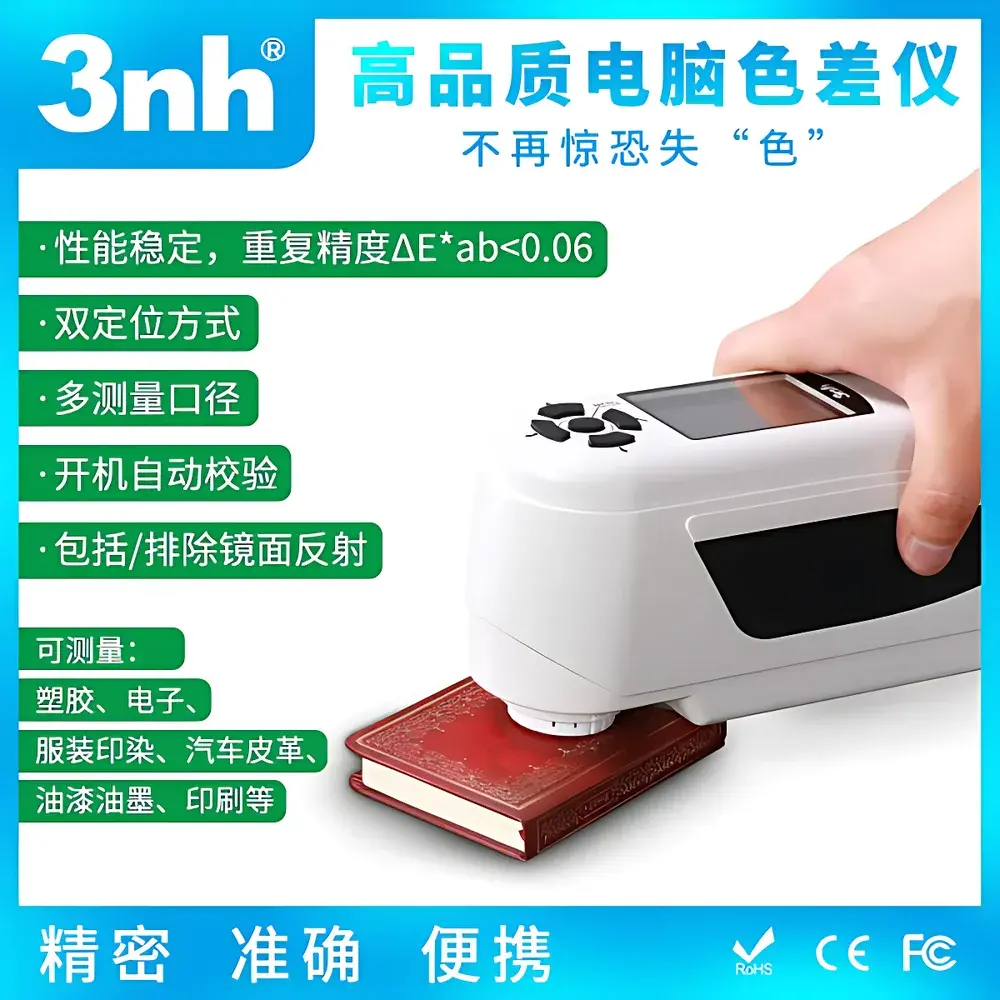
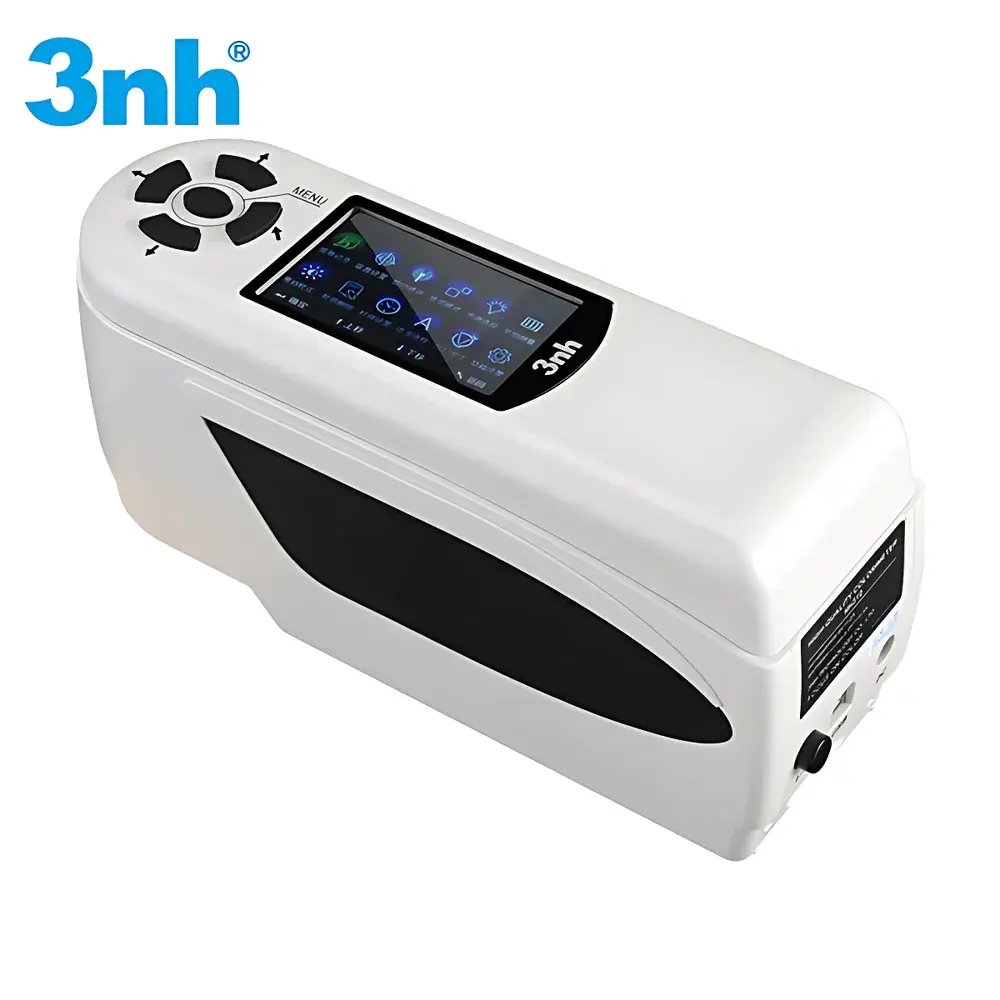
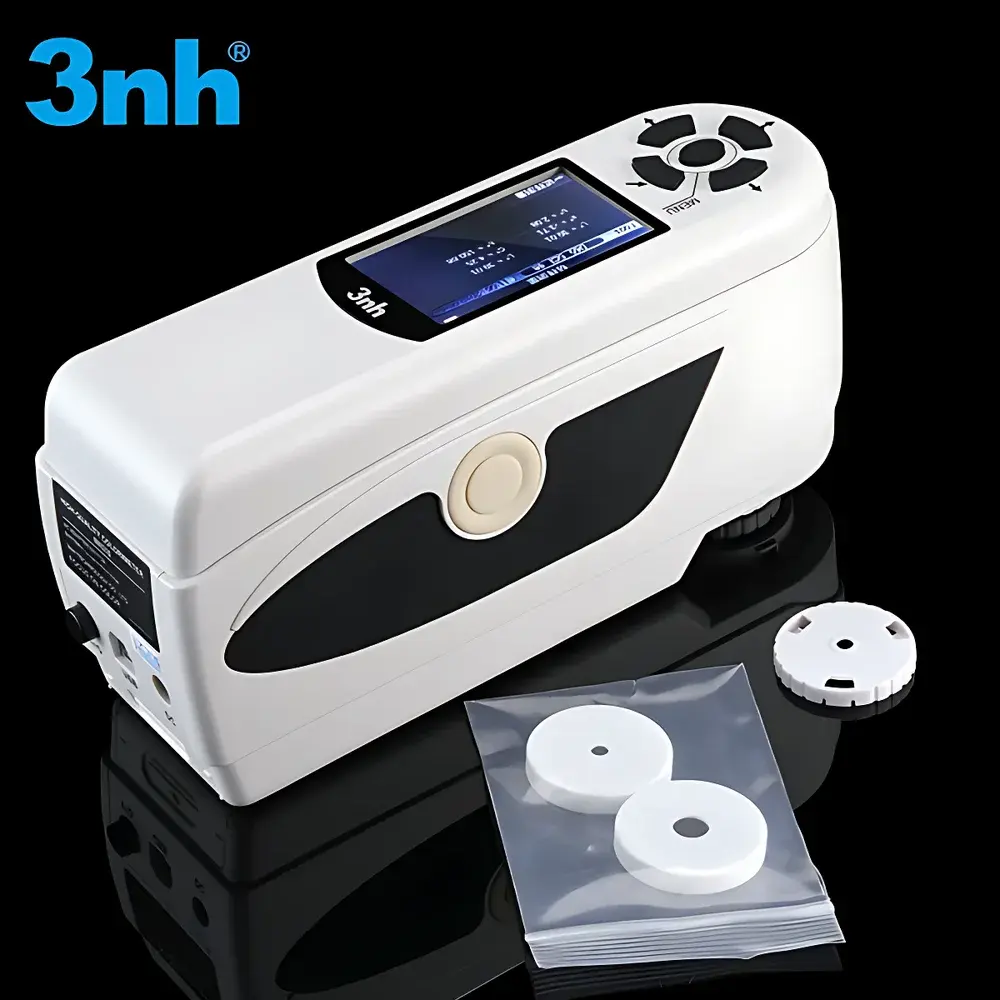
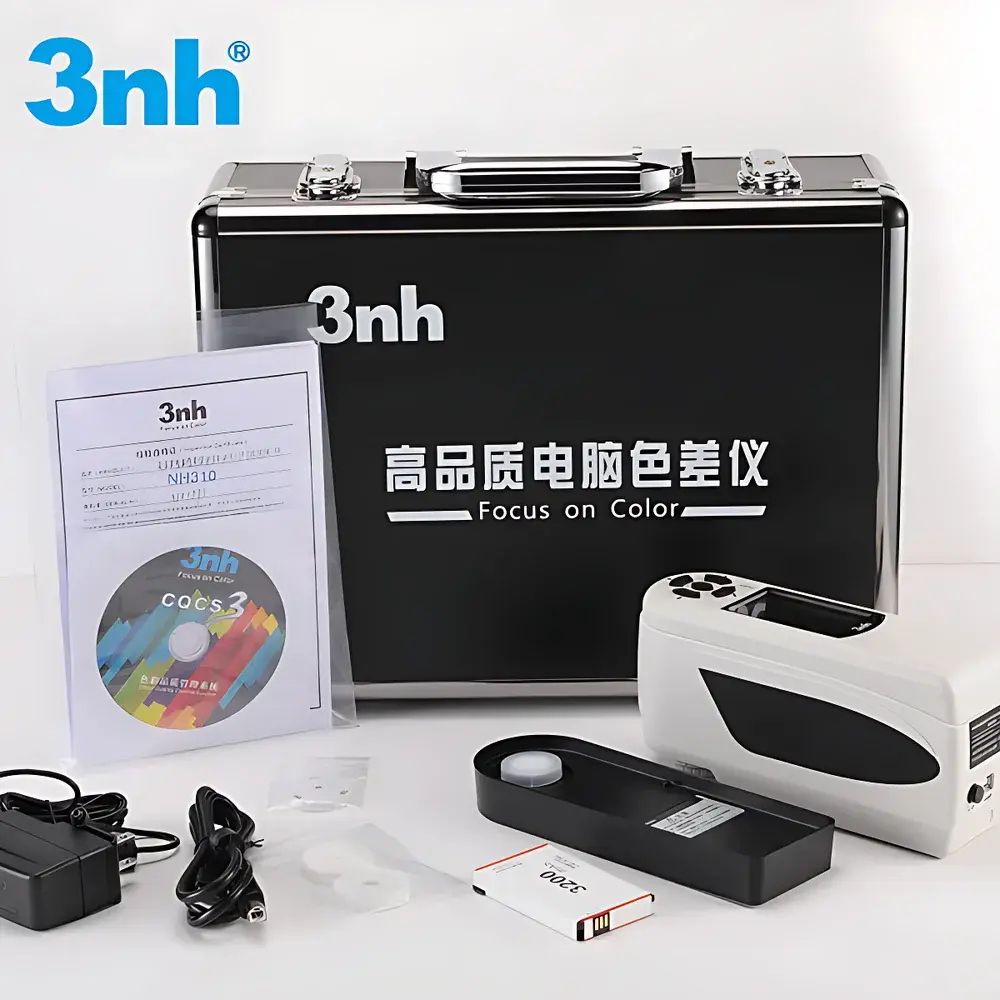
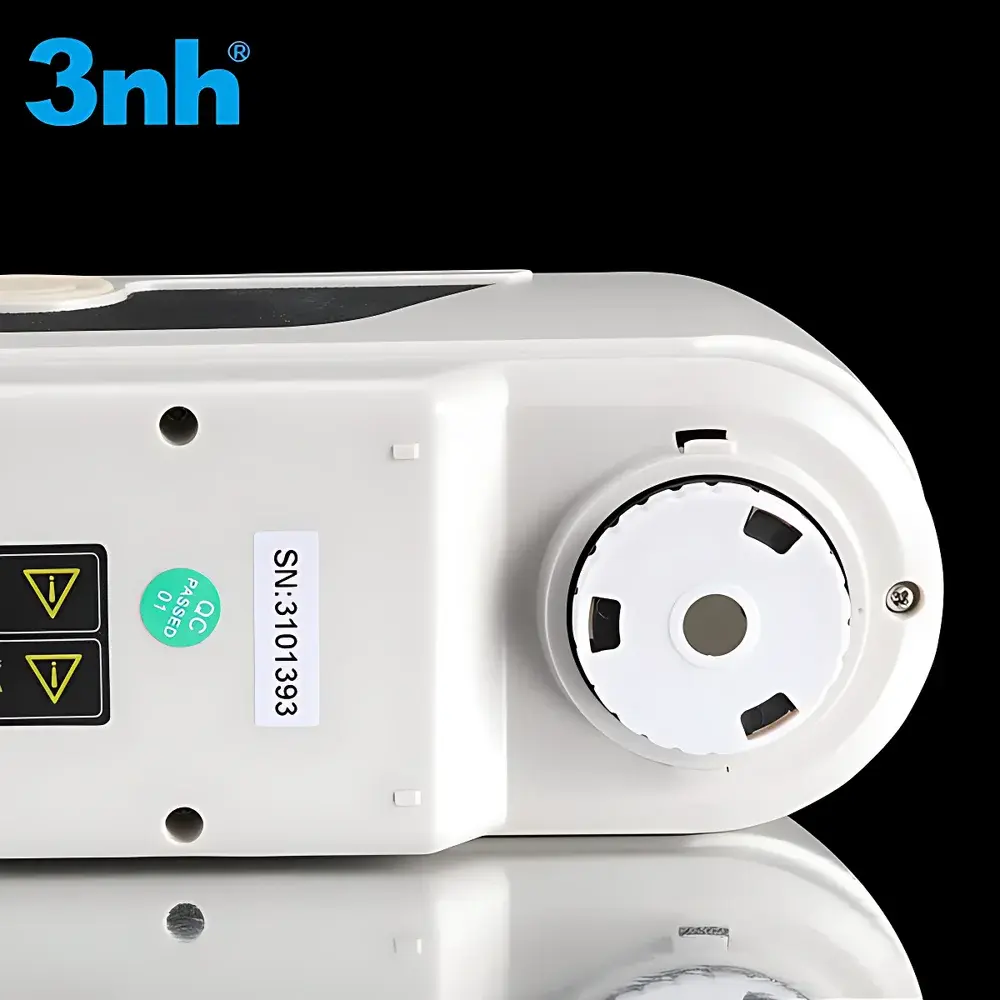
3nh NH310 Precision Portable Color Difference Meter
| Brand | 3nh |
|---|---|
| Origin | Guangdong, China |
| Manufacturer Type | Direct Manufacturer |
| Product Category | Domestic |
| Model | NH310 |
| Product Type | Color Difference Meter |
| Instrument Type | Portable |
| Optical Geometry | d/8° integrating sphere |
| Illuminants | D65, D50, A |
| Spectral Range | 400–700 nm |
| Repeatability | ΔE*ab ≤ 0.06 |
Overview
The 3nh NH310 Precision Portable Color Difference Meter is an engineered solution for objective color evaluation in industrial quality control environments. Based on the CIE 1931 standard observer and CIELAB (L*a*b*) color space, the NH310 employs a d/8° integrating sphere optical geometry—compliant with ISO 7724-1, ASTM E308, and DIN 5033—to ensure uniform illumination and diffuse reflectance measurement across diverse surface textures and geometries. Its spectral acquisition system utilizes a multi-channel silicon photodiode array coupled with precision interference filters, enabling high-fidelity sampling across the visible spectrum (400–700 nm) at 10 nm intervals. Designed for routine use in production lines, R&D labs, and supplier audits, the NH310 delivers metrologically traceable ΔE*ab values with repeatability ≤ 0.06 under controlled ambient conditions—meeting the performance thresholds required for Tier-1 automotive trim verification, paint formulation validation, and plastic extrusion batch release.
Key Features
- Integrated d/8° illuminating/viewing geometry with matte white PTFE-coated integrating sphere for minimized directional bias and enhanced inter-instrument agreement
- Triple-standard illuminant support (CIE D65, D50, and A) with real-time spectral power distribution compensation for accurate metamerism assessment
- Dual-mode operation: single-point measurement and statistical mode (up to 99 readings per batch) with automatic mean, min/max, and standard deviation calculation
- Ergonomic handheld chassis with tactile button layout, anti-slip rubberized grip, and optimized weight distribution (≤ 220 g) for extended operator use
- Onboard memory storing ≥ 2,000 measurement records with timestamp, sample ID, illuminant, observer angle (2°/10°), and pass/fail flagging
- USB-C interface supporting mass storage mode and virtual COM port for seamless integration with factory MES or LIMS platforms
Sample Compatibility & Compliance
The NH310 accommodates flat, curved, textured, and translucent samples up to 40 mm in diameter via its 8 mm measurement aperture. Surface gloss effects are mitigated through polarization-insensitive optics and dual-beam referencing architecture. The instrument conforms to international colorimetric standards including ISO 11664-4 (CIE colorimetry), ISO 17972-1 (color difference tolerancing), and GB/T 3979–2008 (Chinese national standard for colorimeters). It supports user-defined tolerance ellipsoids (ΔL*, Δa*, Δb*, ΔC*, ΔH*, ΔE*00) aligned with industry-specific specifications such as SAE J1547 (automotive interior plastics) and AATCC Evaluation Procedure 1 (textile color matching). Calibration is performed using NIST-traceable ceramic calibration tiles; certificate of conformance includes spectral reflectance data and uncertainty budget per ISO/IEC 17025 requirements.
Software & Data Management
The NH310 operates with PC-based 3nh Color Quality Management Software (v4.2+), which provides full GLP-compliant audit trail functionality—including user login history, parameter change logs, calibration event timestamps, and electronic signature support per FDA 21 CFR Part 11 Annex 11. Data export formats include CSV, Excel (.xlsx), PDF reports (with embedded spectra and tolerance overlays), and XML for ERP integration. Batch analysis tools enable comparative delta-E mapping across multiple lots, trend charting of chromaticity drift over time, and automated pass/fail classification against configurable QC limits. All raw spectral data is retained in native .spc format for retrospective reprocessing using updated color difference formulas (e.g., CIEDE2000 vs. CMC(l:c)).
Applications
- Plastics manufacturing: monitoring color consistency during injection molding, extrusion, and compounding processes
- Automotive supply chain: verifying match-grade color compliance for interior trims, dashboards, and exterior body panels
- Packaging printing: quantifying ink density variation across flexographic, gravure, and digital print runs
- Paint & coatings: evaluating batch-to-batch repeatability in solvent-based and waterborne formulations
- Textiles & apparel: validating dye lot acceptance against master standards under multiple illuminants
- Food packaging films: assessing pigment dispersion homogeneity and UV-induced yellowing stability
FAQ
What is the recommended calibration frequency for the NH310 in a production environment?
Daily verification using the included white calibration tile is advised before first use and after any significant ambient temperature shift (>5°C). Full recalibration against traceable standards is recommended every 30 days or per internal QA protocol.
Does the NH310 support CIEDE2000 color difference calculation?
Yes—the onboard firmware and desktop software both compute ΔE₀₀, ΔE₉₄, ΔE*ab, and ΔE*cmc(2:1) with selectable parametric weighting.
Can the NH310 measure transparent or translucent materials?
It supports transmission mode measurement when used with optional transmission cell accessory (sold separately); standard configuration is optimized for reflectance-only applications.
Is the device compliant with ISO/IEC 17025 laboratory accreditation requirements?
While the NH310 itself is not accredited, its measurement methodology, calibration traceability, and data integrity features fully support implementation within ISO/IEC 17025-accredited laboratories.
How does the NH310 handle specular component exclusion (SCE) versus specular component included (SCI) measurements?
The d/8° sphere design enables both SCE and SCI modes via mechanical trap positioning—SCI for total color appearance (including gloss), SCE for pigment-only evaluation—per ISO 7724-2.



