
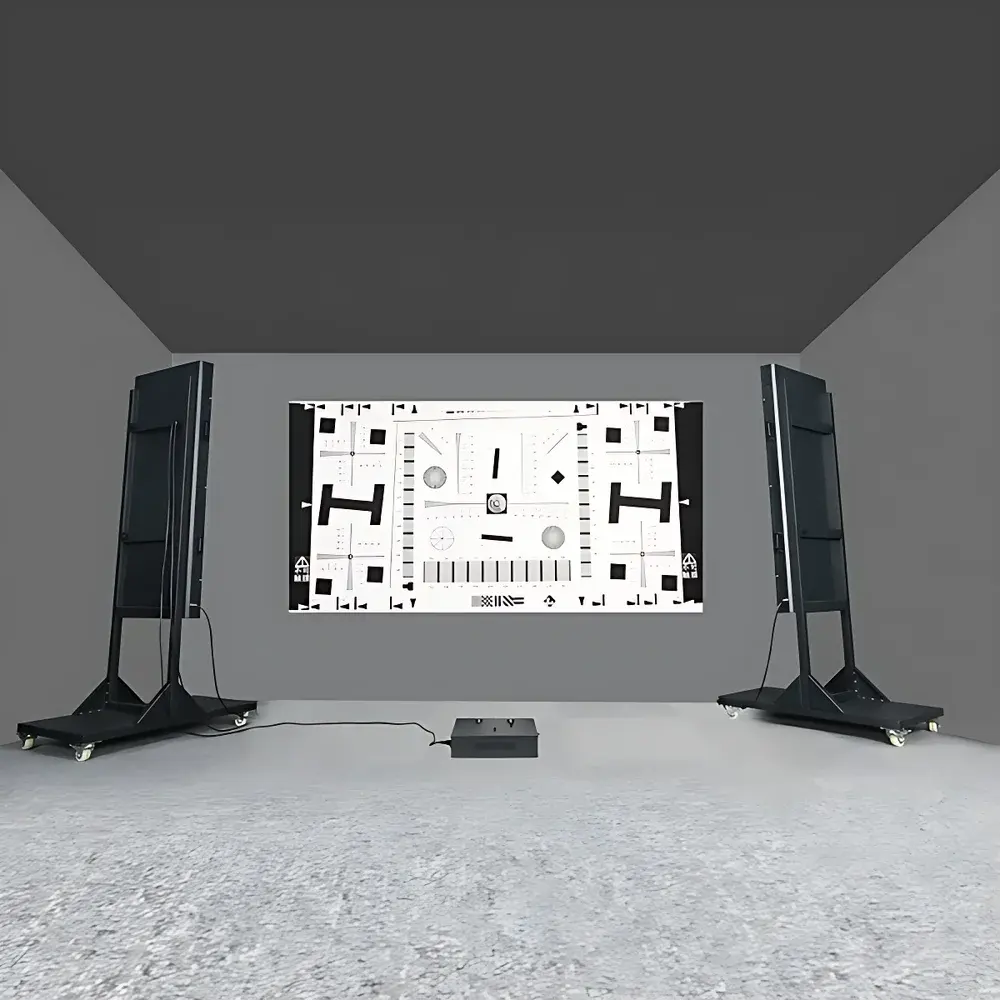
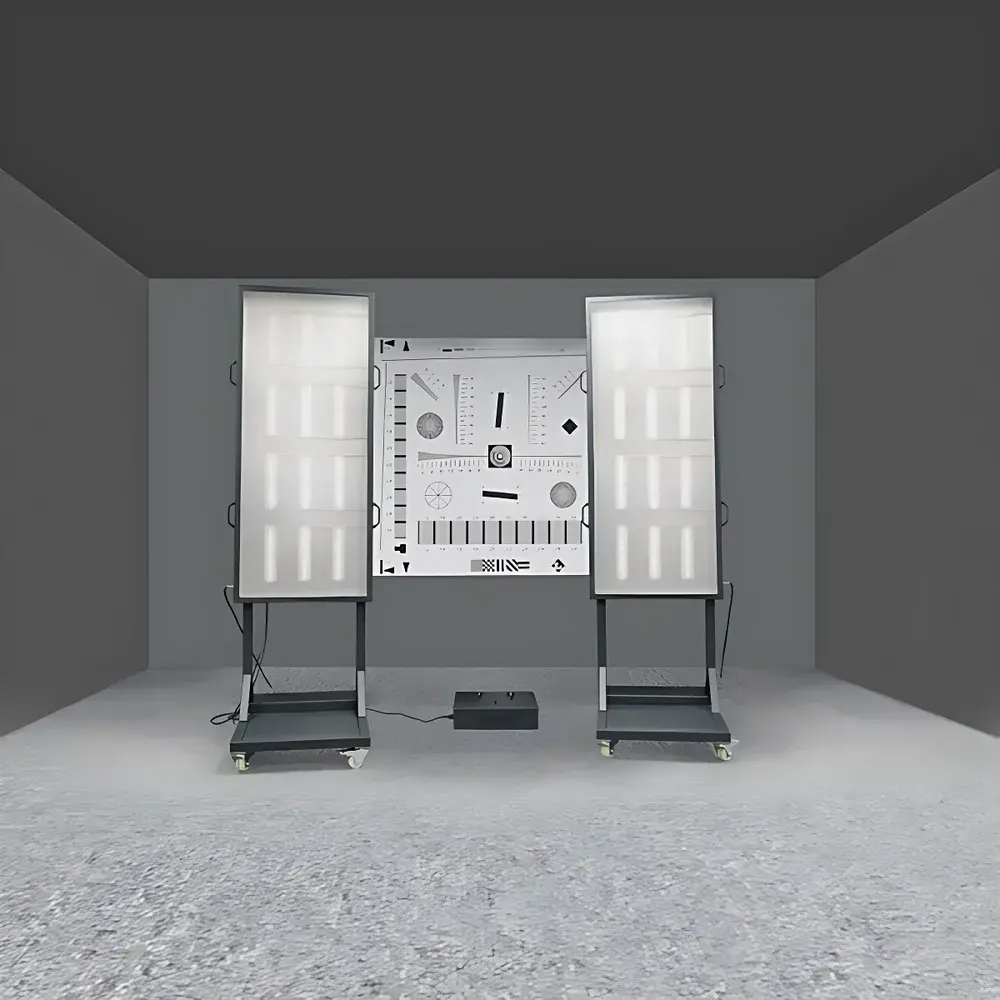
3nh T8B-X-HW Dual-Station Camera Test Illumination Cabinet with Tunable Visible & IR Light Sources
| Brand | 3nh |
|---|---|
| Origin | Guangdong, China |
| Manufacturer Type | Direct Manufacturer |
| Product Category | Domestic |
| Model | T8B-X-HW |
| Pricing | Upon Request |
Overview
The 3nh T8B-X-HW Dual-Station Camera Test Illumination Cabinet is an engineered optical test environment specifically designed for objective evaluation of imaging performance in modern camera modules—particularly those used in automotive ADAS, smartphone multi-camera systems, surveillance, and industrial vision applications. Unlike conventional color-matching cabinets intended for visual assessment under standardized illuminants (e.g., D65, TL84), the T8B-X-HW operates as a precision illumination platform grounded in photometric and radiometric control principles. It delivers spatially uniform, spectrally stable, and temporally flicker-free illumination across both visible (2300K–8000K CCT) and near-infrared (NIR) spectral bands, enabling repeatable quantitative measurement of lens MTF, sensor SNR, auto-exposure convergence, white balance accuracy, and low-light responsiveness. Its dual-station architecture—comprising two identical, position-interchangeable light boxes—supports simultaneous front/back or left/right illumination configurations required for structured lighting analysis, stereo calibration, and dynamic range testing per ISO 12233 and IEEE Std 1858 (CPIQ) guidelines.
Key Features
- Dual independent illumination stations: Left and right light boxes are mechanically and electrically identical, supporting flexible reconfiguration for asymmetric or symmetrical lighting setups.
- Visible light engine: High-power, phosphor-converted LED array with continuous correlated color temperature (CCT) adjustment from 2300K to 8000K; calibrated using NIST-traceable spectroradiometry.
- Precision illuminance control: Dual-range dimming system—high-intensity mode (0–3000 lx at 0.5 m) and fine-resolution low-intensity mode featuring coarse/fine dual-knob adjustment for sub-5 lx resolution in low-light validation scenarios.
- NIR illumination module: Standard 850 nm peak-wavelength LEDs with adjustable irradiance (>400 µW/cm² at 0.5 m); optional wavelengths include 750 nm, 940 nm, and 980 nm for spectral sensitivity mapping and covert illumination testing.
- Optical uniformity: Illuminance uniformity ≥85% across a 600 mm × 600 mm test plane (per CIE 116-1995 methodology), achieved via optimized reflector geometry, diffuser layer stacking, and internal matte-white coating (L* > 97, gloss < 5 GU).
- Stability & longevity: Flicker-free operation (10,000 hours at nominal drive current.
Sample Compatibility & Compliance
The T8B-X-HW accommodates large-format test charts—including ISO 12233 slanted-edge targets, ISO 16067 resolution charts, EMVA 1288 noise patterns, and custom-designed NIR-reflective charts—up to 1000 mm wide. Its open-front design allows direct mounting of camera modules on translation stages or integration into automated test benches. The cabinet complies with IEC 61000-3-2 (harmonic current emissions), IEC 61000-4-3 (radiated RF immunity), and UL/CSA 61010-1 safety requirements for laboratory equipment. While not certified to ISO 3664:2009 (graphic technology) due to its non-visual evaluation purpose, its spectral power distribution (SPD) and temporal stability meet the technical prerequisites for camera characterization per ISO/IEC 17025-accredited laboratories conducting GLP-compliant imaging validation.
Software & Data Management
The T8B-X-HW operates via a dedicated hardware control interface housed in the dual-channel light source controller (model LSC-T8B). No proprietary PC software is required for basic operation; however, RS-485 and analog 0–10 V interfaces support integration with LabVIEW, Python-based test automation frameworks, or third-party DAQ systems. All illumination parameters—including CCT setpoint, visible/NIR channel intensity, and operational runtime—are logged internally with timestamped metadata for audit trail generation. When deployed in regulated environments (e.g., automotive Tier-1 validation labs), the system supports manual logging protocols aligned with FDA 21 CFR Part 11 requirements through external electronic lab notebooks (ELNs) or LIMS platforms.
Applications
- Quantitative camera module evaluation: MTF measurement, chromatic aberration analysis, vignetting profiling, and flare characterization under controlled spectral and geometric conditions.
- Auto-focus and exposure algorithm validation: Dynamic response testing across variable illuminance levels and CCT gradients.
- NIR sensor characterization: Quantum efficiency mapping, hot pixel detection, and crosstalk analysis under monochromatic 850 nm illumination.
- Multi-spectral imaging system alignment: Synchronization verification between RGB and NIR channels in fused-vision architectures.
- Manufacturing process control: In-line verification of lens assembly consistency and sensor binning correlation prior to final calibration.
FAQ
What is the recommended minimum working distance between the T8B-X-HW and the camera under test?
A minimum distance of 0.5 m is specified for photometric calibration reference; however, optimal working distance depends on field-of-view requirements and chart size—typically ranging from 0.5 m to 2.0 m for standard ISO 12233 chart evaluation.
Can the T8B-X-HW be used for human visual assessment of color rendering?
No. This cabinet is not configured to meet ISO 3664:2009 requirements for graphic arts viewing. Its spectral output prioritizes radiometric stability and NIR compatibility over CRI/R9 fidelity.
Is firmware update capability available for the light source controller?
Firmware updates are performed exclusively by 3nh authorized service centers using JTAG interface; end users cannot perform field upgrades.
Does the system include traceable calibration documentation?
Each unit ships with a factory-issued photometric report referencing NIST-traceable standards; full ISO/IEC 17025 calibration certificates are available as an optional add-on service.
What maintenance intervals are recommended for long-term photometric stability?
Monthly cleaning of diffusers and reflectors using deionized water and lint-free wipes is required; annual recalibration of CCT and irradiance sensors is advised for metrology-critical applications.





